
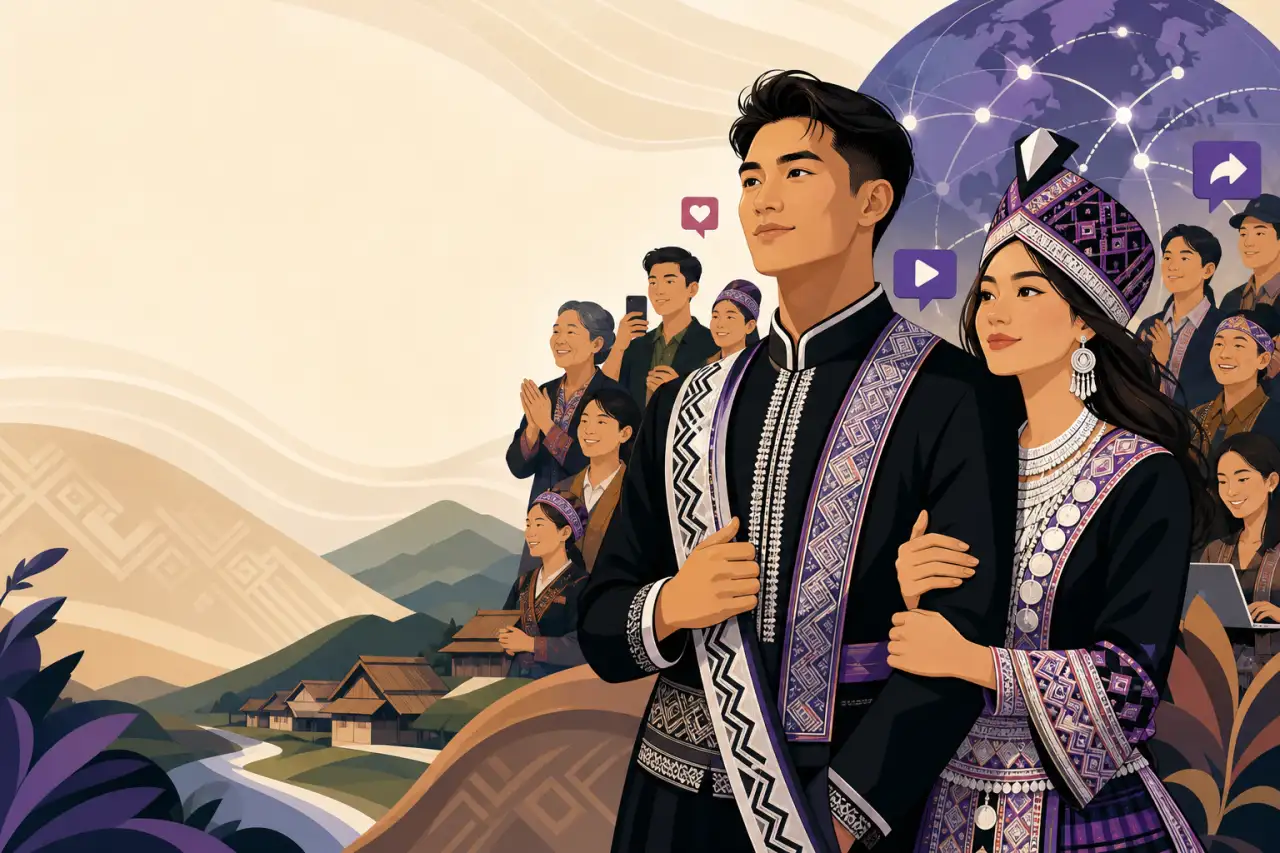
Anthony Moua, 10 Million Votes, and Community Capital
TL;DR
Anthony "Tub Zaj" Moua is a U.S. Marine veteran, martial arts coach, motivational speaker, and barber who is competing at Mister Global in Bangkok wearing a sash for the Hmong people rather than a country. The Hmong diaspora pushed him past 10,000,000 votes and he took home the Golden Charm Award from Nakhon Pathom. The part worth studying is the machine behind it: family group chats, social feeds, and local business networks coordinating across the U.S., Laos, Thailand, France, and Australia in under two weeks, at no cost. That same network, pointed at commerce instead of a vote button, is what Hmong Network is built to hold.
Who is Anthony Moua and what did he actually do?
Anthony "Tub Zaj" Moua competed at Mister Global in Bangkok wearing a sash that did not represent a nation-state. It represented the Hmong people. He finished the run with the Golden Charm Award from Nakhon Pathom and more than 10,000,000 votes behind him.
Stand him next to the rest of the stage and the contrast is the whole story. Every other contestant carried a border on his chest. A country with a passport office, a tourism budget, an embassy somewhere. Anthony carried a people held together by culture, shared history, and group chats.
He is a U.S. Marine veteran. A martial arts coach. A motivational speaker. A barber. That is not a list of hobbies. That is the shape of a lot of Hmong working lives: discipline from one place, income from another, standing in the community from a third.
Nobody institutional sent him. There was no national federation writing checks, no sponsor deck, no ministry of culture. He took personal discipline and local trust and scaled them to an international stage. The barbershop chair and the gym floor came first. The Bangkok stage came after.
Why 10 million votes is a business story, not a pageant story
Ten million votes in under two weeks, gathered across the U.S., Laos, Thailand, France, and Australia, is a marketing result. Price it out the normal way and it gets uncomfortable.
Any company trying to buy that level of engagement would be paying customer acquisition cost on every single action. Hundreds of thousands of dollars, realistically, and that is before you account for how hard it is to get someone to vote daily rather than click once. Paid traffic does not behave like that. Paid traffic clicks and leaves.
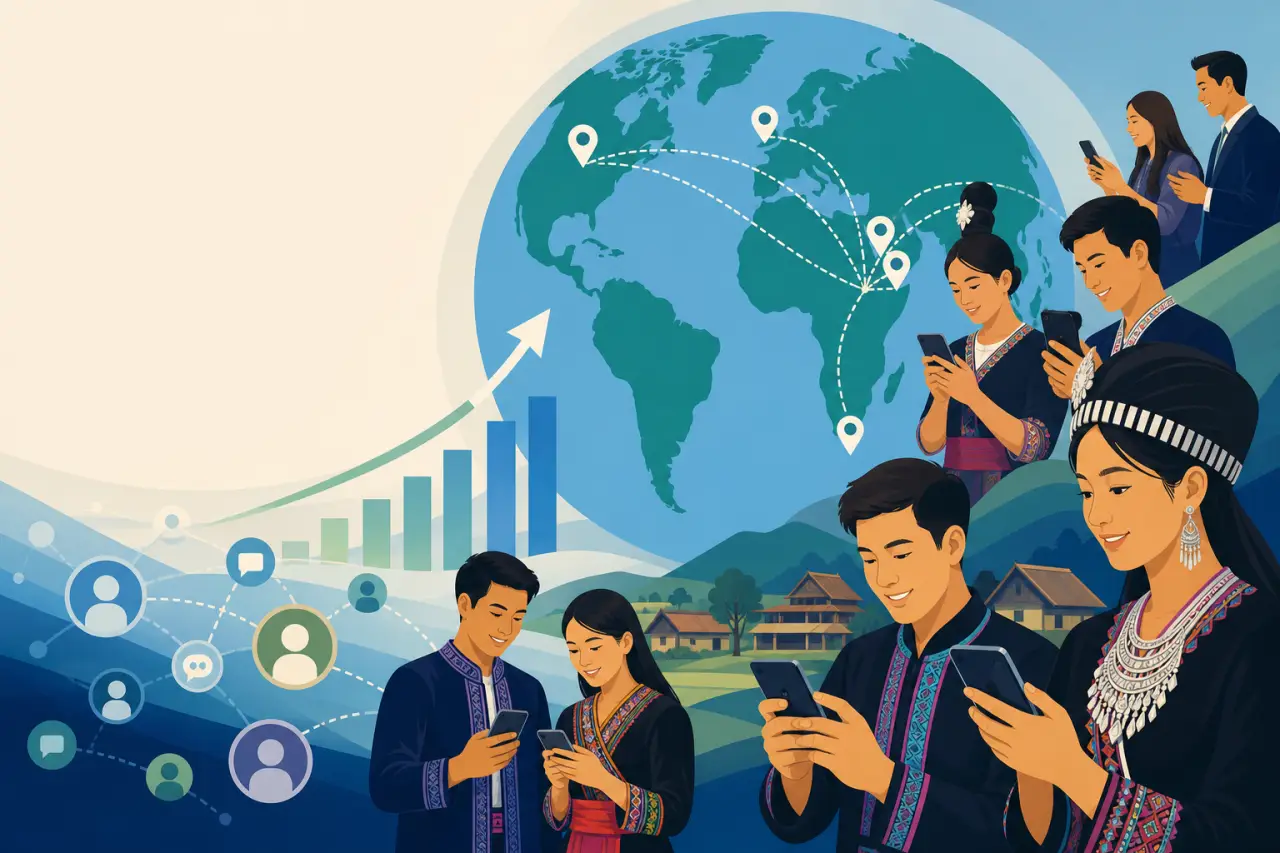
The Hmong community generated it organically. No ad spend. No agency. The distribution channels were already in place: family group chats, Facebook feeds, the WhatsApp thread with cousins in three countries, the local business networks that already talk to each other every week.
Call it Community Capital. It behaves like capital because it can be deployed, it compounds with use, and it produces measurable results. The Golden Charm Award is the receipt. The 10 million is the balance sheet.
What made it work was not a clever campaign. It was shared identity and mutual pride, which are the two things money cannot buy and every brand consultant in America is trying to manufacture. The Hmong community has them already.
What decentralized reach looks like when nobody is in charge
There was no command center. That is the part outside observers miss.
A decentralized network does not need permission to move. One auntie posts a reminder. A barbershop puts the voting link on its story. A martial arts gym mentions it between classes. A page admin in Fresno and a page admin in French Guiana never speak to each other and still run the same campaign on the same day.
Decentralized Networks are slower to start and far harder to stop. Centralized marketing has a single point of failure: the budget. This had none. When one node went quiet, four others were already going.
It also crossed borders without friction, because the thing being organized around was never geographic. Hmong people in Minnesota, Laos, Thailand, France, and Australia did not need a shared government to coordinate. They needed a shared reason.
That is Organic Reach in its truest form. Not a platform metric. People telling people, in languages and threads that no algorithm owns.
"Hmong is the people, not a place—and that's why we are global"
That line, from Anthony's rally, is the thesis of the entire run.
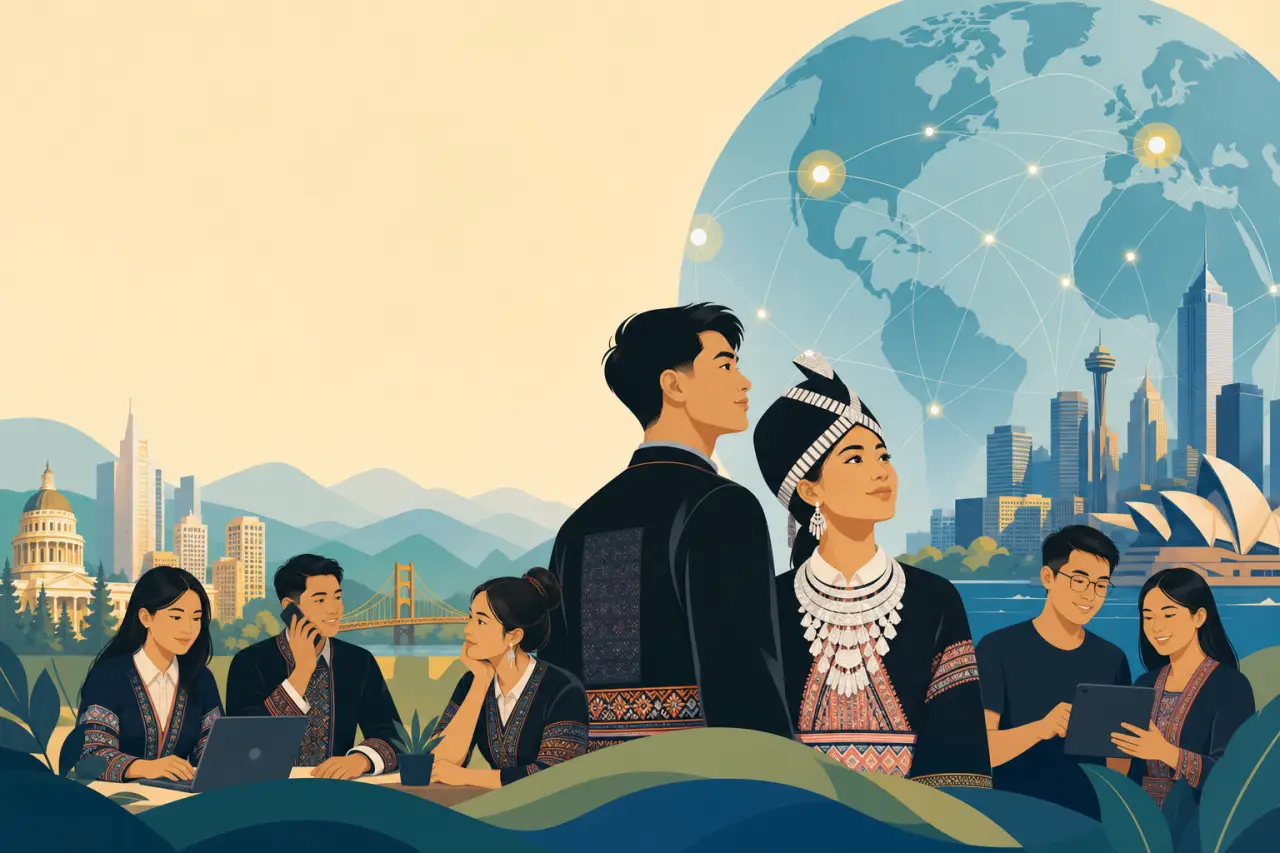
Most diaspora conversations treat the absence of a homeland as a wound. This reframes it as a structural advantage. A people not bound to one territory is already distributed, already multilingual, already used to maintaining relationships across ten time zones.
In network terms, that is not a weakness. That is coverage. A business in Sacramento and a business in Melbourne are already two nodes in the same system, whether or not they have ever been introduced.
The pageant simply made that visible to people who had not thought about it before. The network was always there. It just had never been asked to do one thing at one time, loudly, where everyone could see the result.
Where does all that attention go when the pageant ends?
This is the hard question, and it is the reason to write any of this down.
Most viral moments evaporate. The attention spikes, the shares peak, and then the feed moves on. The energy was real, but it had nowhere to land. No account was opened, no business got a new regular customer, no founder got introduced to the contractor she needed.
That happens because there is no engine underneath to capture the traffic. Attention without infrastructure is weather. It passes over you and leaves nothing behind but a story you tell later.
The cost of that is not abstract. Every time the community mobilizes and the moment dissipates, the consumer dollars and the professional connections that could have followed instead leak out to third-party platforms that collect the data and keep the margin.
Ten million votes proved the community can coordinate. The open question is whether the community has anywhere to put that coordination the next day.
From one moment to actual infrastructure
Hmong Network exists for the day after. Not as a community board, and not only as a place to look up a restaurant. As an economic operating system for the diaspora.
If 10 million votes can move across five countries in under two weeks, the same network can do other work. It can fund and scale Hmong-owned small businesses and startups. It can connect creators, contractors, and professionals across state lines, so the person who needs a videographer in Wisconsin finds one who already understands the job.
And it can keep consumer dollars cycling inside the community instead of leaking to tech giants who contribute nothing back to it. A directory is just a list until the list has enough people in it to route real money.
That routing is what a directory is actually for. Someone searching for a Hmong barber, a Hmong accountant, a Hmong caterer should find one in their city within a minute. Every time that happens, a dollar stays home.
Anthony's run should not be remembered as an isolated high point. It is a proof-of-concept for organized Hmong enterprise, and proof-of-concepts are only worth something if somebody builds the real thing afterward.

What to do with this
Register your business. Claim your profile. Join the discussion on Hmong Network.
It takes less time than voting did, and it compounds. A claimed profile is a permanent address for your business inside the community, not a post that sinks down a feed by Thursday.
The goal is simple. The next time a Hmong creator, founder, or leader steps onto a global platform, the economic foundation should already be built to back them. Not assembled in two weeks of frantic group chats. Already there, already populated, already working.
Ten million people found the vote button. The harder and more useful thing is finding each other.
Questions people ask
Who is Anthony "Tub Zaj" Moua?
Anthony "Tub Zaj" Moua is a U.S. Marine veteran, martial arts coach, motivational speaker, and barber who competed at Mister Global in Bangkok. He represented the Hmong people rather than a country, received more than 10,000,000 votes from the global Hmong community, and won the Golden Charm Award from Nakhon Pathom.
How did he get 10 million votes?
The Hmong diaspora turned its existing channels into a voting engine. Social media feeds, family group chats, and local business networks ran the campaign around the clock across the U.S., Laos, Thailand, France, and Australia, with no central organizer and no ad budget. It took under two weeks.
Why did he represent the Hmong people instead of a country?
The Hmong are a diaspora without a nation-state. As Anthony put it at a rally, "Hmong is the people, not a place—and that's why we are global." His sash represented a community connected by culture, shared history, and digital channels rather than a geographic border.
What does a pageant have to do with Hmong business?
The vote count is a marketing result. Buying that level of engagement through advertising would cost hundreds of thousands of dollars in customer acquisition cost. The Hmong community produced it organically through shared identity and mutual pride, which demonstrates the same network could be used to fund businesses, connect professionals across state lines, and keep consumer dollars inside the community.
How do I get my business listed on Hmong Network?
Register your business or claim your existing profile on Hmong Network. The directory connects Hmong-owned businesses across the United States so customers in your area can find you directly.
Written by
Hmong Network Team
Directory & Digital Services
We run the Hmong Network directory and do the web design and SEO/AEO work behind the results in our case studies. These guides come out of that same hands-on work with Hmong-owned businesses — not secondhand research.
