
How Seller Fees & Commissions Work
TL;DR
Opening a storefront and listing products on Hmong Network never costs anything; a percentage commission is only deducted after an item actually sells, and every dollar you're owed is tracked automatically in your seller dashboard.
What's Actually Free, and What Isn't
Once you've gone through claiming your business listing, there's no cost to open a storefront on Hmong Network, no monthly subscription, and no charge for listing a product — whether you list one item or fifty. You can list your grandmother's paj ntaub patterns, a batch of jars of your family's chili sauce, or a rack of hand-stitched skirts, and none of it costs you a cent until someone actually buys.
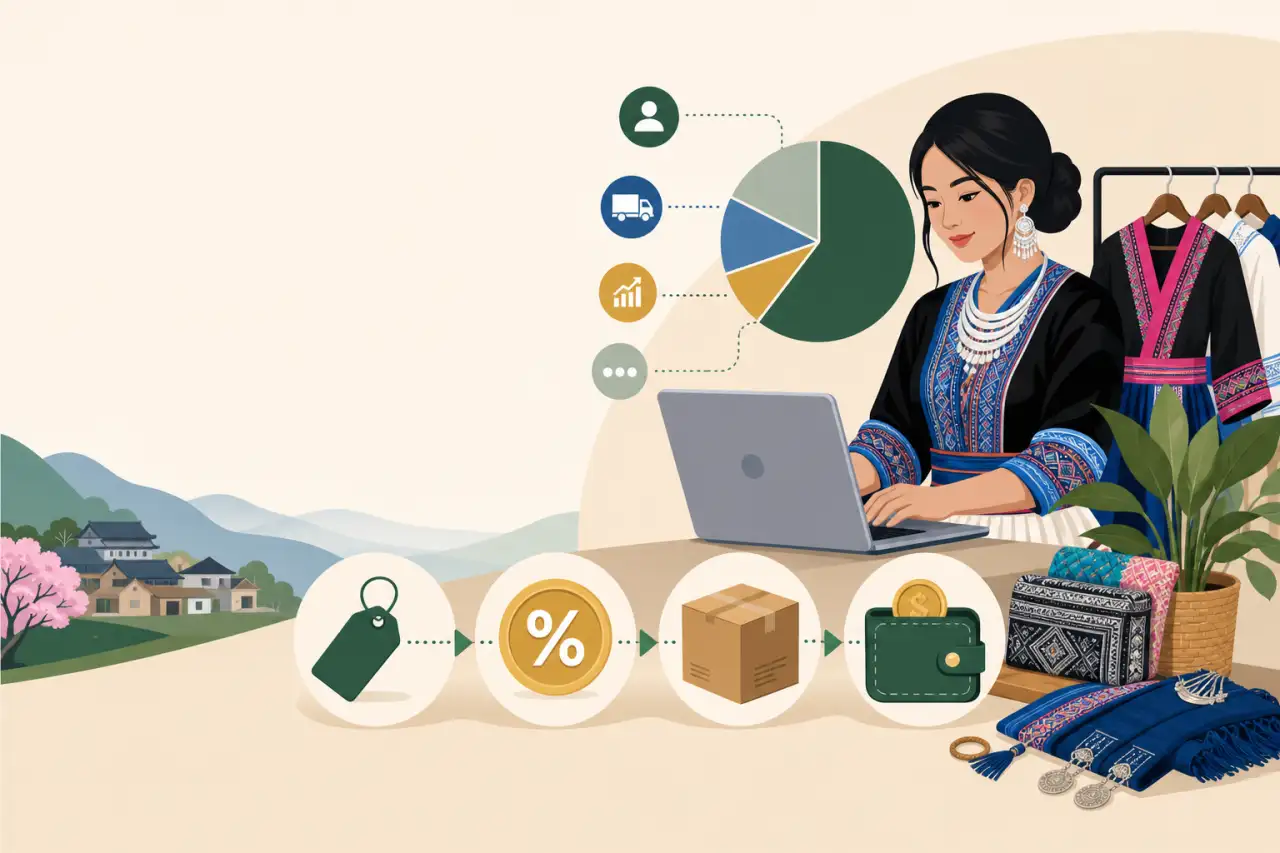
The only time money changes hands is after a sale. A percentage of the sale price is deducted as commission, and the rest lands in your seller balance. That's it — there's no additional cost beyond that:
- No separate listing fee
- No fee for photos
- No fee for keeping an item live for months while you build up inventory or wait for the right season to sell it
This matters more than it sounds like at first. A lot of small business owners get burned by platforms that charge upfront — a monthly seller fee, a setup cost, a fee per photo or per category — before they know whether the platform will actually send them customers. Hmong Network's model only takes a cut when you've already made money, which means testing a new product line costs you nothing but the time it takes to list it.
How the Commission Percentage Gets Calculated
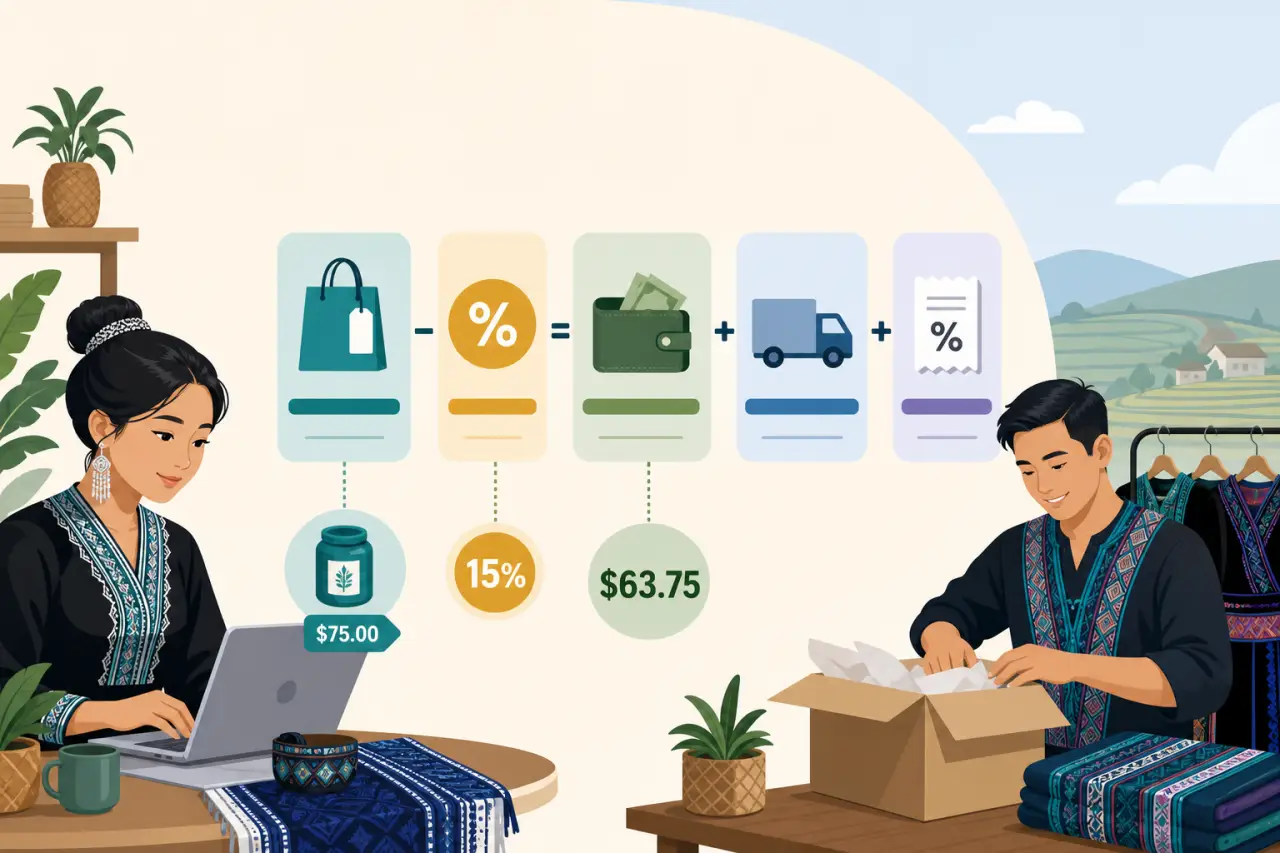
When an order comes through, the commission is calculated as a percentage of the sale price of the item — not the shipping charge, not any tax collected, just the price of the product itself. That percentage is deducted automatically the moment the sale is recorded; you never have to calculate it yourself or issue an invoice for it.
Commission rates can differ a little from one product category to another, since different kinds of products carry different price points and different costs for the marketplace to support. A $15 jar of sauce and a $400 piece of custom jewelry aren't really the same kind of transaction to process, list, and support, so it's normal for the exact rate applied to vary slightly depending on what you're selling.
The practical upshot is that you don't need to keep a spreadsheet of "what percent do I owe this month." Every order that comes in already has its commission worked out at the moment it's placed, and what's left after that commission is exactly what gets added to your balance — no guesswork, no manual math, no waiting on a monthly statement to find out what you actually made.
One thing worth calling out for anyone who's sold through a card reader or a payment app before: there's no separate line item for payment processing on top of the commission. You don't get billed once for the sale and again for the card swipe. The commission you see is the whole cost of the transaction, not a starting point with more fees layered on after.
Why Your Rate Gets Locked In the Moment You Sell
One detail that's easy to overlook but genuinely protects you: the commission rate that applies to a sale is set at the moment that sale happens, and it stays that way permanently. If the marketplace's commission structure changes later — higher, lower, restructured by category — none of your past sales get recalculated.
Think about what that means in practice. Say you sell a batch of embroidered baby carriers in March at whatever the commission rate is that month. If the rate changes in June, the March sale still shows exactly the commission it showed in March. Your historical earnings can't be quietly rewritten by a policy change six months later, and a rate change going forward never reaches backward into money you've already earned.
This is worth knowing because it's not how every marketplace works. Some platforms recalculate fees retroactively, or apply a new rate across your whole account the day it changes, which can mean a seller looks back at old sales and sees numbers that don't match what they remember being told. On Hmong Network, what a sale earned you the day it happened is what it earned you — permanently, on the record.
Where Shipping Costs Fit In
If you buy a shipping label directly through your seller dashboard rather than sourcing your own, that label's cost gets deducted from your balance the same way commission does — it's subtracted alongside the commission so what you see reflected in your balance is your true net, not a number you still have to do more math on.
This is genuinely useful for anyone shipping product regularly, because it means your seller balance already accounts for real shipping cost rather than showing you a gross number that looks better than what you'll actually pocket. If you're selling something like preserved foods, textiles, or small handmade goods that ship in a flat-rate box, buying the label through the dashboard keeps your commission, your shipping cost, and your net earnings all in one place instead of scattered across a shipping carrier's own receipts and a separate spreadsheet.
If your business model is mostly local pickup or delivery — which describes a lot of Hmong-owned food and craft businesses — this section barely applies to you at all, and that's fine. Shipping costs only touch your balance when you actually use the platform's shipping tools; nothing here changes if you're handing items to customers directly.
Optional Paid Upgrades: Never Required to Sell
Beyond the standard commission, Hmong Network offers a few optional, paid ways to get extra visibility — things like a featured placement in search results or sponsored placement options on a category page. These are upgrades you choose deliberately, the same way you'd decide whether to boost a post on social media: you're paying for extra eyes on a listing you already have, not for the ability to sell in the first place.
Nothing about these upgrades is automatic. You're never enrolled by default, never billed without taking an explicit action, and skipping them entirely has zero effect on whether your storefront works or whether your regular commission structure applies. A seller who never touches a paid upgrade and a seller who uses one every month pay the exact same commission percentage on their sales. If you'd rather build visibility without paying for it, optimizing your storefront for search is a free way to help shoppers who are already searching find your listings organically.
Where this can make sense is around a specific push:
- Launching a new product ahead of Hmong New Year
- Clearing out end-of-season inventory
- Trying to get in front of shoppers in a city where you don't have much word-of-mouth yet
Treat it as a marketing decision you opt into when it fits a specific goal, not as a cost of doing business on the platform. For a seller's real growth results after trying a visibility push like this, the numbers speak for themselves.
Reading Your Seller Balance Without Guessing
Your seller balance isn't a number someone typed in and forgot to update — it's recalculated fresh from your actual order and payout history every time you look at it. In plain terms: balance equals everything you've earned from real sales, minus everything that's already been paid out to you. There's no separate "pending adjustment" or manual correction sitting off to the side that could quietly drift from reality.
That matters because it means you can trust the number without cross-checking it against your own records every time. If your balance looks different from what you expected, the answer is always in your actual order history — a sale that came in, a payout that went out, a shipping label you purchased — not in some opaque platform-side adjustment you have no visibility into.
Here's what that looks like in practice. Say in one week you sell:
- A $25 embroidered pillow cover
- A $60 catering add-on for a weekend event
- An $18 jar of chili sauce
Each of those three sales shows up in your dashboard as its own line, with its own commission already subtracted, and your balance climbs by the sum of all three net amounts as soon as each order is placed — not batched together at the end of the week, and not delayed until some later reconciliation.
It also matters if your storefront is popular enough that a single customer order includes items from more than one seller at once. Each seller in that kind of order is tracked and credited separately, so you're only ever charged commission on your own share of what sold, and your balance only ever reflects your own products — never anyone else's.

How and When the Money Actually Reaches You
Payouts go out once your balance reaches the platform's minimum payout threshold, sent to whatever payout method you've set up on your account. You're not required to manually request a payout every time — once the threshold is crossed, it's queued to go out using the method already on file, which is worth double-checking is current if you've recently changed bank accounts.
Your dashboard keeps a full history of every payout you've ever received, not just your current balance. That history is genuinely useful come tax time: because every payout traces back to the specific orders behind it, you can reconcile exactly what was sold, what commission was taken, and what you actually received, without having to reconstruct it from memory or dig through old emails.
If you're new to selling online and this is your first time dealing with a commission-based marketplace instead of cash sales at a community event or a booth at the Hmong New Year celebration, give yourself a little time to get used to checking the dashboard regularly rather than waiting for a big lump sum. Smaller, more frequent payouts as you cross the threshold are normal, and they're a much easier habit to build your bookkeeping around than one large payment a few times a year. If you'd rather talk it through with a person than puzzle it out alone, getting one-on-one seller support is available too.
How This Compares If You've Sold Elsewhere Before
A lot of sellers on Hmong Network have already sold somewhere else first:
- A folding table at a Hmong New Year celebration
- A post in a local Facebook buy-and-sell group
- A storefront on a bigger general marketplace that charges rent on your listings whether or not anything moves
It's worth thinking through how those compare, because the differences change how you should approach testing something new here.
A subscription-style marketplace charges you for shelf space regardless of sales — you're paying to exist there, and a slow month still comes with a bill. A commission-only model flips that around: if nothing sells, nothing is owed. That's a much lower-risk way to find out whether a new product, a different price point, or a seasonal item you've never offered before actually has an audience, since the downside of it not working out is simply your time, not a fee you've already paid.
The other real difference is how visible the math is. If you've ever sold through a platform where the fee structure lived in a document you signed once during setup and never looked at again, checking a dashboard where the commission on every single order sits right next to that order is a genuinely different experience — you're not trusting that the platform did the math right somewhere behind the scenes, you can see it for yourself, sale by sale.
None of this makes the commission free money for you to ignore when you're setting prices — it's a real cost, and it belongs in your pricing the same way ingredients, materials, or your own time do. Our guide to pricing strategies to protect your margin walks through how to build commission into your prices without it quietly eating into what you take home. But it's a cost that only ever shows up in proportion to money actually coming in, which is a very different risk to carry than a fixed fee owed no matter what happens that month.
Questions people ask
What does it cost to list products on Hmong Network?
There's no cost to list products on Hmong Network — no listing fee, no monthly subscription, and no charge per photo. You only pay a commission percentage when an item actually sells. That means you can test new product lines or wait for the right season to sell without spending anything upfront.
How does the commission get calculated?
Commission is calculated as a percentage of the sale price only — not shipping or tax. The rate is set the moment the sale happens and never changes, even if Hmong Network's commission structure changes later. Different product categories may have slightly different rates based on their price points and costs to support.
When do I get paid, and how do I know the balance is right?
Payouts go out once your balance reaches the minimum threshold, sent to your account's payout method. Your balance is recalculated fresh from your actual order and payout history every time you check it, so you can trust the number. Each sale shows its own commission deducted immediately.
Is there a separate fee for shipping if I buy labels through the dashboard?
No separate fee — the shipping label cost is deducted from your balance alongside commission, so what you see is your true net earnings. This keeps your commission, shipping costs, and earnings all in one place. If you do local pickup or delivery, shipping costs don't apply.
Written by
Hmong Network Team
Directory & Digital Services
We run the Hmong Network directory and do the web design and SEO/AEO work behind the results in our case studies. These guides come out of that same hands-on work with Hmong-owned businesses — not secondhand research.
