
Magical Claws' 275% Growth: A Claw Machine Arcade Case Study in Tulsa
TL;DR
Magical Claws, a family-owned token-based claw machine arcade in Tulsa, Oklahoma, opened January 10, 2026 under co-owners Shoua Thao and Kao Lor with no website, no online booking, and manual trade-in tracking. A Shopify rebuild, restructured token packages, and local SEO took average order value from $20 to $70–$75, a 250–275% increase.
Two Business Owners, One Nostalgic Bet
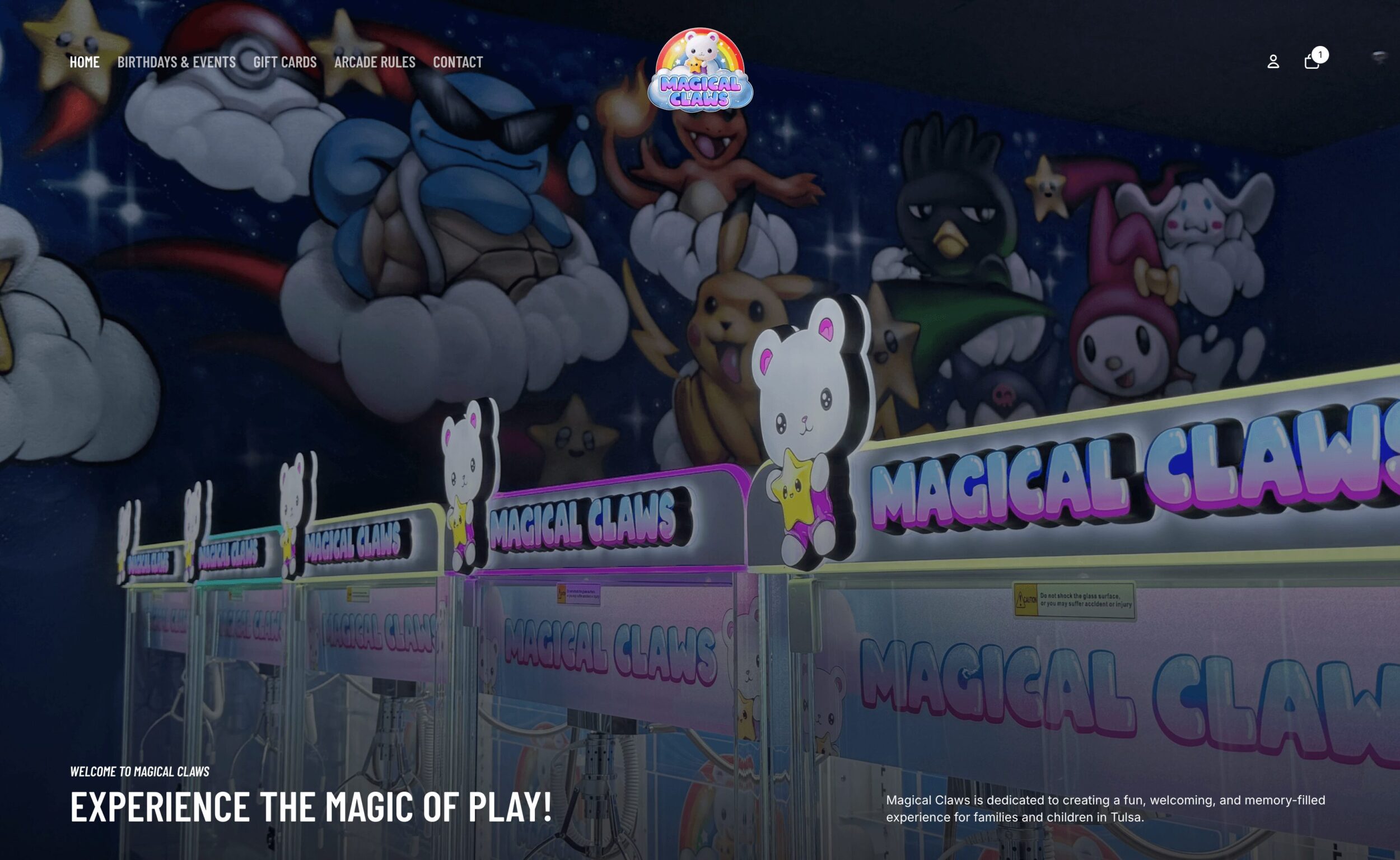
Magical Claws opened its doors on January 10, 2026, in Tulsa, Oklahoma, built around an idea that anyone who grew up dropping quarters into a claw machine at the mall or the movie theater lobby will recognize instantly: a real, physical arcade full of token-operated claw machines, stocked with Pokémon-themed prizes, with private rooms available to rent for parties. It's the kind of business that trades on nostalgia and tangibility in an entertainment landscape that's increasingly digital and app-based.
The arcade is co-owned by Shoua Thao, a working realtor, and Kao Lor, an HVAC contractor. Neither came from a background in retail entertainment or e-commerce, which is a common and often underestimated hurdle for small business owners who have a strong sense of what they want to build but no existing playbook for running the digital side of it. They had the concept, the location, and clearly the ambition to include party rooms and a themed prize selection rather than just a generic row of machines. What they didn't yet have was the infrastructure to turn foot traffic and word of mouth into a business that could scale past its first few months.
That gap, between a genuinely good idea and the operational and digital groundwork needed to support it, is where most new entertainment venues either find their footing or quietly stall out. Passion gets the doors open. It doesn't, by itself, build a booking system, price a party package correctly, or get the business showing up when someone nearby searches for something to do this weekend.
The Gap Between a Great Concept and a Sustainable Business
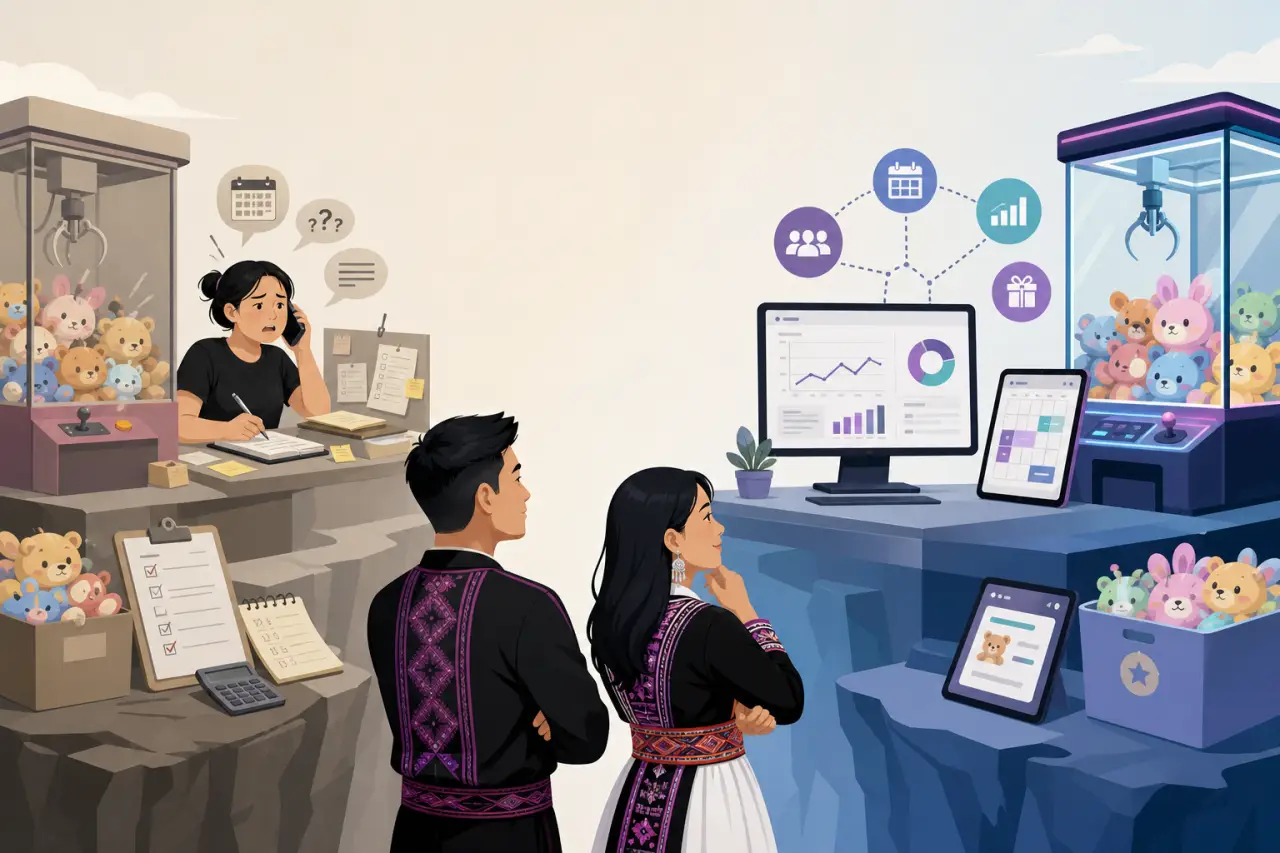
When Hmong Network began working with Magical Claws, the arcade's average token order value sat at $20, a number that, on its own, doesn't tell you whether a business is healthy, but combined with everything else going on painted a clear picture of untapped potential. There was no professional website and no online booking system, which meant every party inquiry, every "are you open today," and every question about token pricing had to be handled manually, one conversation at a time.
The plushie trade-in program, a nice touch that let customers swap smaller prizes toward bigger ones, was being tracked by hand. That's a workable stopgap for the first few weeks of a new business, but it scales badly:
- It invites disputes over what a customer is owed
- It puts pressure on staff to remember or re-create records
- It creates the kind of friction that makes an otherwise fun visit feel disorganized
On top of that, there were more gaps:
- No integrated point-of-sale system tying the arcade's in-person token sales to anything happening online
- Limited search engine optimization
- No clear answer to a question that matters more than it might seem: what makes Magical Claws different from the card-based prize machines and redemption arcades already operating in the region?
Without a clear position, the arcade was competing on nostalgia and vibe alone, against businesses with more established digital footprints.
Rebuilding on Shopify: Why the Website Had to Do More Than Look Good
The rebuild started with the website itself, built on Shopify rather than a generic template builder — a case study in choosing Shopify for your store when e-commerce and in-person sales both matter — which gave the team room to combine e-commerce functionality, selling token packages and party bookings online, with the kind of visual identity a novelty arcade actually needs. The design leaned into an immersive, vibrant arcade aesthetic rather than a conservative small-business look, appropriate for a business whose whole appeal is nostalgia and fun, and a reminder that a website's job is to set expectations for the in-person experience before a customer ever walks through the door.
A major piece of the redesign was restructuring how party packages were presented: a three-tier structure with clear, side-by-side pricing comparisons, so a parent booking a birthday party could see at a glance what each tier included and what it cost, rather than having to ask staff to walk them through options over the phone. That kind of transparent, comparison-friendly pricing does double duty. It reduces the number of back-and-forth questions staff have to field, and it nudges customers toward higher tiers when the value difference is made obvious rather than buried in a phone conversation.
The site was built fully responsive across desktop and mobile, which matters enormously for a local entertainment business. Most people searching for a claw machine arcade nearby, or looking up party pricing, are doing it from a phone, often while comparing several options at once. Supporting pages rounded out the build:
- Products
- Contact
- FAQ
- Policies
- Sitemap
giving the business the same baseline completeness a much larger, more established competitor would have.
Booking, Accounts, and the End of the Manual Trade-In Log
Beyond the storefront and party pages, the build added a real-time booking system with automated confirmations, a change that, for a business built around parties and reservations, removes one of the most common failure points in small entertainment venues: a booking that never got properly recorded, or a confirmation that only exists as a mental note. Customers could also create accounts, which starts building the kind of return-visit relationship a novelty arcade depends on more than most retail businesses, since its whole appeal is repeat play.
Google Analytics and Search Console were integrated as part of the build, giving the owners visibility into how people were actually finding and using the site:
- Which pages they landed on
- What they searched to get there
- Where they dropped off
That's visibility that simply didn't exist when the business had no formal website at all.
Perhaps the most operationally significant addition was the digital plushie trade-in tracking system, replacing the manual process that had been generating confusion. Converting a pen-and-paper, or a purely mental, record into something structured and digital does more than reduce errors. It removes an entire category of dispute and awkward customer conversation, and it means a new hire behind the counter doesn't need to memorize an informal system to do their job correctly. For a business that runs on repeat visits and word of mouth, avoiding a bad trade-in experience is worth more than it might look like on paper.
Fixing the Business Behind the Business
Not everything Hmong Network worked on for Magical Claws lived on the website. Some of the most consequential changes were to the business model itself. Token packages were strategically restructured. The specific mechanism behind turning a $20 average order into $70 to $75 wasn't just a new coat of paint on the pricing page, it was rethinking how you price your products so that the value of buying more tokens at once, or bundling tokens with a party package, was obvious and worth choosing.
A point-of-sale system was integrated to connect online and physical sales, closing the gap between what was happening at the counter and what was happening on the website, a connection that matters for inventory, for reporting, and for giving the owners one coherent picture of the business instead of two disconnected ones.
The engagement also included early development of a subscription model aimed at generating recurring revenue, a meaningful shift for a business that had previously relied entirely on one-off, walk-in transactions. Recurring revenue gives an entertainment venue a more predictable baseline to plan around, rather than living purely off however much foot traffic happens to show up on a given weekend.
One of the more unusual pieces of the project was securing Pokémon Go waypoint approval for the arcade's commissioned mural. For a business themed around Pokémon prizes, having a real, in-game landmark tied to the physical location is a small but genuinely clever bridge between a mobile game its target customers already play and the physical arcade itself, the kind of detail that turns a mural from decoration into a discovery mechanism.

Local SEO for a Business People Have to Physically Visit
An arcade only succeeds if people who are near it, and looking for something to do, can actually find it, which makes local search a different kind of priority than it would be for a purely online business. The SEO work for Magical Claws centered on local search optimization that referenced actual Tulsa neighborhoods — the same on-the-ground specificity that matters for finding opportunities in the Tulsa market more broadly — the kind of geographic specificity that helps a business show up not just for generic searches but for the near-me and neighborhood-qualified searches people actually type when they're deciding where to spend an afternoon.
Technical infrastructure improvements ran alongside that local focus, the unglamorous but foundational work of making sure the site itself is fast, crawlable, and structured in a way search engines can understand, which underpins everything else in an SEO strategy. Content strategy was built to balance keyword targeting with genuine usefulness to the reader, avoiding pages that exist purely to rank without actually helping a parent decide whether this is the right place to book a birthday party.
Structured data markup was added as well, giving search engines explicit, machine-readable information about the business, its hours, its offerings, its location, rather than leaving that information to be inferred from page text alone. For a local, visit-in-person business like an arcade, structured data is part of what determines whether a business shows up cleanly in map results and local business panels, not just in a standard list of search results.
The Numbers: From $20 Tickets to a Different Kind of Business
The headline result of the engagement is a straightforward one: average order value rose from $20 to somewhere between $70 and $75, a 250 to 275 percent increase. That kind of jump rarely comes from a single change. It's the compounding effect of restructured token packages that improved how customers perceived value, party pricing that was easier to understand and compare, and a booking experience that made it simple to add on rather than settle for the minimum.
The operational side of the rebuild paid off too, even if it shows up in numbers that are harder to headline. Streamlining trade-in tracking reduced customer complaints and cut down on how much new staff had to be trained on an informal, error-prone process, the kind of quiet efficiency gain that saves real time and reduces friction every single day, even though it never shows up as a single dramatic statistic.
The technical side of the rebuild was benchmarked with Google PageSpeed Insights, which scored the new site:
- Performance: 71/100 on mobile, 86/100 on desktop
- Accessibility: 86/100 on mobile, 78/100 on desktop
- Best Practices: 92/100 on mobile and desktop
- SEO: 92/100 on mobile and desktop
Those scores give the owners a concrete baseline to track as they keep improving the site, rather than a vague sense that it seems faster now.
What Comes Next
The bigger picture here is that a 250 to 275 percent increase in average order value didn't come from a single fix. It came from treating the website, the pricing structure, the operations, and the local search presence as one connected system rather than four separate projects. A prettier website alone wouldn't have restructured how token packages were priced. A better pricing structure alone wouldn't have made the business easier to find in local search. Each piece reinforced the others, which is a large part of why the results compounded rather than just adding up.
For other family-owned entertainment businesses navigating the same gap between a strong concept and a functioning operation — much like another Tulsa business success story already has — the Magical Claws project is a useful reminder that a lot of what looks like a marketing problem is actually a business-model problem, and vice versa. The two rarely improve in isolation.
The recommended next steps for Magical Claws reflect that same connected thinking:
- Developing a blog to support ongoing search visibility
- Building targeted landing pages for distinct customer segments (parents planning birthday parties look for different things than a group of friends looking for a fun weekend outing)
- AI chatbot integration to handle routine questions automatically
- Continued work on mobile performance and accessibility scores

Questions people ask
How did restructuring token packages increase average order value so dramatically?
By making bundled token packages and party add-ons easier to compare and clearly more valuable at higher tiers, the redesign encouraged customers to buy more than the smallest option. Combined with a booking system that made add-ons frictionless, this shifted Magical Claws' average order from $20 to $70–75, a 250–275% increase.
Why did Magical Claws build its website on Shopify instead of a simpler small-business site builder?
Shopify combines e-commerce functionality, selling token packages and party bookings online, with the flexibility to build a distinctive, arcade-themed visual identity rather than a generic template. That combination let the team support both direct online sales and a fully responsive booking experience across desktop and mobile.
Why does local SEO matter so much for a business like a claw machine arcade?
An arcade only succeeds if people physically visit, so it depends on showing up in neighborhood-specific and near-me searches rather than generic keyword rankings. That's why the SEO work for Magical Claws emphasized real Tulsa neighborhood references, technical site improvements, and structured data that helps the business appear clearly in local map results.
What operational problem did digitizing the plushie trade-in system solve?
The arcade's plushie trade-in program let customers exchange smaller prizes for bigger ones, but tracking it manually caused customer confusion and disputes over what was owed. Moving it to a digital tracking system reduced complaints and cut the amount of training new staff needed to run the program correctly.
Written by
Hmong Network Team
Directory & Digital Services
We run the Hmong Network directory and do the web design and SEO/AEO work behind the results in our case studies. These guides come out of that same hands-on work with Hmong-owned businesses — not secondhand research.
