

Using Coupons to Drive Sales on Your Storefront
TL;DR
A coupon only costs you money when it actually gets used, which makes it a lower-risk way to win a new customer, clear slow-moving stock, or thank a loyal one than cutting your price for good. This guide covers how to set one up from your seller dashboard and how to get real results from it.
Why a Coupon Beats a Permanent Price Cut
Dropping your price to move more product feels like the obvious move, but it has a hidden cost: every single buyer gets the lower price, including the ones who would have paid full price anyway. A coupon flips that. It only costs you anything the moment someone actually redeems it, so you're never discounting a sale that would have happened regardless.
That makes a coupon a much better tool for a specific job than a blanket price change is.
- Use it to get a first-time buyer to finally click purchase instead of just browsing your listing again.
- Use it to move a batch of something seasonal before it goes stale on the shelf, whether that's produce, baked goods, or last year's textile pattern.
- Use it to say thank you to someone who left you a review or bought from you three times already.
Each of those is a targeted nudge aimed at a specific person or moment, not a permanent markdown that follows your product around forever.
There's also a pricing-integrity reason to prefer coupons over cutting your listed price: your regular price stays the number customers associate with your product. Drop your price for a month to clear inventory and raise it back afterward, and some customers notice and feel like they got a worse deal for buying at the wrong time. Run a time-limited coupon instead, and the discount reads as a one-time event tied to a reason, not a price you quietly took back from them.
 Claim your free business listingFree forever — no credit card required.
Setting Up Your First Coupon
Open the Coupons tab in your seller dashboard and create a new coupon. You'll set three things: a code, a discount, and an expiration date. The discount can be either a percentage off the item price or a flat dollar amount off, whichever fits the promotion you have in mind. Once it's saved, it's live immediately, there's no separate publishing step and nothing to wait on.
If this is your first coupon, don't overthink the discount amount. A modest, sustainable percentage teaches you how customers respond without eating into your margin so much that a good sales week turns into a break-even one. You can always create a second, deeper coupon for a specific push later, like clearing end-of-season inventory, once you've seen how the first one performs.
Pick your expiration date deliberately rather than defaulting to whatever feels safest. A window that's too short doesn't give word of it time to spread past the people who saw your first post; a window that's too long stops feeling urgent and starts feeling like your regular price. Somewhere around one to two weeks is a reasonable starting point for most small promotions, long enough to reach people through a couple of posts or conversations, short enough that a deadline still means something.
You'll see every coupon you've ever created in that same tab, active and expired, so there's no need to keep your own separate list of what's currently running.
Picking a Code Customers Will Actually Type Correctly
A clever code is worthless if a customer mistypes it at checkout and gives up. Keep it short, keep it specific to the promotion, and avoid characters that are easy to confuse when read off a phone screen or a flyer, like a capital O next to a zero, or a lowercase L next to the number one.
Tie the code to something the customer will remember from wherever they saw it. If you're running a promotion around Hmong New Year, something like NEWYEAR10 does double duty: it tells the customer what the discount is without them having to check, and it's easy to recall days later if they saved your listing to buy from at a better time. A code like your business name plus the discount amount works the same way for a general, ongoing promotion that isn't tied to a specific event.
Avoid recycling an old code for a new promotion with different terms. A customer who remembers getting 15% off with a code last month and tries the same code expecting the same deal, only to find it's now worth 10% or has expired, walks away more annoyed than if you'd never offered a discount at all.
Percentage Off vs. a Fixed Dollar Amount
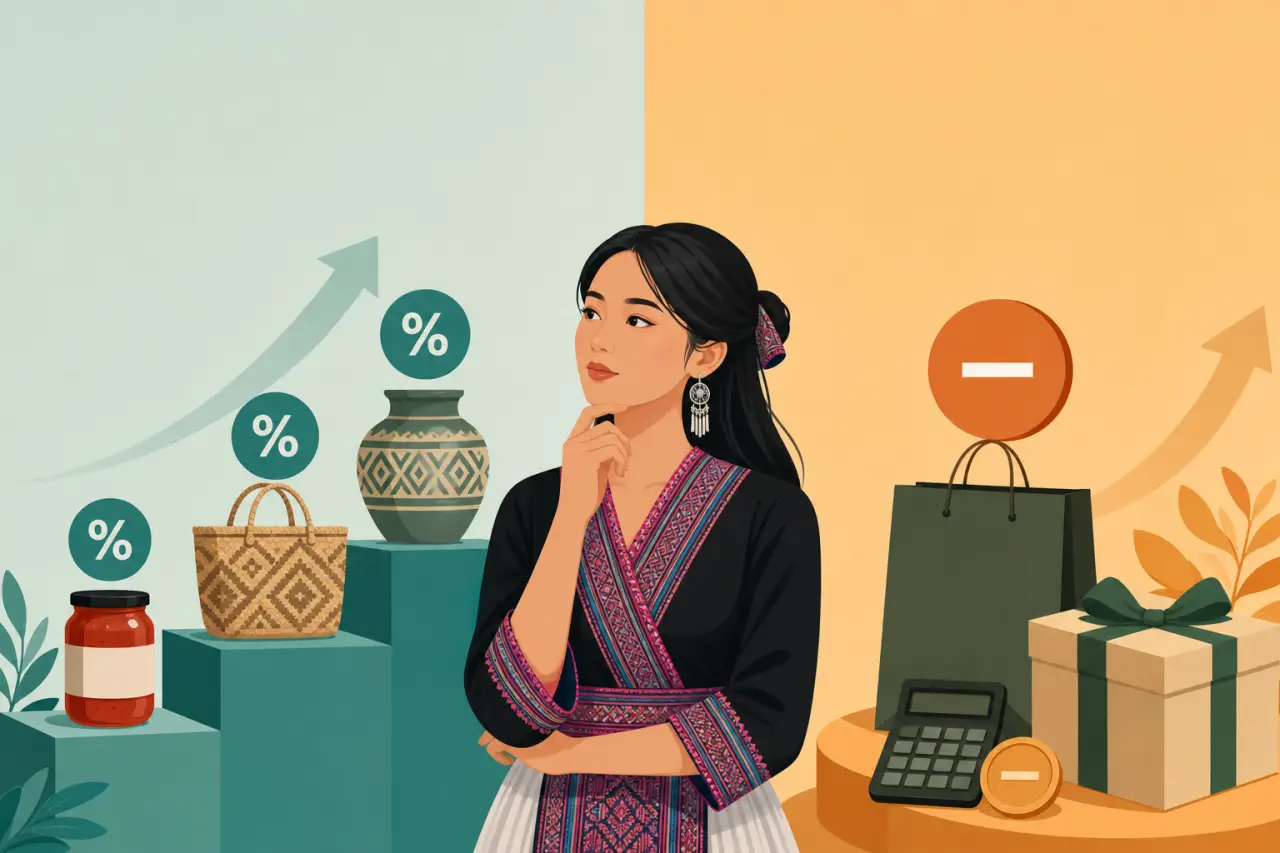
Percentage discounts scale naturally, which makes them the easier default when you're running one coupon across a whole storefront with items at different price points. Ten percent off feels the same whether someone's buying an eighteen-dollar jar of chili sauce or a two-hundred-dollar custom order, and you don't have to think about whether the discount still makes sense item by item.
A fixed dollar amount works better when you want the number itself to be the pitch, or when you're discounting a single higher-priced item. Five dollars off doesn't sound like much next to a fifteen-dollar product, but it reads as a real, concrete deal against a hundred-dollar one. It's also the more natural choice if you want to set a minimum purchase amount to unlock it, since a flat ten dollars off a fifty-dollar order is easy for a customer to picture and easy for you to price around; a percentage minimum-purchase deal takes more mental math on both ends.
Think about the specific transaction you're trying to encourage, not just the product. If you sell catering trays and want people to order for a group instead of just themselves, a fixed amount off once someone crosses a minimum order size directly rewards the bigger purchase. If you sell a range of handmade goods at different prices and just want to encourage a first purchase generally, a flat percentage is simpler for you to apply consistently and simpler for a customer to understand no matter what catches their eye.
If you're not sure which to pick, default to percentage for a storefront-wide promotion and save fixed amounts for a specific item or a minimum-order push. Either way, it helps to have your baseline price dialed in first — see pricing strategies that work for how to land on a number that still leaves room for a coupon without eating into your margin.
Where the Coupon Actually Shows Up to Customers
Once a coupon is active, it appears automatically as an Offers section on your public business listing, positioned between your hours and your reviews, so anyone reading through your page before deciding to buy sees it without you having to post it anywhere separately. Pairing an active coupon with sponsored placement for your listings can put that same offer in front of more browsing customers in the first place, not just the ones who already found your page on their own. An expired coupon simply stops appearing there on its own; you don't need to remember to take it down.
That said, don't treat the listing page as your only promotion channel. Plenty of customers who'd use a coupon never scroll down that far, especially if they're arriving from a direct product link or a search result. Mention the code directly:
- When you post about a sale on social media
- When you text a regular customer
- When you hand someone a business card at a community event
The listing page is where a browsing customer discovers the deal on their own; direct outreach is how you make sure the customers who'd actually use it hear about it at all.
Following Up on an Almost-Lost Sale
This is also where a coupon earns its keep for a specific, almost-lost sale. If someone messaged you asking about a product and then went quiet, following up a day or two later with a small, personal discount code is a much stronger nudge than waiting for them to stumble back onto your listing on their own. It costs you nothing if they never come back, and it's often exactly the small push someone needed who was already interested but got busy or hesitated on price. It's one piece of a bigger habit worth building — see turning visitors into repeat customers for more on what keeps someone coming back after that first purchase.
If you're not sure how to word the promotion itself, the AI writing assist tool in your dashboard can help draft a short line describing the offer, which is often the harder part of running a coupon than setting up the discount itself.
Timing a Promotion Around a Real Reason
A coupon that's always running stops feeling like a deal and starts feeling like your actual price, which trains customers to wait for it instead of buying at full price. A coupon tied to a real, limited window does more work with the same discount, because the deadline itself is part of what convinces someone to act now instead of putting it off.
Look for occasions that already mean something to your customers rather than inventing an arbitrary sale date.
- Hmong New Year is an obvious one if your products or services connect to it.
- A slow week where you know foot traffic or orders typically dip is another good target, since the coupon is doing real work filling a gap rather than discounting a week that would have sold out anyway.
- A new product launch is a third: a short introductory discount gets your first reviews in faster, and those reviews then help sell the product at full price to everyone who comes after.
Varying the occasion also keeps a repeat customer paying attention to what you're offering instead of tuning out a promotion they've seen running unchanged for months.
Using Coupons to Reward the Customers You Already Have
It's easy to think of coupons purely as a tool for winning new business, but some of the best use of a coupon code is on the customers who already know you. A private, unadvertised code you hand directly to someone who just left a thoughtful review, or to a customer who's ordered from you three or four times, costs you nothing until they use it and tells them plainly that their business is worth something to you.
This kind of coupon doesn't need to show up in a public post at all. Text it, hand it over on a receipt, or mention it the next time that customer messages you. The goal isn't volume, it's making one specific person feel like a regular rather than just another sale, which is often what actually turns an occasional buyer into someone who comes back on their own without needing a discount to do it. It's part of a bigger strategy worth building — see turning customers into loyal regulars for more ways to keep the customers you already have.
The same idea works for referrals. Give a loyal customer a code meant to be shared with a friend or relative rather than kept for themselves, and you're spending the discount to reach someone new through a recommendation that already carries trust, instead of a stranger clicking a stranger's ad. It costs the same as any other coupon, but it arrives with a built-in reason to believe you're worth trying.
When to Delete a Coupon Early, and When to Just Let It Expire
Most coupons should be left alone to run out on their own expiration date; that's what the date is for, and it means you never have to remember to go turn one off. But there are real reasons to delete one early from the Coupons tab instead of waiting.
- Delete it if the inventory it was meant to move has actually sold out, since a working code for an item you can't fulfill just creates a customer service problem.
- Delete it if you set the discount too deep and it's cutting into your margin more than you expected on a busier week than you planned for.
- Delete it if a code leaks somewhere you didn't intend, like getting shared in a general coupon-aggregator group instead of staying with the customers you meant it for.
Outside of those situations, resist the urge to end a promotion early just because the first few days were quiet. Give a coupon its full advertised window before judging whether it worked, especially if you only mentioned it once. Customers often act on a deadline closer to the deadline itself, not the day you first posted about it.

Questions people ask
Should I use a coupon or just lower my price permanently?
A coupon is better because it only costs you money when someone actually redeems it. A permanent price cut discounts everyone, including customers who would have paid full price. Coupons also let you keep your regular price visible, so customers don't feel they overpaid if they bought before the discount ended.
How long should I run a coupon for?
One to two weeks is a good starting point. A window that's too short doesn't give word of the deal time to spread. Too long and it stops feeling urgent and starts feeling like your regular price. The expiration date itself is part of what makes someone act now instead of putting it off.
What makes a good coupon code?
Keep it short and specific to the promotion. Avoid characters that are easy to confuse on a phone screen, like capital O next to zero or lowercase L next to one. Tie it to something customers will remember from where they saw it, like NEWYEAR10 for a Hmong New Year sale.
Should I use a percentage off or a dollar amount off?
Percentage discounts work better for a storefront-wide promotion across items at different prices. Ten percent off feels fair whether someone's buying an eighteen-dollar item or a two-hundred-dollar order. Use a fixed dollar amount when you want the number itself to be the pitch, or when discounting a single expensive item or a minimum order.
Written by
Hmong Network Team
Directory & Digital Services
We run the Hmong Network directory and do the web design and SEO/AEO work behind the results in our case studies. These guides come out of that same hands-on work with Hmong-owned businesses — not secondhand research.
