
A Visitor Clicked Your Website. Here's How You Keep Them.
TL;DR
Getting someone to your website is only step one. What actually turns a first-time visitor into a repeat customer is a fast, easy-to-use page, real proof that people trust you, a clear next step, and a simple habit of following up after the sale.
Make the First Few Seconds Count
Most visitors decide whether to stay or leave within seconds, before they've read a single word. A slow-loading page, a menu that's hard to find on a phone, or a site that makes someone pinch and zoom to read your hours loses people who would have otherwise become customers. This isn't a small detail — it's the whole ballgame, because everything else you do to earn loyalty depends on someone sticking around long enough to see it.
Keep the path to "call," "order," or "book" visible on every single page, not buried in a menu three clicks deep. If you sell egg rolls out of a food truck, your hours and today's location should be the first thing anyone sees, not the fourth. If you're a home inspector or an insurance agent, your phone number should be tappable from the homepage without scrolling. Don't make someone hunt for how to reach you — the businesses that lose the most traffic aren't the ones with ugly websites, they're the ones with confusing ones. If you're not sure where yours might be losing people, it's worth working through the website mistakes pushing visitors away one at a time.
Trust matters just as much as speed. A couple of real customer reviews, clear pricing or service information, and a working contact page do more to convert a stranger than any clever headline ever will. People buy from businesses that feel real and responsive, not from businesses that feel like a maze they have to solve before they're allowed to spend money.
Prove You're Real Before You Ask for Trust
A stranger landing on your site has no idea yet whether you're a real, reliable business or a placeholder page that hasn't been updated since you opened. Before they'll hand over their phone number, their money, or their time, they need some kind of proof that other people already trusted you and it worked out.
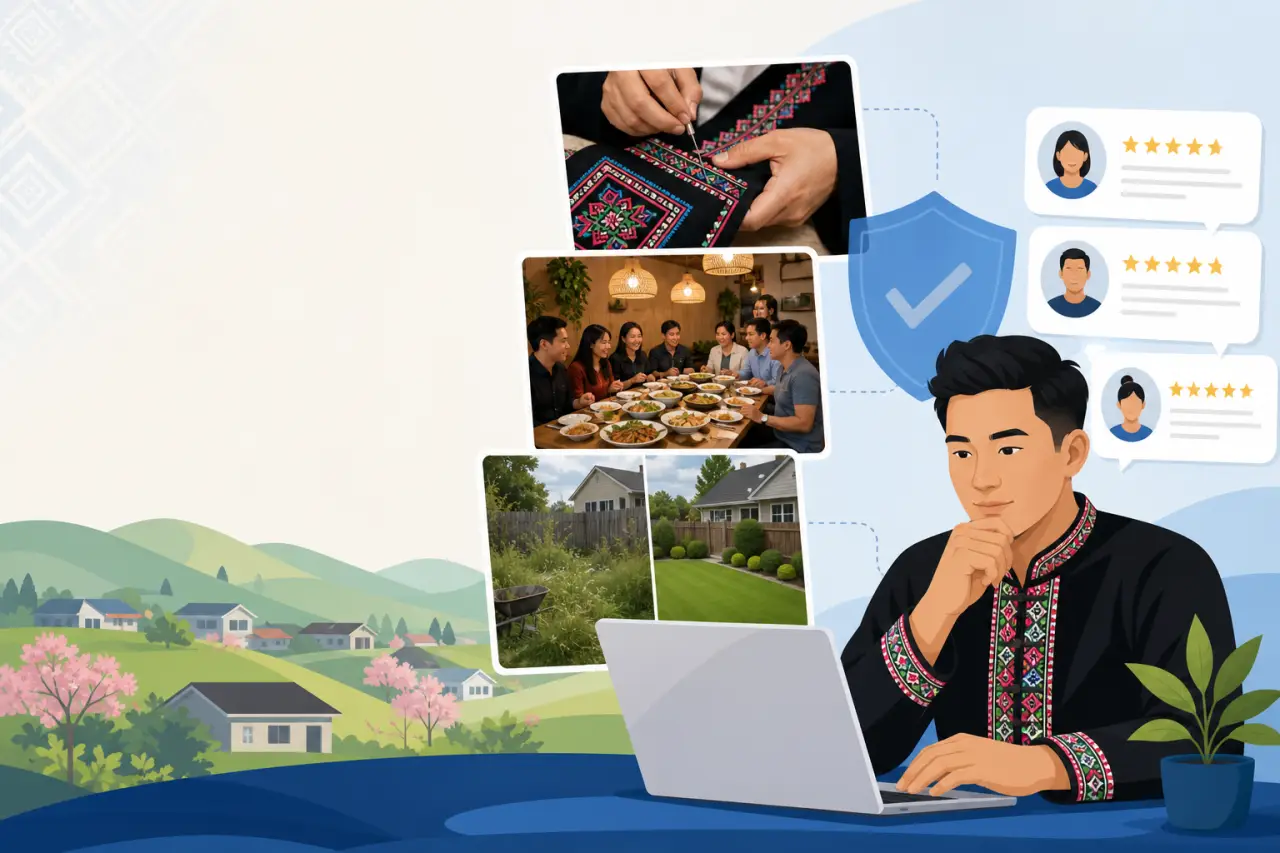
The fastest proof is photos of actual work, actual food, or an actual storefront — not stock images that could belong to any business in any city:
- A sewing shop showing a finished paj ntaub piece
- A restaurant showing a full table instead of an empty one
- A lawn care crew showing a before-and-after of a real yard
These tell a visitor "this business does what it says it does" faster than any paragraph of copy.
Reviews do the same job from a different angle. You don't need hundreds of them. Three or four specific, recent reviews that mention something real — a name, a service, a detail about what it was like to work with you — carry more weight than a generic five-star average with no comments attached. If you don't have reviews yet, the easiest fix is simply asking your last few satisfied customers directly, in person or by text, rather than waiting for it to happen on its own. Most happy customers are glad to leave one; they just rarely think of it unless you ask. There's a fuller playbook for earning trust through reviews if you want to turn this into a repeatable habit instead of a one-off ask.
Make the Next Step Obvious, Not Just Available
Having a phone number on your site is different from making it obvious that calling is what a visitor should do right now. A lot of small business sites bury their strongest call to action underneath paragraphs of background information the visitor didn't ask for yet.
Pick one primary action per page and make it impossible to miss:
- "Call for a free quote"
- "Order for pickup"
- "Book a consultation"
Everything else on the page should support that one action, not compete with it. If you're running paid ads or a Google Business Profile that sends people straight to your homepage, that homepage needs to answer the visitor's actual question — what do you sell, where are you, how do I start — within the first screen they see, before they have to scroll. This is a big part of why your ads aren't working even when the campaign itself is well targeted — a weak landing page undoes all that work in the first three seconds.
This matters even more on mobile, where most of your traffic is probably coming from. A button that's easy to tap with a thumb, sized and placed where a thumb naturally rests, converts better than a small text link buried in a paragraph. Test it yourself: open your own site on your phone, in your own home's wifi, and try to book, call, or order like a stranger would. If you get frustrated, so will they.
It also helps to think about which action you're actually optimizing for, because it isn't always the same one. A restaurant during lunch rush wants a phone call or an online order, right now. That same restaurant on a slow Tuesday afternoon might be better served by getting someone to save the page or follow the business online, since there's no urgency to act immediately. If your site treats every visitor the same way regardless of when or why they showed up, you're leaving easy wins on the table.
Turn a Single Purchase into the Start of a Relationship
A first purchase doesn't make someone loyal. A second one does. That's the whole distinction between traffic and customers who stick around, and it's decided almost entirely by what happens after someone pays you, not before.
Simple follow-up matters more than most owners think.
- A text a few days after a job asking how it went
- An email after a purchase with a thank-you and an easy way to reach you if something's wrong
- A quick check-in call for anything higher-stakes, like an insurance policy or a real estate deal
None of this requires software or a marketing budget — it requires a habit. Pick one moment in your sales process where you'll follow up, every time, and build the reminder into how you already work: a note on the invoice, a recurring task on your phone, a line in your appointment book.
This is also where a lot of trust gets built or lost. Something goes wrong in almost every business eventually — an order gets mixed up, a delivery is late, a service doesn't quite hit the mark. How you handle that moment, whether you're easy to reach and quick to make it right, does more for long-term loyalty than a flawless first transaction ever could. Customers remember how you responded to a problem far longer than they remember that everything went smoothly.
Give People a Concrete Reason to Come Back on Their Own
Following up gets someone's attention once. A reason to return on their own is what turns an occasional customer into a regular one — the real work of keeping the customers you already have rather than constantly chasing new ones. This doesn't need to be complicated or expensive — it needs to be specific enough that a customer actually remembers it exists.
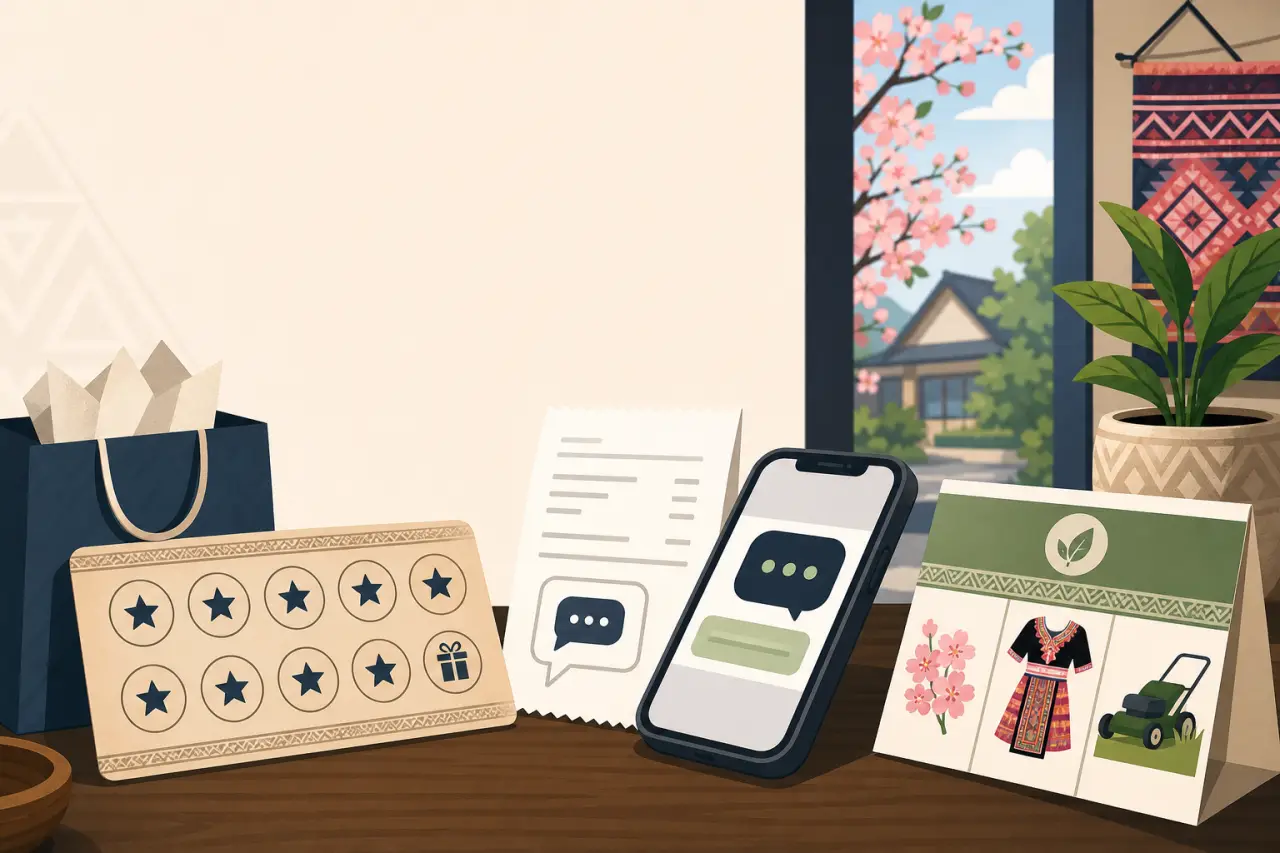
- A punch card for a tenth-visit discount works because it's visual and tangible; a customer sees it every time they open their wallet.
- A simple "text us when you're ready to reorder" note on a receipt works because it removes the friction of a customer having to remember your business name and search for you again later.
- A seasonal reminder — new stock before Hmong New Year, a spring lawn care package, tax season reminders from a bookkeeper — works because it ties your business to a moment the customer was already thinking about.
What doesn't work as well is a vague "follow us for updates" ask with nothing behind it. Give people something specific to come back for, tied to an actual date, discount, or event, and you'll see far more repeat visits than from a generic loyalty message with no real hook.
Keep the mechanism as low-effort for you as it is for the customer. A punch card only works if it's actually at the register every time, not stuffed in a drawer. A text-to-reorder system only works if someone actually checks that phone and replies. Pick one method you can run consistently rather than three you'll abandon after a busy month — a loyalty idea that only works when things are slow isn't a loyalty program, it's a hobby.
Meet Customers Where They Already Are
For a lot of Hmong-owned businesses, the strongest channel for staying in touch isn't email — it's the channels your customers are already using every day: texting, Facebook groups, and word of mouth through family and community networks. Fighting that instinct and forcing everyone into a formal email list usually backfires; leaning into it usually works.
- A short text message after a purchase gets read almost immediately, far more reliably than an email that sits in an inbox.
- A Facebook post in a local Hmong community group, tagging your own business page, reaches people who trust the recommendation of whoever shared it more than they'd trust an ad.
- Referrals from someone's aunt, cousin, or church friend still close more sales for small, relationship-driven businesses than almost any digital tactic — which means making it easy for a happy customer to tag or share your business matters as much as anything on your website itself.
The lesson isn't to abandon your website — it's the foundation everything else points back to. It's to treat your website as one piece of a bigger loop: someone hears about you through a person they trust, checks your website to confirm you're real and see your hours or menu, then either calls, texts, or shows up. Each piece needs to work, and each piece should make the next one easier, not harder.
Pay Attention to What Actually Happens After Someone Visits
You can't fix what you don't measure, and most small business owners have no real visibility into what happens after someone lands on their website — did they call, did they leave, did they check your hours and drive over anyway? Without that information, you're guessing at what to fix.
At minimum, know which pages or listings are actually sending you calls and messages, not just visits. If your business has a listing here on Hmong Network, that tracking already happens automatically — every view, phone tap, and direction request gets counted, even before a listing is claimed, so you can see real numbers instead of guessing. The same discipline applies wherever else you show up online: your Google Business Profile shows call and direction-click counts for free, and it's worth checking monthly, not just when business feels slow.
What you're really looking for is where the drop-off happens. If a listing gets plenty of views but almost no calls, the problem probably isn't your visibility — it's what people see once they arrive, which points back to the trust signals and clear next step covered above. If calls are strong but repeat business is weak, the problem is more likely the follow-up habit, not the front door. Treat the numbers as a diagnostic tool, not a report card: they tell you which part of the chain to fix next.
Questions people ask
What's the most important thing to get right on my website?
Make it fast and easy to navigate on a phone, with your call-to-action visible without scrolling. Most visitors decide whether to stay within seconds, before reading anything. If someone has to hunt for your hours, phone number, or how to order, they'll leave. Everything else depends on them staying long enough to see it.
How many reviews do I need to build trust?
Three or four specific, recent reviews that mention real details carry more weight than a generic five-star average with no comments. You don't need hundreds. The easiest way to get them is simply asking satisfied customers directly in person or by text — most are happy to leave one if you ask.
What should I do after someone buys from me?
Follow up within a few days with a text, email, or call asking how it went. This builds far more loyalty than a perfect first transaction. When something goes wrong — and it will — how quickly you respond and fix it matters more for long-term loyalty than any smooth sale ever could.
How do I get customers to come back on their own?
Give them something specific to return for, not a vague "follow us for updates." A punch card for a tenth-visit discount, a text-to-reorder note on receipts, or seasonal reminders tied to actual dates work because they're concrete. Pick one method you can run consistently, not three you'll abandon when busy.
Written by
Hmong Network Team
Directory & Digital Services
We run the Hmong Network directory and do the web design and SEO/AEO work behind the results in our case studies. These guides come out of that same hands-on work with Hmong-owned businesses — not secondhand research.
