

Use Your Slow Season to Plan the Next Twelve Months
TL;DR
Your slow season isn't dead time — it's the best window to look at what actually worked last year and build a simple, written plan for the next twelve months instead of marketing on impulse.
Look back before you plan forward
Before you decide anything new, spend one real hour looking at what actually happened last year:
- Which months were your busiest?
- Where did new customers say they heard about you when you asked?
- Which specific post, flyer, or promotion actually got someone through the door, and which ones you spent time on that nobody seemed to notice?
Most of that answer already exists somewhere — your register totals by month, your phone's photo roll of what you posted, a stack of receipts, or just what you and your family remember from being there every day. It just hasn't been written down in one place yet, which is the only reason it feels harder to plan than it actually is.
You're not trying to build a perfect report. You're looking for a pattern you can act on: maybe referrals from other business owners outperform anything you paid for, maybe one specific weekend drove a third of your whole year, maybe your slowest stretch is exactly when a competitor across town runs their big sale. Write that pattern down in plain language — “September was dead, most new customers came from other Hmong-owned shops sending people our way, the flyer for the fall promotion did basically nothing” — and that sentence is more useful than any marketing template, because it's true for your business specifically, not for a business like yours in general.
Figure out when your slow season actually is
It's tempting to assume January and February are slow because that's when everyone else says business slows down. For some businesses that's exactly right. For others it's backwards:
- A tax preparer or an insurance agent is often at their busiest right after the new year and quiet the rest of the year.
- A restaurant near a Hmong New Year celebration site might see its best weekend of the entire year fall in November or December, with the real lull landing in late winter once that's over.
- A wedding photographer or event caterer might be slammed all spring and summer and nearly silent from October through February.
The only way to know your actual slow season is to check your own numbers against your own calendar, not borrow an assumption from a business that isn't yours. Once you know the real window — even roughly, even just “usually mid-February through late March” — that's the block of time you're planning inside of. It's also the block of time when you have the most spare hours to actually do the planning, which is the whole reason this works: you're not trying to build a marketing calendar during your busiest month, when there's no time to think straight.

Write the year on one page, not a marketing binder
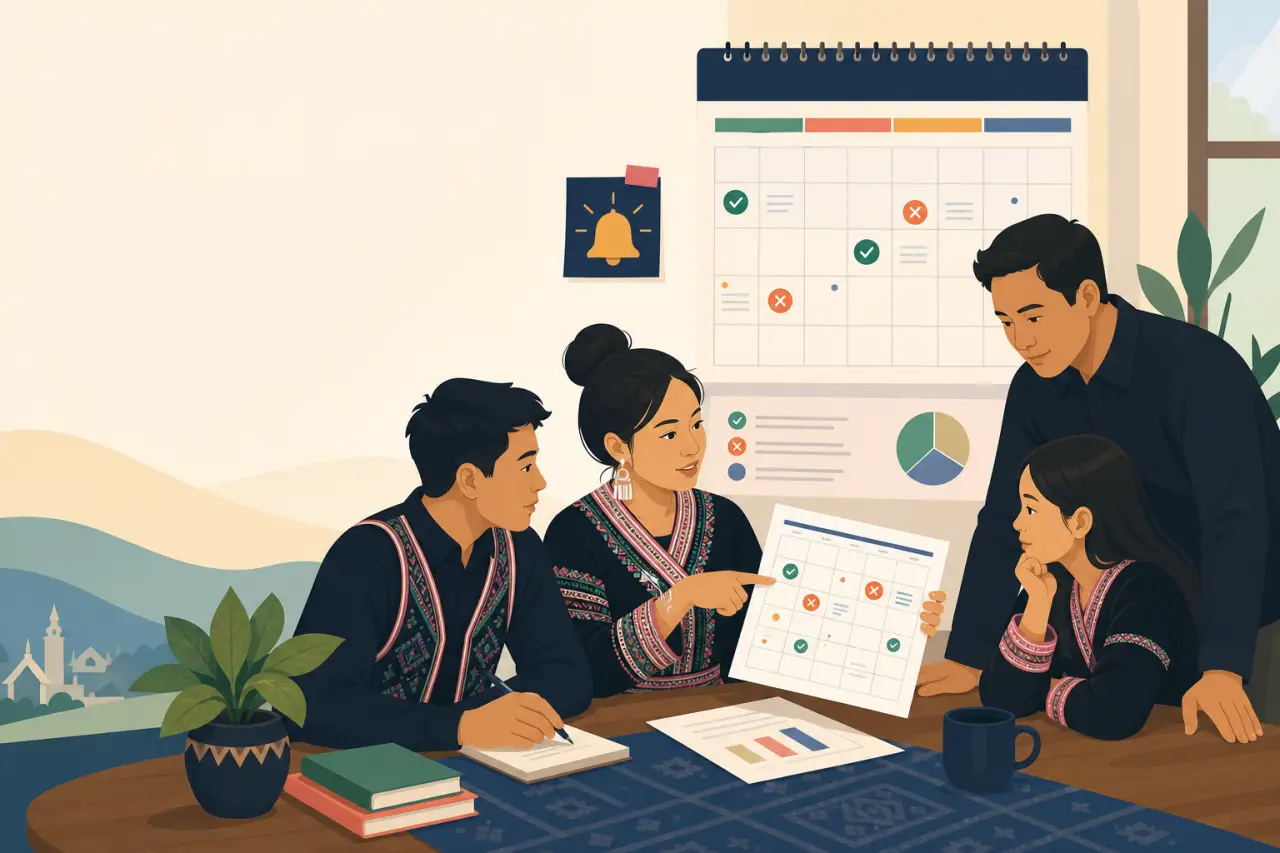
The plan itself should fit on one page. A simple twelve-row calendar — one row per month — taped up near where you do your ordering, or a single spreadsheet tab, works better than any elaborate marketing document you'll open once and never look at again. For each month, jot down three things:
- What's already happening around that time (a holiday, a community event, a slow patch, a busy patch)
- One specific action you're going to take because of it
- Who's actually doing it — you, a family member who helps with the page, an employee who's good with a camera.
If committing to a full twelve months in one sitting feels like too much, treat it as four smaller rounds of setting up your next quarter instead, revisiting the page every few months rather than writing the whole year at once.
The point of keeping it this plain isn't laziness, it's that a plan you can glance at in ten seconds is a plan you'll actually follow. A twenty-page strategy document with goals and sub-goals and channel breakdowns looks impressive and then sits in a drawer, because nobody has time to re-read it every week. One page you can see at a glance, update with a pen, and hand to whoever's covering the counter that day will outlast almost anything more polished.
Batch your content ahead of time
While you're building the page, batch whatever you can ahead of time instead of starting from scratch every week. If posting photos is one of your two or three things, spend one slower afternoon each month taking pictures of that month's specials or projects all at once, so you're not scrambling for content on a day you're already busy running the business. The plan tells you what to post and when; batching just means the actual work of making it happens in one sitting instead of eating into every single day.
Pick two or three things, not everything
The businesses that burn out on marketing usually tried to do all of it at once — social media, paid ads, a monthly email, a booth at every event they hear about — and kept none of it consistent for more than a few weeks. Pick two or three things you can actually sustain for the whole stretch ahead, and put specific dates on the calendar now instead of a vague intention:
- A post every Friday about what's new
- A table at the spring Hmong New Year celebration
- A text to your regulars once a month
If social media is one of the two or three you keep, picking one platform and showing up consistently beats spreading yourself across four apps you'll abandon by March.
Two things done every single time beat five things done once. If you run a food truck, that might mean showing up reliably to the same two community events every year rather than chasing every new one you hear about, plus one short video a week of what's on the menu that day. If you run a service business — tax prep, insurance, real estate — it might mean a monthly check-in call to past clients plus a presence at one big community gathering a year, instead of trying to also run ads and post daily on top of that. Fewer commitments, kept consistently, build the kind of trust that a scattered effort never does.
Build your calendar around the events your customers already show up for
You don't need to invent a marketing calendar from nothing. Most Hmong-owned businesses already have a built-in one, and planning around Hmong New Year is the clearest example:
- Celebrations often run in several cities across different weekends rather than on a single date
- Community soccer tournaments
- Temple and church gatherings
- School events
- Wedding season in spring and summer
If you're already showing up to these as a vendor or a sponsor, that attendance is marketing — the planning part is just making sure you don't let it happen to you by accident.
That means locking in dates as soon as they're announced, not the week before. It means having:
- Enough product or capacity ready
- Business cards or a simple sign to scan for your listing
- A plan for collecting contact information from people who stop by — even something as basic as a notebook and pen for names and numbers works fine if you don't have anything fancier
Treating these events as the backbone of your calendar, rather than as extra things you squeeze in if there's time, is usually the highest-return move available to a business with a small marketing budget, because the trust is already built into the room before you say a word.

Keep a simple record of what's working as you go
You don't need analytics software to track whether your plan is working. The simplest version is a single question, asked consistently: when someone new comes in, ask how they heard about you, and write the answer down somewhere — a notebook by the register, a sticky note, a running note on your phone. After a month or two, patterns show up on their own without you having to calculate anything. If more than one person works the counter, ask them to do the same thing, and compare notes at the end of the week — a pattern that shows up across two or three people is a lot more reliable than one person's memory.
A few other things are already free and sitting there waiting to be checked:
- Your Google Business Profile has a dashboard showing how many people viewed your listing, called, or asked for directions, updated automatically with no setup required.
- Your review count and how often new ones come in
- Something as simple as how many loyalty punch cards get filled in a given month
None of this needs to be turned into a chart or a report — you're just glancing at it every few weeks to notice whether the two or three things you committed to are actually moving the needle, so you can do more of what's working and quietly drop what isn't when the next slow season rolls around.
Protect a little room to react
Leave a small, separate amount of time or budget genuinely unplanned. Something will come up mid-year worth reacting to that you couldn't have scheduled in advance:
- A trend on social media that fits your business
- A last-minute request from a community organizer to set up a table
- A slow Tuesday where a same-day text to your regulars offering a small discount would actually bring people in that same afternoon
If every hour and every dollar is already assigned to the plan you built months ago, you won't have room to take it.
This doesn't mean leaving the whole plan loose — the two or three committed things still need to happen on schedule, or the plan falls apart. It means treating maybe one afternoon a month, or a small slice of whatever budget you have, as flexible on purpose. The same discipline behind never losing a day to busywork applies here — that flexible slice only stays flexible if you actually guard it on the calendar, instead of letting the next urgent task quietly swallow it. That's the difference between a plan that guides you and a plan that traps you: the goal was never to fill every day with marketing, it was to stop marketing being something that only happens when you suddenly remember you haven't done any in a while.
Check in at the halfway point, not just once a year
Set one reminder, right now, for six months from today. When it comes up, pull out the same one-page calendar and be honest about it:
- Which of the two or three things did you actually keep doing?
- Which quietly stopped happening around week three?
- Which community event turned out to matter less than you expected?
Update the second half of the year based on what you now know, the same way you used last year's numbers to build the first half.
A plan built once in the slow season and never touched again slowly turns into exactly the kind of thing this whole approach was meant to replace — a document nobody looks at. A plan you check on halfway through stays a living thing your family can adjust together, which is really the whole point: not a perfect twelve-month forecast, just a realistic, written-down way to spend your limited time and money on the two or three things most likely to bring people back, instead of scrambling every time business slows down again.
Questions people ask
How do I figure out when my slow season actually is?
Check your own numbers against your own calendar instead of assuming January and February are slow for everyone. A tax preparer might be busiest after the new year, while a wedding photographer could be slammed in spring and summer. Once you know your real window—even roughly—that's when you have the most spare hours to actually plan.
What should I put on my one-page marketing calendar?
For each month, write down three things: what's already happening that time (a holiday, community event, busy or slow patch), one specific action you're going to take because of it, and who's actually doing it. Keep it simple enough to glance at in ten seconds, so you'll actually follow it.
How do I know if my marketing plan is actually working?
Ask new customers how they heard about you and write it down—a notebook by the register works fine. After a month or two, patterns show up without calculation. You can also check your Google Business Profile dashboard, review count, or loyalty card fill-ins. You're just glancing every few weeks to notice what's moving the needle.
Should I try to do every type of marketing at once?
No. Most businesses that burn out tried to do social media, paid ads, email, and events all at once and kept none consistent. Pick two or three things you can sustain for the whole year—like a Friday post and one community event—and put specific dates on the calendar now. Two things done every single time beat five things done once.
Written by
Hmong Network Team
Directory & Digital Services
We run the Hmong Network directory and do the web design and SEO/AEO work behind the results in our case studies. These guides come out of that same hands-on work with Hmong-owned businesses — not secondhand research.
