

Turn Your Culture Into Content, Not a Sales Pitch
TL;DR
The everyday process behind your food, craft, or trade is content most businesses would have to fake to get — you already have it, you just haven't been pointing a camera at it. This guide covers how to turn that into a real, sustainable posting habit instead of a stream of sales pitches.
Show the process, not just the product
A finished plate of food or a finished piece of paj ntaub is nice to look at, but it doesn't tell a story. The twenty minutes before it does — the prep, the technique passed down from someone specific, the small decision you make without thinking about it anymore because you've made it a thousand times. A short video of you making sauce from scratch, or stitching a pattern by hand, will usually get more genuine attention than a clean product photo, because it's something a stranger could never get anywhere else, no matter how much they searched.
You don't need editing skills for this. A phone propped up while you work, posted with a two-line caption explaining what's happening, is the whole format. Authenticity here is just doing the work you'd be doing anyway, with a camera nearby to catch it. If you're a farmer, that's the walk through the field before market day. If you're a mechanic, that's the part of the repair most customers never see because they dropped the car off and left. The mistake most small businesses make is assuming their normal Tuesday isn't interesting. It usually is — you're just too close to it to notice. That's often the first step in finding your business's real story: the parts that feel too ordinary to you are usually the ones a stranger would stop scrolling for.
One practical habit: keep your phone somewhere you can grab it in under ten seconds while you're working, not in a bag across the room. The moments worth filming — a customer's reaction, a technique you're mid-way through, a batch that came out exactly right — last a few seconds and don't wait for you to go get equipment.
Build a simple content calendar around what already recurs
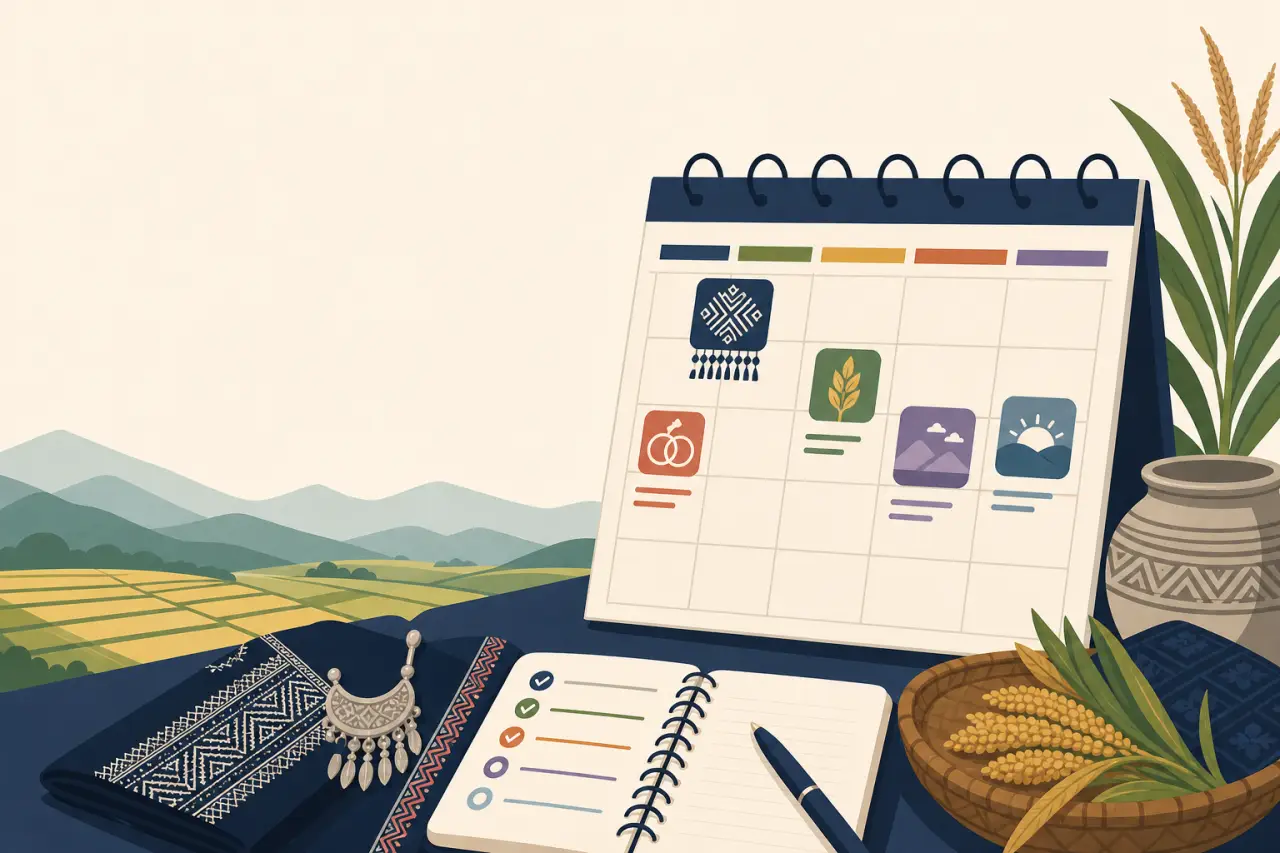
You already have a yearly rhythm — Hmong New Year, harvest season, wedding season, a slow month, a busy month. Map your content to that rhythm instead of scrambling for ideas every week, starting with marketing around Hmong New Year — the single biggest stretch on that calendar for most Hmong-owned businesses.
- A "getting ready for Hmong New Year" series in the weeks before
- A "why we make it this way" post during a slow week
- A quick customer shoutout after a busy one
This turns content from a chore you have to invent into something you're already living through, which makes it much easier to keep up for months instead of two weeks.
Write the rhythm down once, even roughly, so you're not relying on memory in the middle of a busy season. A simple list works: what happens in your business every January, every spring, every fall. Next to each one, jot one or two content ideas — not scripted posts, just a reminder of what's coming so you're not caught off guard when the moment passes. If you sew, that might be "start posting New Year outfit prep six weeks out." If you run a restaurant, that might be "post the harvest ingredients as they come in, before the seasonal menu even launches."
The advantage of this approach over a generic content calendar template is that it's specific to your business instead of generic to "small business marketing." A template will tell you to post on Mondays and Thursdays. Your own calendar tells you to post the week people are actually shopping for New Year outfits, which matters more than the day of the week.
Let family and community be part of the story, without turning them into props
A lot of Hmong-owned businesses are genuinely multi-generational — a parent taught a technique, a grandmother's recipe is the one still in use, a whole extended family shows up to help during a busy weekend. That's real content, and it usually resonates more than anything a business could script, because people can tell the difference between a business using "family-owned" as a marketing phrase and a business where the family is actually there.
The honest way to do this is to ask before you post, every time, not just the first time. Some family members are glad to be on camera; others aren't, and that can change from one week to the next. A quick "okay if I post this?" costs you nothing and avoids a real problem — an elder who didn't want to be filmed seeing themselves online is a trust issue you don't want to create for a caption.
When someone is comfortable being featured, let them explain something in their own words rather than narrating for them. A grandmother describing why she still makes a dish a certain way, even briefly and even partly in Hmong, carries more weight than a polished voiceover. You're not producing a documentary — you're capturing something true and letting it be a little rough around the edges, which is usually what makes it feel real instead of staged.
Speak to two audiences without splitting your message
Post in both Hmong and English when you can, even if it's just one extra caption line. You're not choosing one audience over the other — you're making sure both can actually understand what you're proud of, and both can share it with someone else. A lot of Hmong-owned businesses default to English because that's what feels natural for a public-facing post, but that quietly leaves out the customers most likely to already trust you and refer you to others — understanding why customers support Hmong-owned businesses in the first place makes it obvious why that's a costly thing to leave out.
You don't need a professional translator for most of this. A short, plain caption in Hmong under the English one is enough — it doesn't have to be a literal translation, just the same core message in both languages. If writing in Hmong is slower for you than English, keep a running note of phrases you use often:
- Welcome back
- Now open
- Thank you for coming
- Available this weekend
That way, you're not starting from scratch every post.
The same logic applies to video. If a family member is speaking Hmong in a clip, a simple English caption underneath or in the description opens it up to customers who don't speak Hmong but are curious about the culture behind the business — which, for a lot of the customers this kind of content reaches, is exactly why they stopped scrolling in the first place.
Turn everyday customer moments into content
Some of the best content isn't something you make — it's something that happens in front of you that you just have to notice and capture:
- A regular customer picking up the same order every week
- A first-time customer trying something and their reaction to it
- A custom order coming together exactly the way someone asked for it
These moments already have a built-in audience, because the person in them is a real customer, not a model or an actor.
Ask permission on the spot — "mind if I post this?" — and if they say yes, tag them if they have an account, or at least mention them by first name if they're comfortable with that. People share things they're featured in far more often than they share generic business posts, which means a single good customer moment can reach people your own page never would on its own.
Keep a short mental list (or a real one, in your notes app) of the kinds of moments worth watching for:
- A reaction
- A repeat visit
- A specific request that shows what you can do
- A small mistake you fixed well
You'll start noticing them more once you're actually looking, the same way you notice a car you're thinking about buying suddenly everywhere on the road.

Match the format to the story instead of posting everywhere the same way
Not every moment needs to be a video, and not every video needs to be long. A finished dish might be a single photo with a caption about what went into it. A technique might need thirty seconds of video to actually make sense. A quote from a customer might just be text on a plain background — no filming required. Trying to force every idea into the same format is usually what makes posting feel like a burden, because some stories genuinely take more effort to tell well than others.
A rough guide that works for most small businesses:
- Use a photo when the finished result is the interesting part
- Use video when the process or motion is the interesting part
- Use text or a simple graphic when the interesting part is something someone said or a fact worth stating plainly, like new hours or a limited batch
You don't need to master every format at once — pick the one or two that match how your business actually operates, and get comfortable there before adding more.
It also helps to repost the same core content in different forms over time instead of treating every post as disposable. A video from six months ago showing a technique is still true today. Trim it, re-caption it, and post it again for anyone who missed it the first time — most of your audience did.
Don't let every post become a sales pitch
It's tempting, especially when business is slow, to turn every post into some version of "come buy this." The problem is that an audience made up entirely of sales pitches stops paying attention to any of them, the same way a store that plays the same commercial on repeat gets tuned out. The content that actually builds an audience willing to buy from you later is the content that doesn't ask for anything — the process video, the family story, the customer moment — and the direct offer works better when it's the occasional post in a feed that's mostly something else.
A useful rule of thumb: for every direct "here's what we're selling" post, aim for two or three posts that are just honestly interesting on their own, with no ask attached. That doesn't mean hiding your product — a process video still shows what you make and how well you make it, which sells the business without saying "buy this" out loud. It just means the selling happens through the audience trusting what they're seeing, not through repetition of the pitch.
When you do post a direct offer, be specific rather than generic. "Now taking Hmong New Year custom orders, limited slots, message to reserve one" gives someone a real reason to act this week. "Check out our products" doesn't give anyone a reason to do anything today instead of some other day, which for most small businesses means it never happens. This is really the core idea behind marketing that actually works for Hmong-owned businesses: build trust first, ask second, and let the specifics do the work generic advice never could.
Know what's actually working without chasing vanity numbers
A post with a lot of likes isn't automatically a post that brought in business, and a post with modest reach isn't automatically a failure. What actually matters for a small business is simpler to track than most social media advice makes it sound: which posts led to an actual message, call, order, or someone walking in and mentioning they saw something online. Start noticing that pattern, even informally, and you'll learn faster what to keep making than any general advice could tell you.
A simple habit that works without any special tools: when someone reaches out, ask casually how they found you or what made them message. Jot it down somewhere, even just a running note. After a month or two of doing this, you'll usually see a pattern:
- Maybe it's the process videos
- Maybe it's the customer moments
- Maybe it's the bilingual captions reaching people who wouldn't have understood an English-only post
That pattern is worth more than any follower count, because it tells you exactly what to keep doing and what you can let go of.
Give any new type of content real time before judging it — a few weeks at minimum, not a single post. Some formats take longer to find their audience than others, and abandoning something after one quiet post is a common way small businesses talk themselves out of the thing that would have worked if they'd stuck with it a little longer.

Questions people ask
How do I film content about my business without expensive equipment?
Use your phone propped up while you work. Keep it somewhere you can grab in under ten seconds so you catch moments as they happen — a customer's reaction, mid-technique, a batch that came out right. A two-line caption explaining what's happening is the whole format. Authenticity is just doing the work you'd be doing anyway with a camera nearby.
Should I post in Hmong or English?
Post in both when you can, even just one extra caption line. English-only posts quietly leave out the customers most likely to already trust you and refer you to others. You don't need a professional translator — a short, plain caption in Hmong under the English one is enough. It doesn't have to be a literal translation, just the same core message.
How often should I be asking for the sale in my posts?
For every direct "buy this" post, aim for two or three posts that are just honestly interesting with no ask attached. When you do make a direct offer, be specific: "Now taking Hmong New Year custom orders, limited slots, message to reserve" works better than generic "check out our products." Trust built through interesting content makes the occasional direct offer actually work.
How do I know which content is actually bringing me business?
Don't chase likes — track what actually matters: which posts led to a message, call, order, or someone mentioning they saw you online. Ask casually how people found you and jot it down. After a month or two you'll see a pattern: maybe it's process videos, customer moments, or bilingual captions. That pattern tells you what to keep doing.
Written by
Hmong Network Team
Directory & Digital Services
We run the Hmong Network directory and do the web design and SEO/AEO work behind the results in our case studies. These guides come out of that same hands-on work with Hmong-owned businesses — not secondhand research.
