

Marketing That Actually Works for a Hmong-Owned Business
TL;DR
Skip the big ad budget and start with what's already free: a filled-out Google Business Profile, real photos, a presence in the two or three spots your community actually gathers, and a habit of asking every happy customer to send someone your way.
Start where people are already looking for you
Before you spend a dollar on ads, make sure the free stuff is actually done right.
- That means a claimed and fully filled-out Google Business Profile with real photos, current hours, and your actual phone number — not a placeholder you meant to fix later.
- That means a listing on Hmong Network and any other directory your community actually checks — making sure customers can find you no matter which one they search first.
- That means a Facebook or Instagram page that gets updated at least monthly, even if it's just a photo of what's fresh that week.
Most people decide whether to walk in the door before they ever talk to you. If they search your name and find a Google listing with no photos, wrong hours, or a phone number that doesn't work, you've lost them before you had a chance to earn them. This is the part of marketing that costs nothing but attention, and it's the part almost every small business gets lazy about after the first month. Set a reminder to check your listing every couple of weeks — update the hours around holidays, swap in a new photo, answer any questions people have left on it. That fifteen minutes does more for you than most paid campaigns.
Don't forget the little things that trip people up: your business name, address, and phone number should read exactly the same everywhere they appear — Google, Facebook, your directory listing, your receipts. A shop listed as one name on Google and a slightly different name on Facebook confuses both customers and the search engines trying to figure out if those two listings are even the same business.
Get your photos right before you spend on anything else
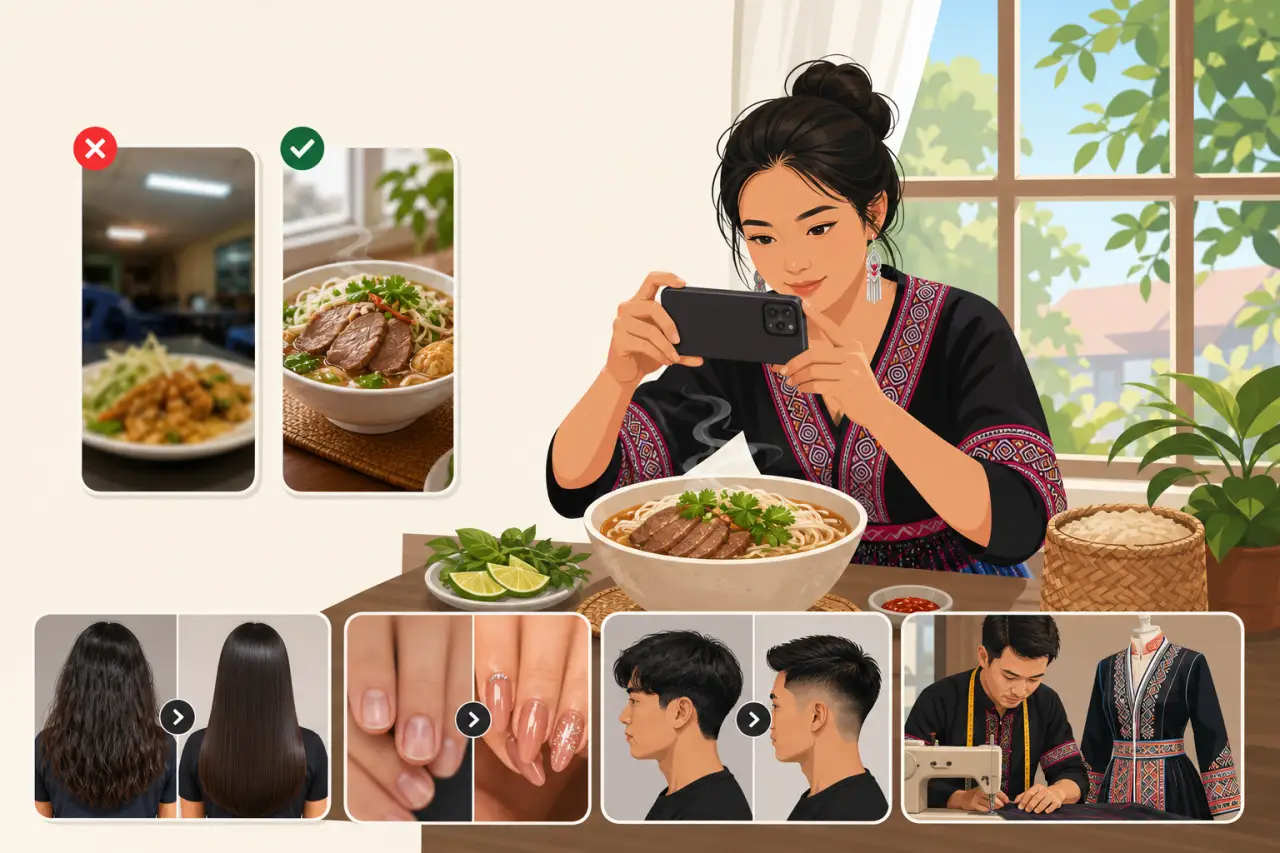
If you sell food, hair, nails, tailoring, or anything else people can see, your photos are doing more selling than your words ever will. A blurry phone photo taken under fluorescent light at 9pm tells a customer nothing except that you didn't think it was worth doing well. A photo taken near a window with actual daylight, of the actual dish or the actual finished cut, tells them exactly what they're going to get.
You don't need a professional photographer. You need consistency:
- Take a few photos every time you have something worth showing, in daylight, in focus, without a busy background.
- For services, before-and-after shots do more work than any caption you could write.
- For food, get close — steam, texture, the actual portion size, not a wide shot of an empty dining room.
- Skip stock photos entirely.
A slightly imperfect photo of your real food or your real work builds more trust with a first-time customer than a polished stock image ever will, because it proves you're a real person running a real business, not a template.
If you can, add a short video every so often too — thirty seconds of the wok, the sewing machine, or the chair is plenty. You don't need editing software or a script. A phone propped against a cup while you work is enough, and it tends to hold attention longer than a still photo on a scrolling feed.
Show up in the two or three places your actual customers gather
Get specific about where your community actually spends time — a particular Facebook group, a temple or church bulletin, a booth at Hmong New Year, a table at a local craft fair, a mention on a Hmong-language radio show — and if your calendar lines up with the holiday season, our guide to marketing around Hmong New Year covers that timing in more depth. One well-placed post in a group of three thousand people who already trust each other will almost always outperform a boosted ad shown to thirty thousand strangers who've never heard of your name.
When you do show up in person — at a New Year celebration, a community fundraiser, a market — bring more than a smile:
- Business cards.
- A small sample of what you sell, if that's realistic.
- A printed QR code that goes straight to your Google review page or your Facebook page.
A booth without a way for someone to remember you the next day is a missed follow-up, not a finished job. Go narrow first. Prove that one channel works before you try to be everywhere at once — spreading yourself across five platforms you update rarely does less for you than one platform you actually keep current.
Don't overlook the smaller, less obvious spots either:
- Sponsoring a youth soccer team's jerseys.
- Donating a gift card to a school fundraiser raffle.
- Setting up a small table at a community health fair.
None of these look like marketing in the traditional sense, but they put your name in front of the exact people most likely to become repeat customers, and they build the kind of goodwill an ad simply can't buy.
Write for two audiences at once, not one
A caption or a sign written only in English misses the aunties, uncles, and elders in your own community who trust word passed in Hmong more than anything they read in English. A caption written only in Hmong misses the younger generation, the coworkers, and the neighbors outside the community who are searching in English and would come if they knew you existed. You don't need a professional translator to solve this — a bilingual family member, an employee, or even a customer who's willing to help can get you a plain, accurate version in both languages.
This matters most for the basics:
- Your menu or service list.
- Your hours.
- A short line about what makes your shop worth the drive.
Keep both versions plain and specific rather than clever — search engines and the AI tools people increasingly ask for recommendations both reward businesses that state clearly, in whichever language, exactly what they offer and where. A sign in the window that says both what you sell and how much it costs, in both languages, is quietly one of the most effective pieces of marketing a small storefront can put up.
The same logic applies to your Google Business Profile description and your social posts — write a short line in English for search visibility, then let the Hmong version carry the warmth and detail that speaks directly to the community you grew up in. You're not writing the same thing twice; you're writing for two different readers who both matter to your business. And that instinct doesn't stop at translation — turning culture into content, whether it's a recipe, a family tradition, or the story behind your shop's name, gives you material a generic competitor simply doesn't have.
Turn happy customers into your sales team
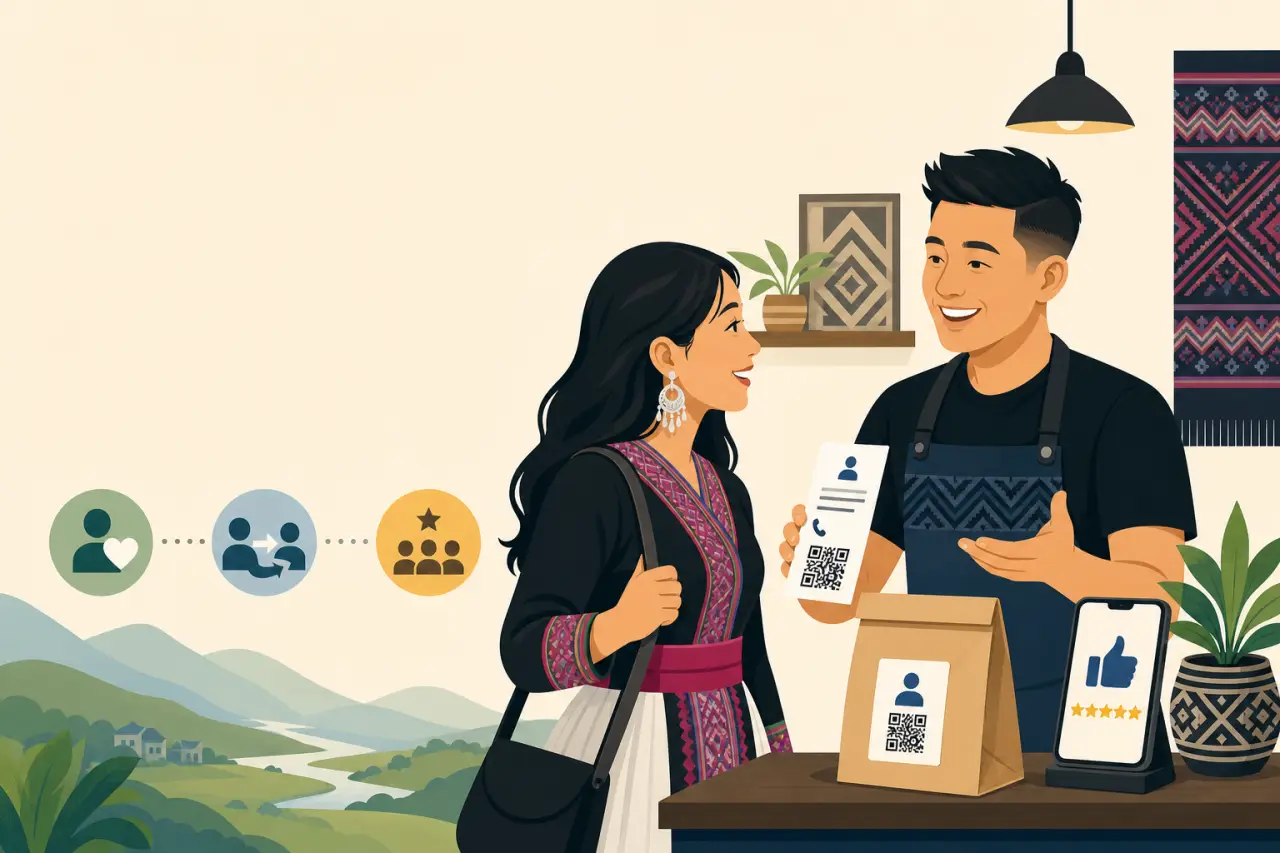
Referrals are the cheapest marketing channel you have, and most business owners never actually ask for them out loud. After a good haircut, a good meal, a good repair job — say it directly: if you know someone who needs this, send them my way. It feels awkward the first few times. It works anyway, because people are far more likely to recommend you if you've explicitly given them permission and a reason to think of you later.
Make it easy to act on. Put your phone number and a link or QR code to your Google or Facebook page on the receipt, the business card, even the takeout bag. If you have regulars, consider a small, simple thank-you for a referral that actually leads to a new customer — it doesn't need to be a formal program, just a genuine acknowledgment that you noticed and appreciated it. The goal isn't a gimmick, it's making the natural thing — telling a friend — slightly easier to remember and slightly more rewarding to do.
Community pride is part of why this works so well — understanding why customers support Hmong-owned businesses in the first place helps you lean into that loyalty instead of taking it for granted. Extended family networks move information fast in the Hmong community — a satisfied clan or cousin group can fill your calendar for weeks after a wedding, funeral, or house blessing you catered or helped with. Ask that first family member directly whether you can use a couple of photos from the event, with permission, for your page. The next family planning something similar will trust a real event you clearly handled over any description you could write yourself.
Ask for reviews like you mean it, then actually respond to them
Almost nobody leaves a review unprompted, even when they loved the experience — not because they don't care, but because it simply doesn't cross their mind once they've walked out the door. The moment to ask is right when someone says something positive, in person: hand them your phone with the review page already open, or hand them a small card with a QR code that goes straight to it. Asking in that exact moment, while the good feeling is fresh, gets you far more reviews than a generic social post asking people to review you someday.
Just as important: respond to every review you get, good or bad. A short, genuine thank-you on a good review costs you thirty seconds and shows the next person reading it that you pay attention. A calm, specific response to a bad review — acknowledging what went wrong and saying plainly what you did or will do about it — often does more to earn a new customer's trust than a wall of five-star reviews with no owner replies at all. If a complaint gets heated, move it offline quickly:
- Reply publicly with a short, polite line.
- Invite them to call or message you directly to sort it out.
Skip anything that looks like buying reviews or trading them with other business owners; it's easy to spot, it violates most platforms' rules, and it teaches you nothing true about how your business is actually doing.
Remember that your most loyal customers might not be on social media at all
It's easy to assume marketing means posting more, but a real share of your best, most loyal customers — especially older customers — may never see a single post you make. They hear about you through a phone call from a cousin, a mention after service at the temple or church, or a conversation at a family gathering. For them, a working phone number that gets answered, and a shop that looks the same reliable way every time they visit, is the marketing.
Don't let your online presence become the only place you invest. Keep your voicemail current and check it daily. If you take appointments, make it just as easy to book by a phone call as by a form online. And when an older customer does walk in because someone told them about you, treat that referral with the same care you'd give a five-star online review — because in a lot of ways, it carries even more weight in this community than one does.
Know which two or three channels are actually working, and cut the rest
Keep a simple notebook by the register, or a shared note on your phone, and ask new customers how they heard about you. It takes five seconds per customer and after a month you'll have real answers instead of guesses. You'll usually find that one or two channels — maybe a specific Facebook group, maybe word of mouth from one regular customer, maybe a booth at one particular event — are doing almost all the work, while everything else is barely moving the needle.
Once you know that, act on it. Stop spending time maintaining a platform nobody in your customer base actually uses just because it's the trendy one. Put the time and money you free up into doing more of what's already proven to work:
- Another booth at that same event.
- A better version of the post that did well.
- A small budget boosting the post in the group that actually converts.
Marketing for a small, community-rooted business isn't about doing everything at once; it's about finding the two or three things that genuinely work for your specific customers and doing those consistently, month after month, long after the novelty wears off.

Questions people ask
How do I get customers to leave reviews for my business?
Ask in person the moment someone says something positive about their experience. Hand them your phone with the review page already open, or give them a card with a QR code that links straight to it. Asking while the good feeling is fresh gets far more reviews than posting a generic request online. Respond to every review you get, good or bad, with a short thank-you or genuine acknowledgment.
What's the best way to market my business in both English and Hmong?
Write plain, specific content in both languages for the basics: your menu, hours, and what makes your shop worth visiting. You don't need a professional translator—a bilingual family member or customer can help. Search engines and AI tools reward businesses that state clearly what they offer and where. Both versions matter because different customers search in different languages.
Where should I spend my marketing money if I'm just starting out?
Start with the free stuff: claim and fill out your Google Business Profile completely, list yourself on Hmong Network and other local directories, and keep your Facebook or Instagram updated monthly. Get your photos right next—real photos in daylight of your actual work or food. Only after these are done well should you spend on ads. Track which channels actually bring customers by asking new customers how they heard about you.
How do I know which marketing channels are actually working?
Keep a simple notebook by the register and ask every new customer how they heard about you. After a month, you'll see which one or two channels—maybe a specific Facebook group, word of mouth, or a particular event—are doing most of the work. Stop maintaining platforms nobody uses, and invest more time and money into what's already proven to work for your actual customers.
Written by
Hmong Network Team
Directory & Digital Services
We run the Hmong Network directory and do the web design and SEO/AEO work behind the results in our case studies. These guides come out of that same hands-on work with Hmong-owned businesses — not secondhand research.
