

Where AI Actually Saves a Small Business Owner Time
TL;DR
AI tools save real time on the repetitive middle of the day — replies, descriptions, review summaries, bilingual drafts — not through some dramatic reinvention of the business, and everything they produce still needs a human check before it goes out.
Start With What's Repetitive, Not What's Flashy
The most useful place to start with AI isn't a big flashy project. It's the task you already do the same way twenty times a week without needing much judgment:
- drafting a reply to a common customer question
- writing a product description from a few bullet points
- summarizing a stack of reviews into what's actually going wrong
Those small time-savings add up faster than one impressive-sounding automation that takes a month to set up and never quite gets finished. A chatbot that handles every possible customer scenario sounds great in a sales pitch, but most small business owners don't have a month to configure it, and the payoff on a half-finished project is zero.
A useful test before adopting any tool: would this save real time on something you already do weekly, or does it just sound impressive? If you can't name the specific weekly task it replaces, it's probably not worth the subscription or the learning curve yet. Start with one task, get comfortable with it, and only add a second tool once the first one has actually earned its place in your routine.
This also protects you from a real cost that doesn't show up until later: subscription creep. It's easy to sign up for three different tools in one enthusiastic afternoon and forget two of them exist by the following month, still billing your card every thirty days. One tool you actually open every week beats three you tried once and abandoned, both in the time you save and in the money you're not quietly losing. If you want a shortlist instead of trial and error, it helps to start from the few tools that actually help most small businesses, rather than testing everything that shows up in your feed.
Where This Actually Shows Up in a Day-to-Day Business
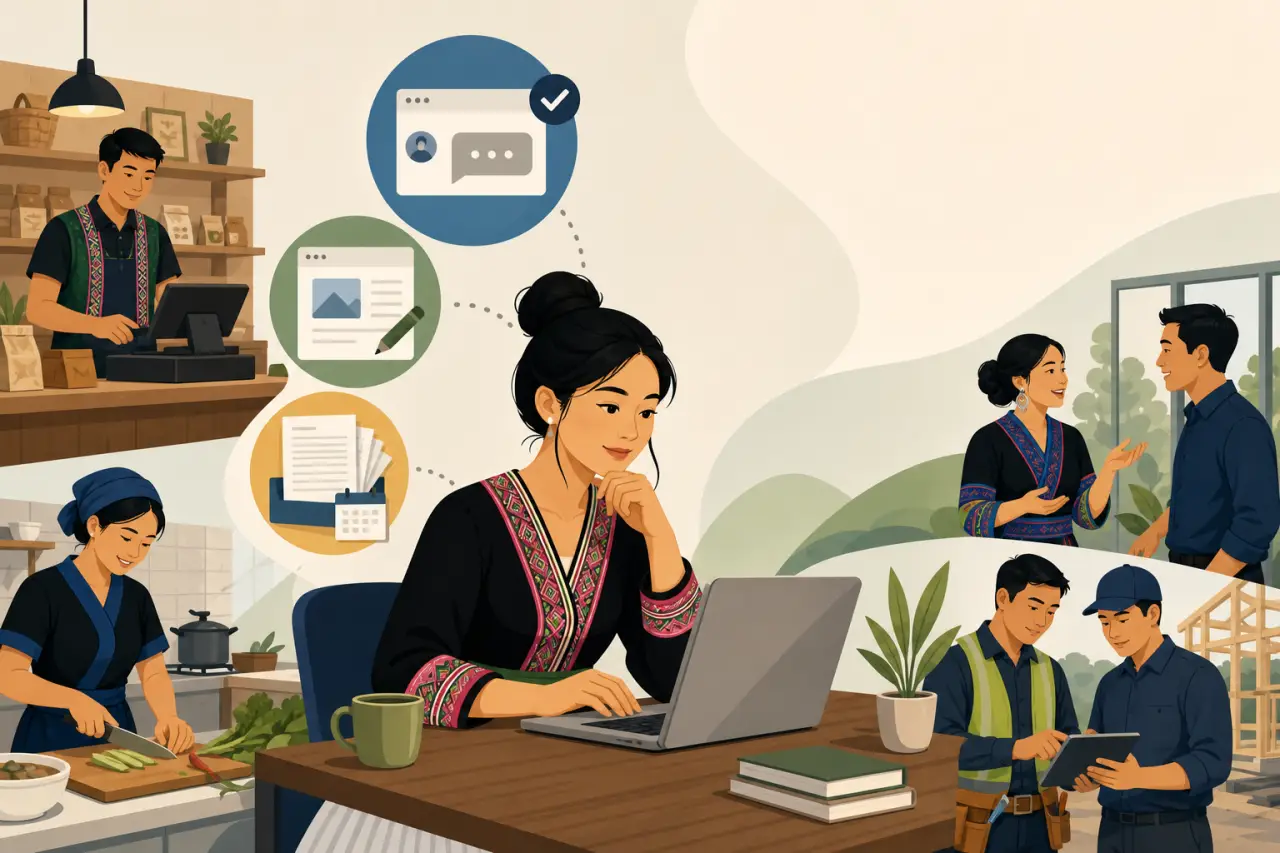
For a restaurant or food truck, this looks like turning a rough list of ingredients and a price into a menu description that reads well online, or drafting a reply to a Facebook Messenger question about catering minimums that you've answered fifty times before. For a salon or a home services business, it's writing the appointment-confirmation text, or turning "we do brakes, oil changes, and alignments" into a services page that actually says something.
For anyone running a booth at a community event or selling through a marketplace listing, it's turning a photo and a short note into a product description that doesn't sound like every other listing next to it. None of these are dramatic. They're the small, unglamorous writing tasks that pile up around actually running the business, and they're exactly where a fast first draft saves the most real time.
For a professional services business, like an insurance agent, a tax preparer, or someone doing web design, the repetitive task is often the intake email: explaining what documents a new client needs to bring, or what happens after they submit a form. Writing that once and having a tool adapt it slightly for each situation beats retyping the same explanation from memory every time a new client asks the same question you answered yesterday.
Some of these same owners are also starting to use an AI browser assistant in practice for the research half of the job, checking a competitor's pricing page or confirming a supplier's hours, instead of opening a dozen tabs by hand.
The pattern across all of these: you already know what you want to say, you just don't want to spend twenty minutes typing it out from scratch every time. That's the gap AI is actually good at closing.

Writing in Two Languages Without Losing the Real Meaning
A lot of Hmong-owned businesses are writing for two audiences at once: English-speaking customers finding you through search or social media, and Hmong-speaking customers who found you through word of mouth or a community group. AI tools can genuinely help here, drafting a first pass of a Hmong translation for a post, a flyer, or a text message so you're not starting from a blank page every time.
But this is also the area where a quick draft can go wrong in ways that are easy to miss if you're moving fast. General-purpose AI tools frequently get names, honorifics, clan terms, and regional dialect differences wrong, and a translated business name or a mistranslated phrase in a wedding or funeral services listing reads very differently to someone who knows the language than it does to the tool that generated it.
Treat a translation the same way you'd treat a translated legal document: useful as a starting point, never final without a native speaker reading it end to end. If you have a family member, an employee, or a regular customer who's fluent, it's worth the five minutes to have them glance over anything customer-facing before it goes out in Hmong, even if the English version got no review at all.
Turning Customer Feedback and Reviews Into Something You Can Act On
Most small business owners read reviews one at a time, as they come in, and never step back to look at them as a set. That's understandable when you're also cooking, cutting hair, or answering the phone, but it means patterns get missed. Ten reviews mentioning slow weekend service is a real signal; one review mentioning it is just one bad day.
This is a task AI genuinely handles well: paste in a batch of reviews, messages, or even notes from conversations with regular customers, and ask for the actual patterns, not a generic summary. What comes back is often more useful than what you'd notice reading them one by one, because it's not filtered through however your day happened to be going when you read them.
The same approach works on your own internal notes. If you jot down customer complaints or requests on a notepad by the register, running a month's worth through a summarizer at the end of the month can surface a request you've been hearing repeatedly without realizing it was as common as it was.
It's also worth using this on your own responses, not just customer feedback. If you're claimed on a directory listing here on Hmong Network or elsewhere, pull your last dozen review replies and ask whether they're starting to sound repetitive or defensive. Owners who reply to every review the same templated way, even when the review is glowing, are missing a chance to actually sound like a person, and a quick pattern check catches that faster than rereading them yourself.
Using AI for the Marketing Tasks You Keep Putting Off
Social media and email marketing are the first things to get dropped when a small business gets busy, not because owners don't value them, but because writing a caption or a newsletter takes real focus that's hard to find between customers. This is where a fast draft matters most, because the alternative for most owners isn't a polished post, it's no post at all.
Give an AI tool the bones of what happened this week (a new dish, a holiday hours change, a new product) and ask for three short caption options. Picking the best of three and tweaking it takes two minutes. Writing three options from scratch takes twenty. That difference is the entire reason this is worth doing.
The same goes for a monthly email to your customer list, an event flyer, or the description on a listing here on Hmong Network. None of these need to be perfect on the first try. They need to exist, on a schedule, which is the actual bar most small businesses are failing to clear, not a bar of literary quality.

Keep a Human in the Loop, Every Time
AI-drafted content is a starting point, not a finished product, especially for anything customer-facing. A wrong detail, like a price, an hour, an ingredient, or a policy, damages trust more than a slightly clunky sentence ever would, and these tools will state a wrong detail with exactly as much confidence as a correct one. Read everything before you send it, every time, not just when something feels off.
This matters most for the messages carrying real consequences:
- a quote for a job
- a cancellation policy
- an allergy or ingredient question
- anything with a dollar amount or a date attached
Those are worth a careful read even when you're rushing, because the cost of a mistake there is a lost customer or a refund, not just an awkward sentence.
The businesses getting real value out of these tools treat them like a fast first draft, not a decision-maker. Use the tool to get from a blank page to something workable in under a minute, then apply the judgment only you have about your own customers, your own prices, and your own reputation in the community. That judgment is the part of the business no tool replaces, and it's also the part your customers are actually trusting when they choose you over a stranger's listing.
What AI Still Can't Do For Your Business
It's worth being honest about the limits, because the businesses that get burned by AI are usually the ones that expected it to do more than write and summarize. It can't:
- taste your food
- cut hair
- fix a car
- sit with a grieving family planning a funeral
It doesn't know your regular customers by name, and it has no idea that the woman who calls every Tuesday always asks about her usual order before she says anything else.
It also can't build the kind of trust that gets a Hmong-owned business recommended at a wedding, a funeral, or a New Year gathering, which is still how a large share of these businesses actually get new customers. That trust is built one interaction at a time, by a person, and no draft a tool generates substitutes for showing up and doing the work well.
There's also a shift starting on the customer's side of this, not just yours: AI shopping agents coming for customers are beginning to do some of the comparing and research a customer used to do by hand, which is worth knowing about even if it doesn't change anything you do this week.
So the honest way to think about these tools is as a way to buy back time on the writing and summarizing tasks that were eating into the hours you'd rather spend doing the actual work of the business, whether that's cooking, building, advising, or being present with customers. It's a time tool, not a trust tool, and confusing the two is where businesses get into trouble.
A Simple Way to Start This Week
Pick one repetitive task, not five:
- the reply you type most often
- the description you rewrite for every new item
- the monthly review pile you never quite get to
Try an AI tool on that single task for two weeks and see if it actually saves time once you factor in the reading and editing you still need to do.
If it does, keep it and add a second task. If it doesn't, drop it and try something else. There's no prize for using more AI tools than the business next door; there's only a real question of whether a given tool gives you back time you can spend on the parts of the business that actually need you, whether that's the counter, the kitchen, the job site, or a conversation with a customer who came in because someone they trust sent them your way. And if the bigger issue isn't which tool to use but how your day gets eaten no matter what, a system for reclaiming your time is worth building alongside whatever you pick here.
Questions people ask
What kind of AI tasks actually save a small business owner the most time?
Start with repetitive tasks you already do the same way multiple times per week, like drafting replies to common customer questions, writing product descriptions from bullet points, or summarizing customer feedback. These small time-savings add up faster than one impressive-sounding automation that takes months to set up. Pick one task, get comfortable with it, and only add a second tool once the first has earned its place in your routine.
How should I handle AI translations for Hmong customers?
Treat AI translations as a starting point, never final. General-purpose AI tools frequently get names, honorifics, clan terms, and dialect differences wrong. Have a fluent family member, employee, or regular customer glance over anything customer-facing in Hmong before you send it out, even if the English version got no review. It's worth five minutes to protect your reputation.
What mistakes do small businesses make when using AI for customer-facing content?
The biggest mistake is treating AI drafts as finished products. Wrong details like prices, hours, ingredients, or policies damage trust more than awkward sentences. Always read everything before sending it, especially messages with dollar amounts or dates. AI states wrong details with the same confidence as correct ones, so human judgment is essential every time.
Can AI build trust with customers for my Hmong-owned business?
No. AI is a time tool, not a trust tool. It can draft messages and summaries, but trust gets built one interaction at a time by a person showing up and doing good work. That trust—the kind that gets you recommended at weddings, funerals, and community gatherings—is what no tool replaces. Use AI to buy back time so you can spend it where it actually matters.
Written by
Hmong Network Team
Directory & Digital Services
We run the Hmong Network directory and do the web design and SEO/AEO work behind the results in our case studies. These guides come out of that same hands-on work with Hmong-owned businesses — not secondhand research.
