

AI Shopping Agents Are Coming for Your Customers — Here's How to Be Ready
TL;DR
A growing share of searches now get answered by an AI agent instead of a results page, and those agents can only recommend what they can clearly read. Making your hours, menu, and services plain, structured, and consistent everywhere is how you show up when a customer never opens a browser tab at all.
The Search Box Is Turning Into a Conversation
When someone asks an AI assistant where to get Hmong food in St. Paul, or which shop does alterations near them, that answer used to be ten blue links and a map. Increasingly it's a single direct recommendation, sometimes with no click at all. Some of these tools go a step further and actually try to complete the task themselves, like starting a booking or placing an order on the customer's behalf, without a human ever browsing a website in the traditional sense.
This isn't a reason to panic, and it isn't really a new skill to learn from scratch. It's the same fundamentals that already make you show up in regular search and on Google Maps, done a little more rigorously, because an AI agent has zero tolerance for guessing. A person can squint at a blurry photo of a handwritten sign and figure out you're open Saturdays. An agent either finds a clear, plain-text answer, or it quietly recommends the next business on the list instead.
You don't need to know how any specific AI tool works under the hood to prepare for this, and you shouldn't chase every new app that shows up in the news — though it can help to see an AI browser assistant in practice to get a feel for what these tools actually do. What stays true across all of them is simple: they're reading text, checking whether it's consistent across sources, and rewarding whichever business made that easy. That's a fixed target you can actually hit, even as the tools themselves keep changing.
Why This Hits Word-of-Mouth Businesses Differently
A lot of Hmong-owned businesses have historically gotten by on something an algorithm can't see: a customer's aunt telling her the good place for paj ntaub, or a regular vouching for a mechanic in a community Facebook group. That reputation is real and it still matters, but it lives in conversations, not in any format a shopping agent can read. The business that's been trusted in the community for fifteen years and the one that opened last month look identical to an AI agent if neither has clear, structured information anywhere online.
That's actually good news if you treat it as a leveling opportunity rather than a threat. You don't need a marketing budget or a big following to be agent-ready — you need your hours, your menu, and your services written down clearly in a couple of the right places. A small, well-documented business can out-rank a much bigger one that never bothered to fix a wrong phone number on its Google listing.

What 'Agent-Ready' Actually Means in Practice
Keep your hours, address, phone number, and what you actually sell stated in plain text somewhere a machine can read it — not buried inside a photo of a menu board or a PDF flyer, which most AI tools still can't parse reliably. If your hours change seasonally, or you close early on Hmong New Year weekend, that needs to be written down too, not just something regulars happen to know.
Structured data — the behind-the-scenes markup that tells a machine 'this is a business, this is its price range, this is its rating, these are its hours' — matters more here than almost anywhere else, because it's literally built for machines to parse rather than for humans to read. A listing on a platform like Hmong Network already carries this kind of structured markup automatically; if you also run your own website, ask whoever built it whether that same markup is switched on there too.
Just as important: keep that information consistent everywhere it appears. An AI agent comparing your listing against a competitor's will quietly favor whichever one is complete, accurate, and doesn't contradict itself across different sites — the same trust signal a human customer uses, just checked automatically and instantly, across every source at once instead of just the one they happened to click on. It's the same groundwork behind outranking bigger competitors in traditional search results, just applied with less room for a human's benefit of the doubt.
Categories and tags matter too
One more thing worth stating plainly: category matters as much as content. If you're a Hmong grocery store but your listing is filed only under a generic 'retail' category somewhere, an agent looking for Hmong-owned businesses specifically, or for a place that sells a particular ingredient, may never surface you at all. Pick every category and tag that honestly applies to what you sell, not just the broadest one.
Where Your Information Quietly Contradicts Itself
Most small businesses have their basic information scattered across four or five places without realizing it: a Google Business Profile, a Facebook page, maybe a Yelp listing, a directory listing like the one on Hmong Network, and sometimes an old website nobody has touched in a year. Each one was probably filled out at a different time, by a different person, in a hurry.
The mismatches are usually small and easy to miss if you're not looking for them on purpose:
- Google says you close at 8, your website still says 9 from before you shortened your hours.
- Facebook lists an old phone number after you switched carriers.
- Your directory listing says 'cash only' even though you've taken cards for two years.
A human customer might shrug and call to check. An AI agent doesn't call — it either picks the version it trusts most, or it hedges and doesn't recommend you confidently at all, because it can't tell which answer is true.
Set aside twenty minutes and pull up every place your business appears online, side by side, and just read the hours, address, and phone number out loud. It's a tedious task, but it's the single highest-leverage thing you can do this month, and it costs nothing.
The Menu-as-Photo Problem
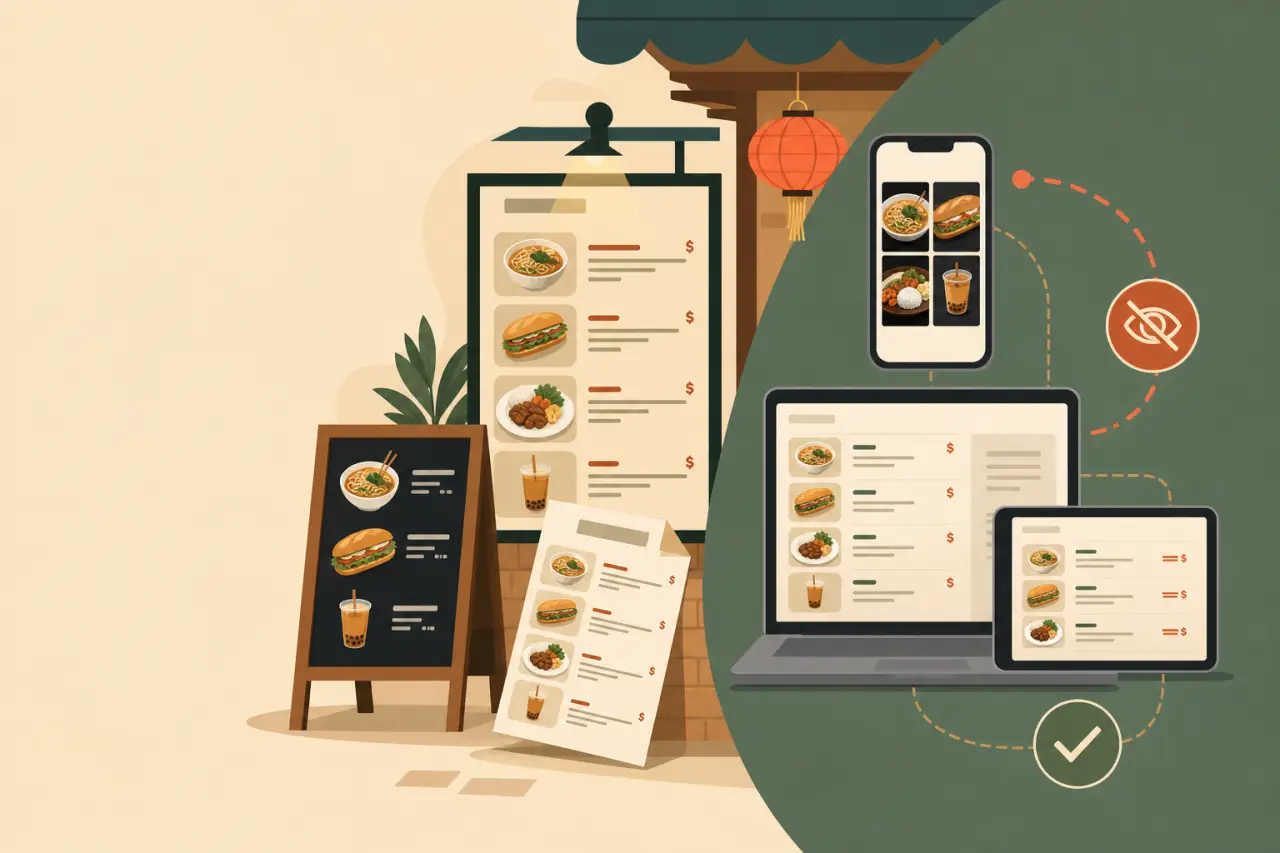
This is the single most common gap for restaurants, food trucks, and any business whose 'menu' is really a list of items and prices. A photographed menu board, a scanned PDF, or a carousel of Instagram photos looks perfectly normal to a customer scrolling on their phone. To most AI agents today, it's effectively invisible — there's no reliable way for them to read prices or dish names out of an image.
The fix isn't to abandon the photos, which people genuinely like browsing. It's to also have the same information somewhere as actual text: item names, short descriptions, and prices typed out, either on your own site or in your directory listing's product or menu section. If you sell physical goods rather than food — vendors, seamstresses, home goods sellers — the same logic applies to your product listings: a name, a price, and a plain description for each thing you sell, not just a photo with a caption.
This matters even for dishes or items that are hard to translate simply. If a dish name is in Hmong and doesn't have a clean English equivalent, write a short plain-language description next to it anyway — what it is, what's in it, roughly how spicy or how it's served. An agent that can't confidently describe a dish to a customer usually won't recommend it at all, even if it's your best seller.
Answering the Questions an Agent Gets Asked on Your Behalf
When someone asks an AI assistant to find them a place, the follow-up questions are usually the practical ones: does it have parking, is it kid-friendly, do they take walk-ins or is it appointment-only, is there a vegetarian or halal option, how long is the wait usually. A customer would normally just show up and find out, or call and ask. An agent researching on their behalf needs that answered somewhere in text before it will confidently suggest you over a competitor who already answered it.
The simplest way to close this gap is a short, honest FAQ section wherever your listing lives — three to six real questions your own customers actually ask you, answered in plain sentences.
- Do you accept walk-ins.
- Is there street parking or a lot.
- Do you deliver, and how far.
- Is it cash-only or do you take cards.
These are small details you might not think to advertise because they feel obvious to you, but they're exactly what an agent is trying to confirm before it recommends you.
When the Agent Tries to Actually Book or Buy Something
Some AI tools are starting to go beyond recommending and try to complete simple tasks directly — starting a reservation, adding an item to a cart, or filling out a booking form on a customer's behalf. This part of the shift is newer and less settled than search itself, and most small businesses don't need to build anything special for it yet — though it's worth knowing where AI actually saves time elsewhere in your day-to-day, since that's a related but separate question from what's covered here. What actually helps is making sure the booking or ordering process you already have is simple and doesn't depend on a phone call as the only option.
If the only way to book an appointment or place an order is to call during business hours, an agent working on a customer's behalf at 11pm hits a dead end and moves on. A basic online booking or contact form, even a simple one, at least gives an agent — and a human customer — something to act on immediately instead of waiting for you to pick up the phone. You don't need a complicated online store to benefit from this; you need one clear, working way to start a transaction without a live conversation being required first — the kind of small, practical upgrade covered in tech tools that move the needle.
A Simple Monthly Habit to Stay Ready
This doesn't have to become a recurring project. Once your hours, menu, and FAQ are written down accurately in text, most of the work is just noticing when something changes and updating it everywhere at once, not just in the one place you remembered.
A useful habit: whenever you change your hours, your prices, or what you offer, make a short list of every place that information lives, and update all of them in the same sitting, rather than fixing one and meaning to get to the rest later:
- Your Google Business Profile
- Your directory listing
- Your website
- Your Facebook page
Once a month, spend five minutes checking that your listed hours match what's actually posted on your door. That single small habit is most of what it takes to stay visible as more of your customers start their search with a question instead of a click.
 Claim your free business listingFree forever — no credit card required.
Questions people ask
What do I need to do to show up when AI assistants search for my business?
Keep your hours, address, phone number, and what you sell written as plain text online, not just in photos. Make sure that information is consistent across every place it appears — Google, your website, your directory listing, Facebook. An AI agent checks all those sources at once and favors whichever business has complete, accurate, consistent information.
Why does it matter if my menu is just photos?
Most AI agents today can't read text out of images reliably. If your menu only exists as a photo of a board or an Instagram post, an agent can't confidently describe dishes to customers or see prices. Write your menu items, prices, and descriptions as plain text somewhere online — your website, a directory listing, or anywhere customers can find it.
What kind of details should I put in an FAQ section?
Answer the practical questions customers actually ask you: Do you take walk-ins. Is there parking. Do you deliver. Do you accept cards or cash only. These details feel obvious to you, but an AI agent needs them answered in text before it will confidently recommend you over a competitor.
If my only way to book an appointment is by phone, will that hurt me?
Yes. If someone uses an AI agent to book at 11pm and the only option is to call during business hours, the agent hits a dead end and recommends a competitor instead. Add a basic online booking form or contact form so customers and agents can start a transaction immediately without waiting for a phone call.
Written by
Hmong Network Team
Directory & Digital Services
We run the Hmong Network directory and do the web design and SEO/AEO work behind the results in our case studies. These guides come out of that same hands-on work with Hmong-owned businesses — not secondhand research.
