
What Makes the Hmong Community Feel Like Family
TL;DR
Hmong community life runs on a wider definition of family than bloodline alone — clan ties, naming ceremonies, and decades-long habits of mutual aid turn neighbors, in-laws, and even strangers into people you're expected to show up for.
Family as a Circle, Not a Bloodline
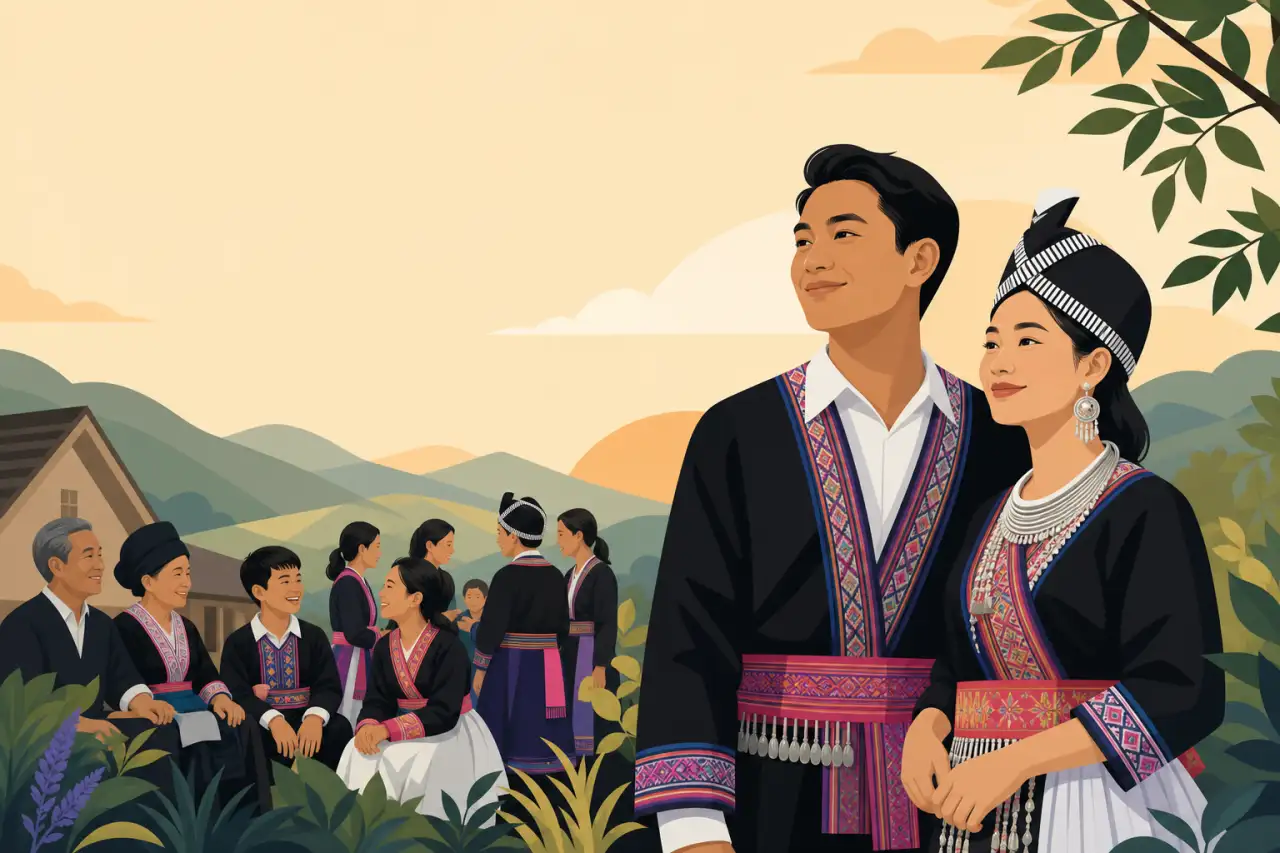
In many Hmong communities, being part of the family is not strictly a matter of birth. It's common for someone who marries in, is adopted, or simply becomes close enough to a household to be given a Hmong name and folded into that family's clan, or xeem — a gesture that carries real weight, not a symbolic one. From that point on, they're treated as family in the fullest sense: included in celebrations, expected at gatherings, and supported the same way a blood relative would be.
The naming itself usually happens through a soul-calling ceremony, hu plig, performed by an elder or shaman who welcomes the new person's spirit into the household and clan. It's not a paperwork formality — it's the moment the relationship becomes real in the eyes of everyone present, and from then on the new family member is introduced by their clan name at every future gathering, not by their original last name or their relationship to whoever brought them in.
That openness is part of what makes the community durable. Clans and extended families function as a built-in support network, one that shows up for weddings and funerals alike, and one that a newcomer can be welcomed into rather than permanently kept outside of. A son-in-law who gets folded into his wife's clan network, or a longtime family friend who's given a name after years of showing up, isn't a guest at the next funeral or New Year gathering — he's expected there, and missing it without a good reason gets noticed.
Showing Up, in Good Times and Hard Ones
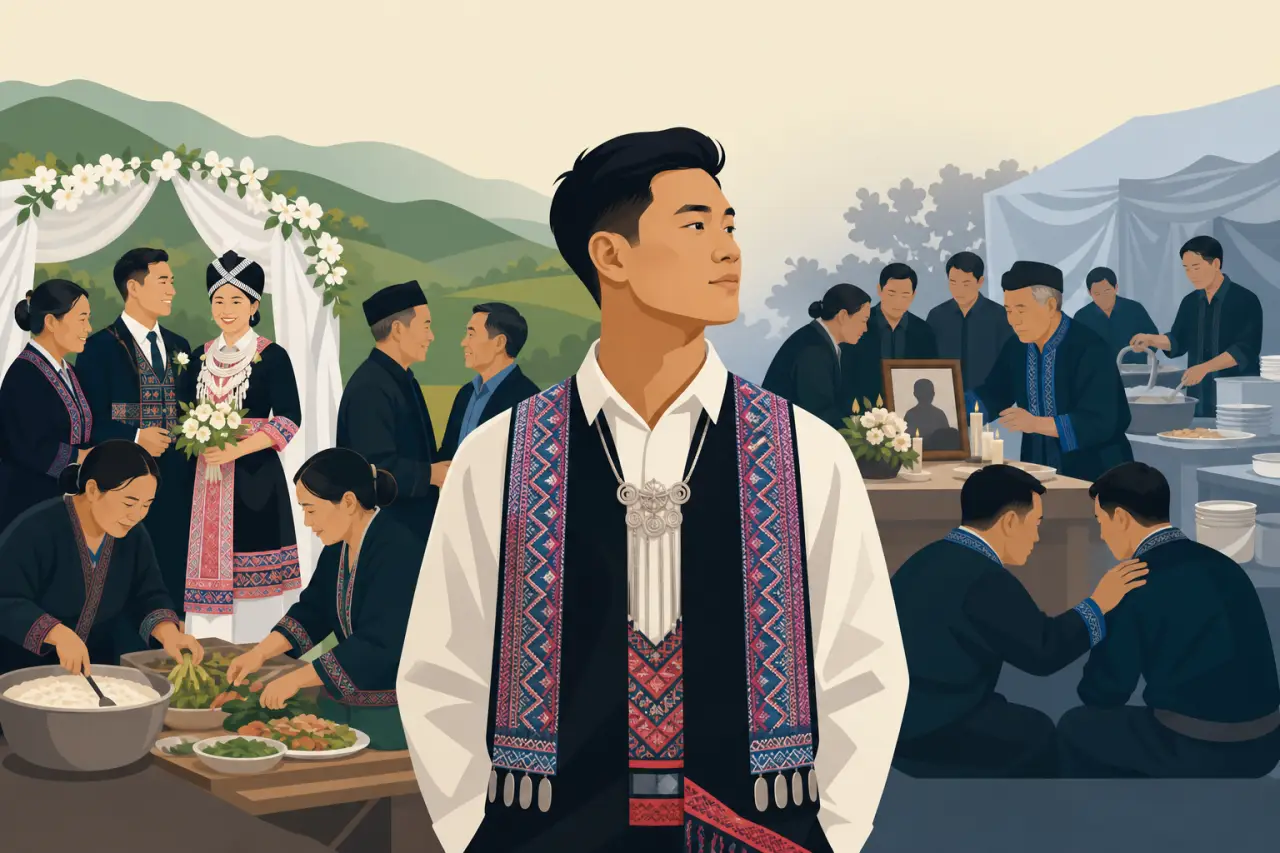
The clearest way to see Hmong community values in practice is to watch how people respond to both celebration and crisis. A wedding pulls in far more people than the immediate couple — parents from both sides, uncles who negotiate the nqi tshoob (the traditional wedding costs discussed between families), cousins who cook for two days straight, and clan elders whose presence at the negotiation table is what makes the marriage recognized within the community, not just legally married on paper.
A death pulls in just as many people, often more. Hmong funerals can run several days, with extended family and clan members arriving from other states to help with everything from cooking for hundreds of guests to taking overnight shifts so the deceased is never left alone before burial. Someone in the family calls the clan leaders first, not last, because a funeral of that scale isn't something one household can pull off alone — it runs on people arriving, without being asked twice, to fill whatever role needs filling.
The same instinct shows up in smaller, quieter ways too:
- A meal train that starts the day someone comes home from surgery
- A group chat that turns into a moving crew when a family loses their apartment
- A collection passed around at a funeral to help cover costs before anyone even has to ask directly
No one keeps a formal ledger of who helped whom — the expectation is just that no one carries a hard season alone, and that you'll be there for someone else's hard season eventually too.
The Clan System as Practical Infrastructure
Outside the community, the clan system can look like a genealogy chart — eighteen or so surnames (Vang, Lee, Yang, Xiong, Thao, Moua, and others) that trace back generations. Inside the community, it functions more like an operating system for daily life. If a family is negotiating a marriage, planning a funeral, or trying to resolve a serious dispute, the first move is almost always to bring in clan leaders — respected elders within that surname group — rather than handle it alone or take it to an outside authority.
That matters practically, not just symbolically. A clan leader's role in a wedding negotiation is to make sure both families feel the terms are fair before anything is finalized. A clan leader's role in a conflict between two households is to sit both sides down and mediate toward an outcome everyone can live with, because an unresolved rift between two families can ripple through an entire extended network for years. This is why, when something serious happens in a Hmong family, one of the first questions is often "who's the clan leader on this side, and have we called him yet" — it's the actual first step, not a ceremonial afterthought.
This structure also means a Hmong person rarely walks into a major life event without backup. Moving to a new state, starting a business, or even just needing someone to vouch for you often starts with the same question: who's your clan, and who do you know through it. It's less about pedigree and more about which network of people already has an obligation to help you succeed.
How Support Actually Moves: Time, Money, and Labor
Mutual aid in the Hmong community rarely shows up as a formal program. It shows up as:
- Cash handed over in an envelope at a wedding or funeral
- An aunt who shows up with a car full of groceries the week a baby is born
- A dozen relatives who take a Saturday off to help pour concrete for a cousin's new restaurant instead of hiring a contractor
None of it is tracked on a spreadsheet, and that's part of the point — it's not a loan with terms, it's a long-running relationship where help flows in whichever direction is needed at the time.
Medical bills and funeral costs are where this shows up most visibly. When a family is hit with an expense they can't absorb alone, it's common for word to move through the clan and extended family network, with people contributing what they can — five dollars from one person, five hundred from another — until the number that seemed impossible for one household gets covered by dozens of small contributions. The same thing happens, on a smaller scale, when a family member is trying to get a small business off the ground: relatives cook for the opening, show up as the first customers, and tell everyone they know, because a struggling family business reflects on the whole extended network, not just the person whose name is on the door — the same instinct behind why — and how — to support Hmong-owned businesses even once the customer isn't family at all.
The reciprocity isn't immediate or one-to-one. Someone who receives help at a funeral this year might be the one organizing a collection for someone else's medical bill three years from now. The system works because people trust that it evens out over a lifetime, not because anyone is keeping score in the moment.
Elders and the Weight of Guidance
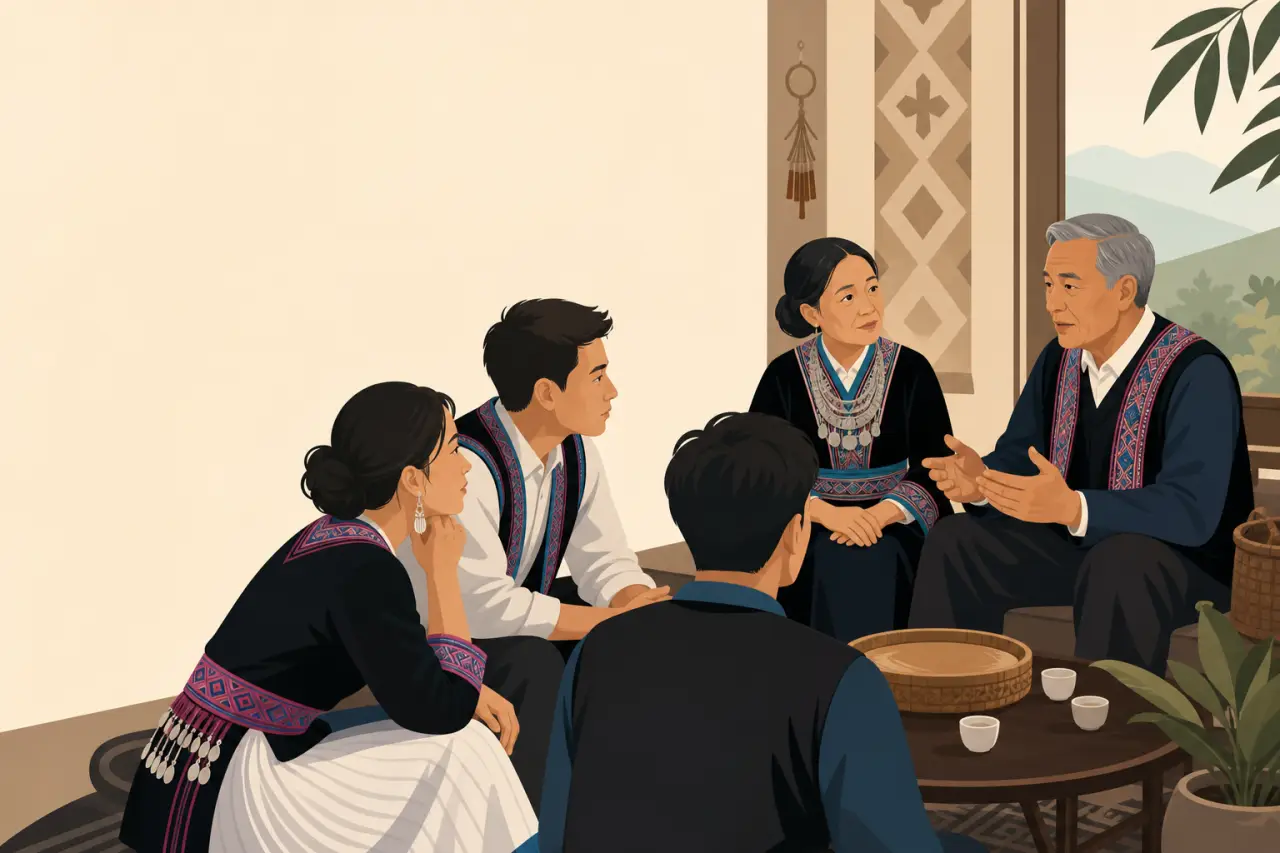
Respect for elders isn't an abstract value in Hmong households — it shapes who gets consulted before big decisions get made. A young couple planning a wedding, a family considering a major move, or someone weighing whether to leave a stable job to start a business will often talk to parents and elders first, not because they need permission exactly, but because an elder's blessing and practical input carry real weight, and going around them can strain the relationship in ways that outlast the decision itself.
That guidance isn't always gentle, and it isn't always what a younger family member wants to hear. Elders are often the ones asking the hard questions before anyone else will:
- Whether a new business idea is realistic
- Whether a marriage match is being rushed
- Whether a family can actually afford the funeral or wedding costs being discussed
Their role is partly ceremonial (presiding over negotiations, leading rituals) and partly just practical experience: they've usually seen a version of whatever situation the family is facing play out before, in their own generation or the one before it.
For younger Hmong Americans balancing this with more individualistic norms around independence and personal choice, the tension is real and doesn't always resolve cleanly. But even families who've moved away from strict deference to elders on personal decisions still tend to keep them in the loop on the big communal ones — weddings, funerals, and anything that touches the wider clan — because those events aren't really private in the way a lot of American culture treats major life milestones.
Where Business and Community Overlap
Most Hmong-owned businesses don't start from a cold customer base — they start inside the same network that shows up for weddings and funerals. A new restaurant's first month of customers is often family, clan members, and church or temple connections before it's anyone unrelated. A new insurance agent, real estate agent, or salon owner builds their client list the same way: through people who already trust them because of who their parents are, which clan they belong to, or which community events they show up to.
That overlap cuts both ways. It means a Hmong-owned business can get real traction fast through word of mouth inside a tight community — but it also means the business's reputation is tied to the family's reputation in a way a business without those ties doesn't have to think about. Treating a customer poorly, or falling short on a promise, doesn't stay contained to a single bad review; it's the kind of thing that gets discussed at the next family gathering, because the customer and the business owner are likely to run into each other there.
Community events function as real infrastructure for these businesses too, not just cultural touchpoints. Hmong New Year celebrations, church and temple gatherings, and Hmong arts and crafts fairs are often where small business owners set up booths, hand out cards, and pick up new customers directly — the kind of grassroots marketing reach that would otherwise cost real advertising dollars to build. A caterer, a clothing vendor, or a photographer who shows up consistently at these events over a few years builds a reputation that a paid ad campaign alone couldn't replicate, because it's backed by the same trust the rest of the community runs on.
Staying Connected Across a Scattered Map
Hmong families in the U.S. are spread across states in a way that makes staying close to family require real effort — Minnesota, Wisconsin, California, and pockets of Oklahoma, North Carolina, and Georgia all have significant Hmong populations, often because one family or a small group settled somewhere first and pulled relatives out to join them over the following years. It's common for someone's closest cousins, in-laws, or even siblings to live several states away, which means the mutual support described above doesn't happen automatically just because people live nearby — it has to be maintained on purpose.
Phone calls, group chats, and now video calls carry a lot of that weight day to day, but they don't replace the expectation of physically showing up for the events that matter most. It's not unusual for extended family to drive eight or ten hours, or fly across the country, for a funeral or a major wedding, because those events are exactly where the clan network reaffirms itself in person. Missing one without a serious reason isn't just missing a party — it reads as stepping back from the obligations that come with being part of the family circle.
Community organizations — Hmong mutual assistance associations, churches, temples, and cultural centers in cities with sizable populations — help bridge the distance in a more structured way, organizing New Year celebrations, funeral support, and events that give people scattered across a metro area, or flying in from another state, a place to reconnect. For a lot of families, these organizations are the closest thing to a hometown they have left — in the Twin Cities, that hometown feeling has a literal address, since the Hmong Village marketplace in St. Paul draws relatives back most weekends the same way a hometown storefront once did, even for people who now live states away.
Teaching the Next Generation to Stay Inside the Circle
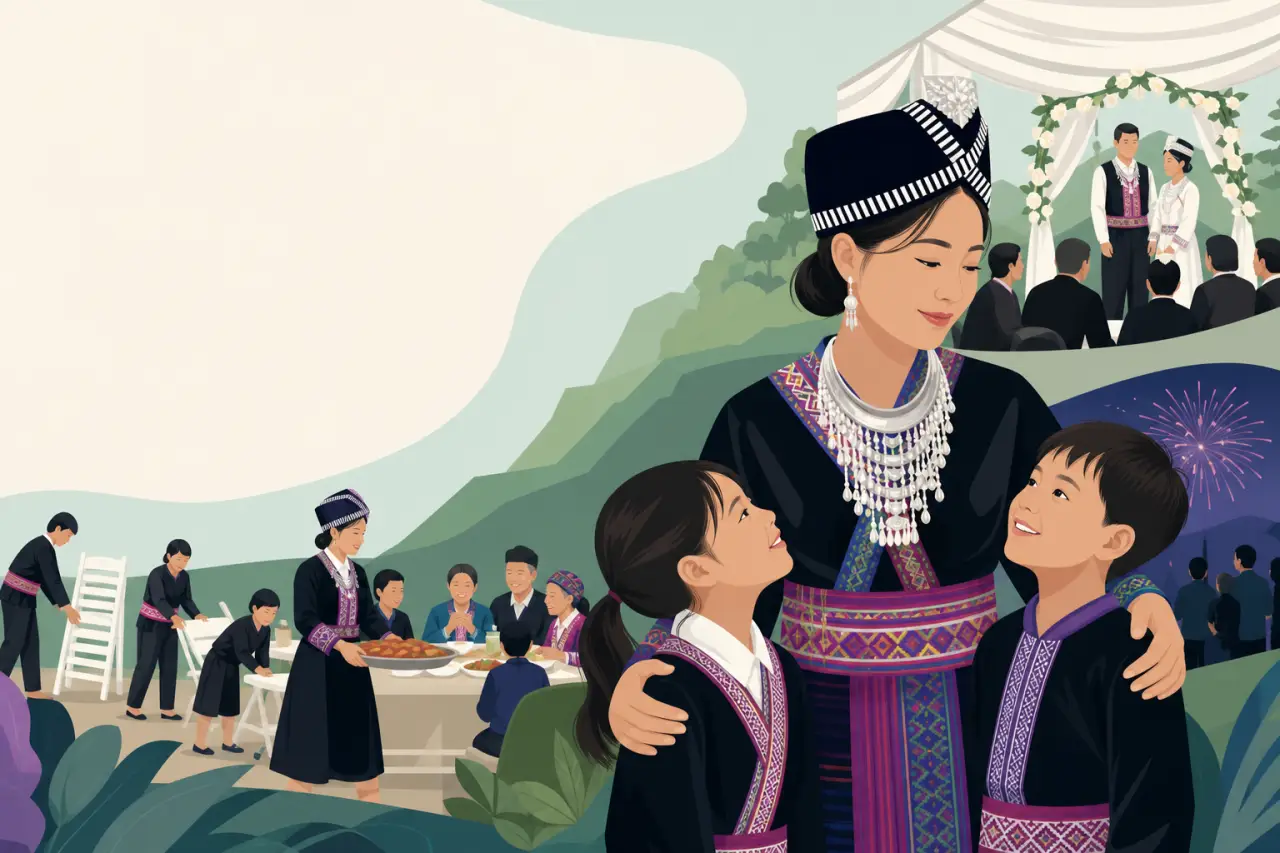
Passing these values down doesn't happen through a single conversation — it happens through repetition, by bringing kids to every funeral, wedding, and New Year celebration long before they understand what any of it means, so that showing up becomes instinct rather than an instruction they're given later. Kids who grow up helping set up chairs, running food between tables, and sitting through hours of ceremony they don't yet follow are absorbing the expectation that this is simply what family does, the same way they absorb language.
Language itself is often where the tension between generations shows up first. Many younger Hmong Americans understand more than they speak, and plenty of families have had the experience of a grandparent and grandchild needing a parent to translate between them. Communities that have managed to keep the language alive tend to do it the same way they keep everything else alive — through consistent, unglamorous repetition:
- Hmong-language classes at community centers
- Elders who insist on speaking Hmong at home even when kids answer in English
- Cultural programs built specifically to give younger people a reason to want to hold onto it
The younger generation is also renegotiating some of these obligations rather than rejecting them outright:
- Questioning arranged elements of wedding negotiations
- Taking more say in who they marry and when
- Building careers and businesses on their own terms rather than strictly the ones their parents expected
But most still keep the core habit intact: they show up for the family, contribute when someone needs help, and pass the same expectation on to their own kids, even while the specific traditions around it keep shifting from one generation to the next. That kind of steady adaptation without abandonment is itself part of a longer pattern — fifty years of Hmong American resilience since resettlement, with each generation renegotiating just enough to keep the core of it intact.
Questions people ask
What does it mean when someone gets given a Hmong name and joins a clan?
It means they've been formally welcomed into a family or clan through a soul-calling ceremony, hu plig, performed by an elder. From that point on they're treated as a full family member — included in all celebrations, funerals, and gatherings — and introduced by their clan name instead of their original last name. It's a real relationship change, not just symbolic.
How do Hmong families usually handle big expenses like funerals or medical bills?
Word moves through the clan and extended family network, and people contribute what they can — sometimes five dollars, sometimes hundreds — until dozens of small contributions cover what one household can't absorb alone. No one keeps formal track. The system works because people trust that help flows in whichever direction is needed over a lifetime.
Why would someone travel across the country for a Hmong funeral or wedding?
These events are where the clan network reaffirms itself in person. Extended family scattered across different states see them as non-negotiable — missing one without a serious reason reads as stepping back from the obligations that come with being part of the family circle.
How do most Hmong-owned businesses get their first customers?
They start inside the same network that shows up for weddings and funerals — family, clan members, and church or temple connections. This means the business reputation is tied to the family reputation. Bad treatment of a customer doesn't stay private; it gets discussed at the next family gathering.
Written by
Hmong Network Team
Directory & Digital Services
We run the Hmong Network directory and do the web design and SEO/AEO work behind the results in our case studies. These guides come out of that same hands-on work with Hmong-owned businesses — not secondhand research.
