
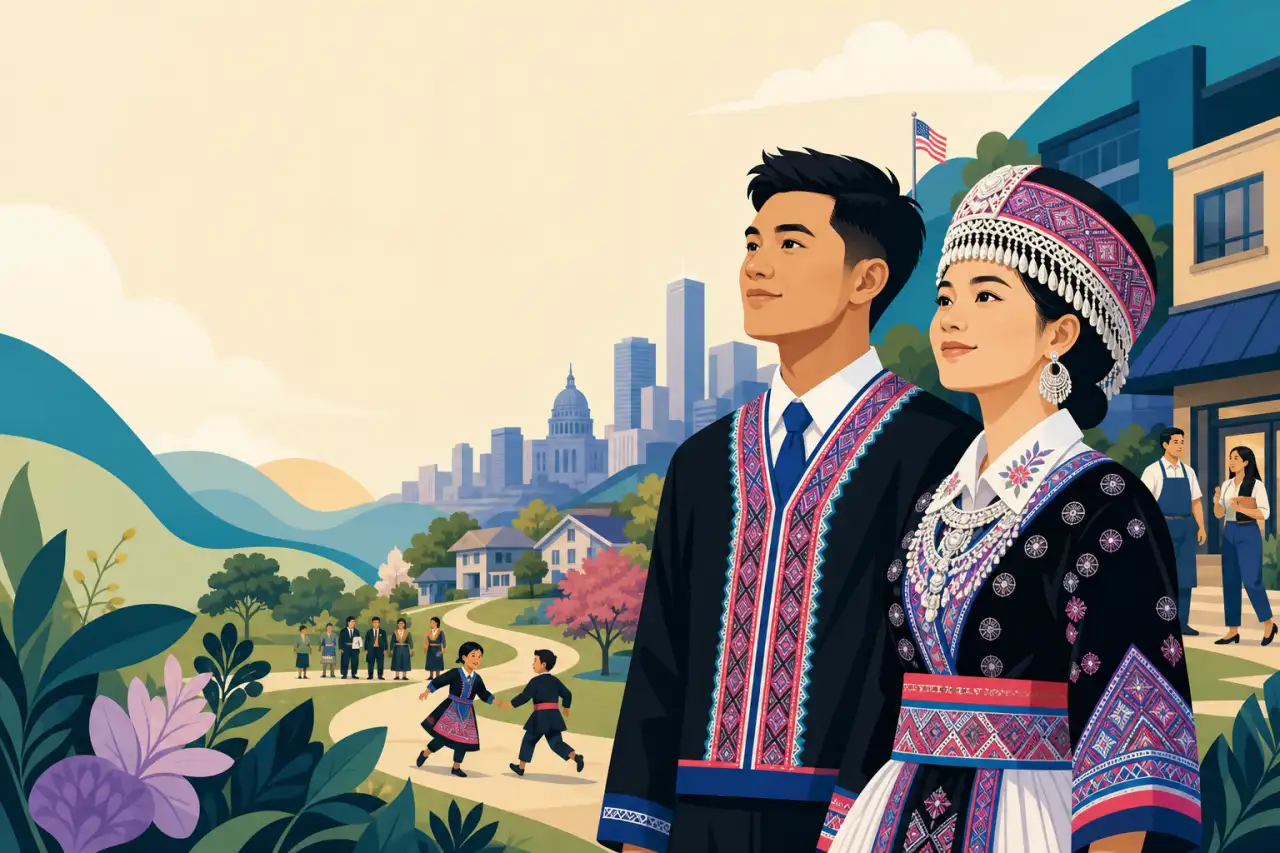
Fifty Years of Hmong American Resilience
TL;DR
Fifty years after resettlement, Hmong American communities turned displacement into deep roots, building businesses, sending kids to college, and carrying culture forward on purpose. Here is how that happened, generation by generation.
Why "Refugee," Not "Immigrant," Is Where This Story Has to Start
Hmong families didn't choose to leave Laos the way that word "immigrant" usually implies. After years of involvement in the conflict that engulfed Laos through the 1960s and into the mid-1970s, Hmong communities faced retaliation once American forces withdrew from the region. Entire villages fled on foot, crossing the Mekong River into Thailand with whatever they could carry, and spent months or years in refugee camps like Ban Vinai before resettlement to a third country became possible.
That distinction matters for understanding everything that came after. An immigrant usually has some choice in timing, destination, and what to bring. A refugee has none of that. Resettlement agencies placed Hmong families based on which churches, charities, and sponsors had space and paperwork ready — not on climate, job markets, or where extended family already lived. That's part of why the first wave of arrivals in the mid-1970s landed in places as varied as rural Montana, industrial Rhode Island, and small-town Wisconsin, often as the only Hmong family within driving distance.
Being scattered that way, with no built-in community to land in, is a detail that's easy to skip past but shouldn't be. A family arriving in a city with no one who spoke their language, no clan nearby, and no shared history with their new neighbors had to build every piece of a support system from zero — at the same time they were learning a new language, a new climate, and an entirely new way of earning a living. The years that followed were spent, in part, simply finding each other again.
The Improvised Economy of the First Ten Years
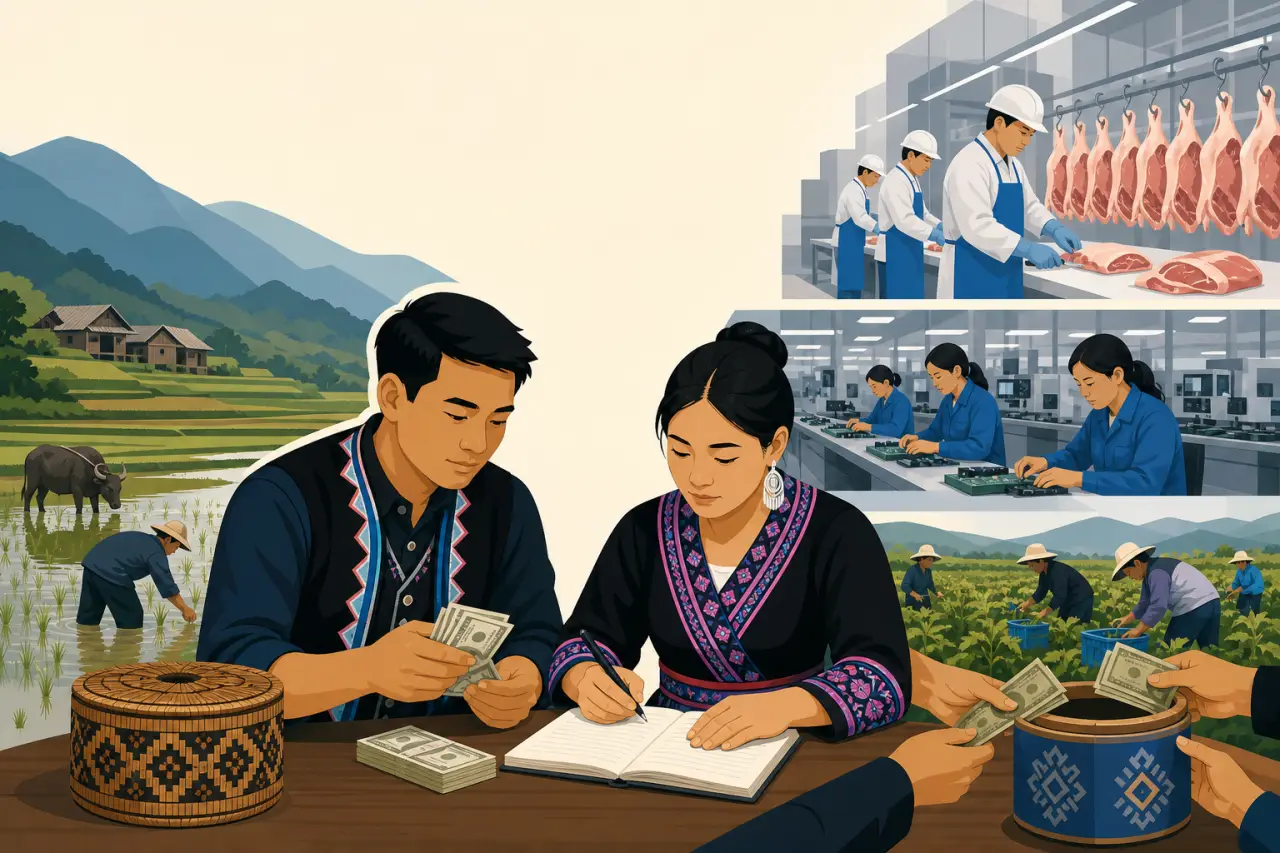
Survival work came first, and it rarely matched anyone's training or ambition. Farmers who had grown rice and raised livestock in the highlands of Laos took jobs in meatpacking plants, electronics assembly lines, and seasonal agricultural crews — work that didn't require fluent English and hired in bulk. Language was the immediate wall: reading a lease, opening a checking account, or understanding a pay stub all assumed a familiarity with American systems nobody had time to teach.
What filled that gap wasn't a bank loan — most first-generation families had no credit history and no collateral a bank would recognize. It was the clan. Extended family and clan networks pooled money the way they always had, rotating loans among households so that whoever needed capital that month — rent, a used car, a sewing machine, inventory for a small stand — could get it without paperwork or interest, on the understanding that they'd do the same for someone else later. That system didn't just move money; it moved information, too, since the same networks that lent cash also passed along which landlords wouldn't discriminate, which employer would hire without asking for perfect English, and which agency actually helped instead of stalling.
That informal credit system is where the first Hmong-owned storefronts came from:
- A small grocery stocking imported goods a mainstream store wouldn't carry
- A home sewing operation turning out embroidered textiles
- A card table at a weekend market
Children old enough to speak English became the de facto translators for business licenses and health permits, doing paperwork for a business they were too young to legally run. It was common for the person whose name was on the lease to be barely literate in English, while the person filling out the forms to get that lease was still in elementary school.
From Farmers Market Stalls to Full City Blocks
Farming was one of the few skills that transferred directly, and it's where Hmong entrepreneurship first became visible outside the community. In the Twin Cities and across California's Central Valley, Hmong farmers became fixtures at local farmers markets, building reputations stall by stall for quality produce and flowers grown on small leased plots. That visibility mattered — it was often the first sustained contact many non-Hmong shoppers had with the community, and it built a customer base that Hmong-owned businesses could later draw on for everything that came after.
From there, the range of businesses widened well past food and farming. Restaurants and food trucks came next, since cooking was another skill that needed no translation and could start small — a single cart, a folding table, a menu handwritten because there was no time or money for a printer. Then came the businesses that required navigating American licensing and regulatory systems the first generation had struggled with:
- Insurance agencies
- Real estate offices
- Auto repair shops
- Salons
- Legal and accounting services
- Eventually, web design and marketing agencies serving other small businesses in the community
That range was a sign of how far institutional knowledge had traveled in one generation.
The lending model matured alongside the businesses. What started as an informal loan between relatives became, for many families, a formally registered LLC with a business bank account, employees hired outside the family, and a second generation running day-to-day operations their parents had started from nothing. That shift — from a card table to a storefront with a lease and a sign — is one of the clearest measures of how far the community has come in fifty years, and it's a shift that's still happening today, business by business, in cities most people wouldn't think to look, proof of what Hmong-owned businesses keep getting right generation after generation.
Education Cracked Open Doors the First Generation Couldn't Reach
Schools weren't ready for Hmong students in the 1970s and 1980s, and in some real sense couldn't have been: a widely used romanized Hmong alphabet had only existed since the 1950s, and most school districts had no experience teaching a language with no prior local footprint. Bilingual education programs were built slowly, often years after the first Hmong students had already struggled through classes with no support at all, learning English by immersion because there was no other option on offer.
The children who did make it through often ended up doing double duty — not just as students, but as their family's connection to English-speaking America. It was common for a ten- or twelve-year-old to sit in on a parent's meeting with a landlord, a loan officer, or a school registrar, translating in real time for conversations that would shape the whole household's future. That responsibility, carried quietly by an entire generation of kids, doesn't show up in most accounts of this history, but it's part of what made everything after it possible — a generation that grew up fluent in two worlds because it had no choice.
College attendance climbed steadily as that generation grew up, and with it came the first Hmong doctors, lawyers, teachers, and engineers in communities that a decade earlier had no professional class of their own. Public office followed the same arc: Mee Moua's election to the Minnesota State Senate in the early 2000s, the first Hmong American elected to a state legislature anywhere in the country, was a milestone that opened the door for others to follow into city councils and school boards across Minnesota, Wisconsin, and California. That same momentum eventually reached an even bigger stage: Sunisa Lee's Olympic gold medal in gymnastics put Hmong American achievement in front of a global audience no election ever could. None of that happened because opportunity arrived on its own — it happened because a generation of parents who couldn't read an English report card were still determined that their kids would.
Carrying the Culture Forward Wasn't Automatic — It Took Deliberate Work
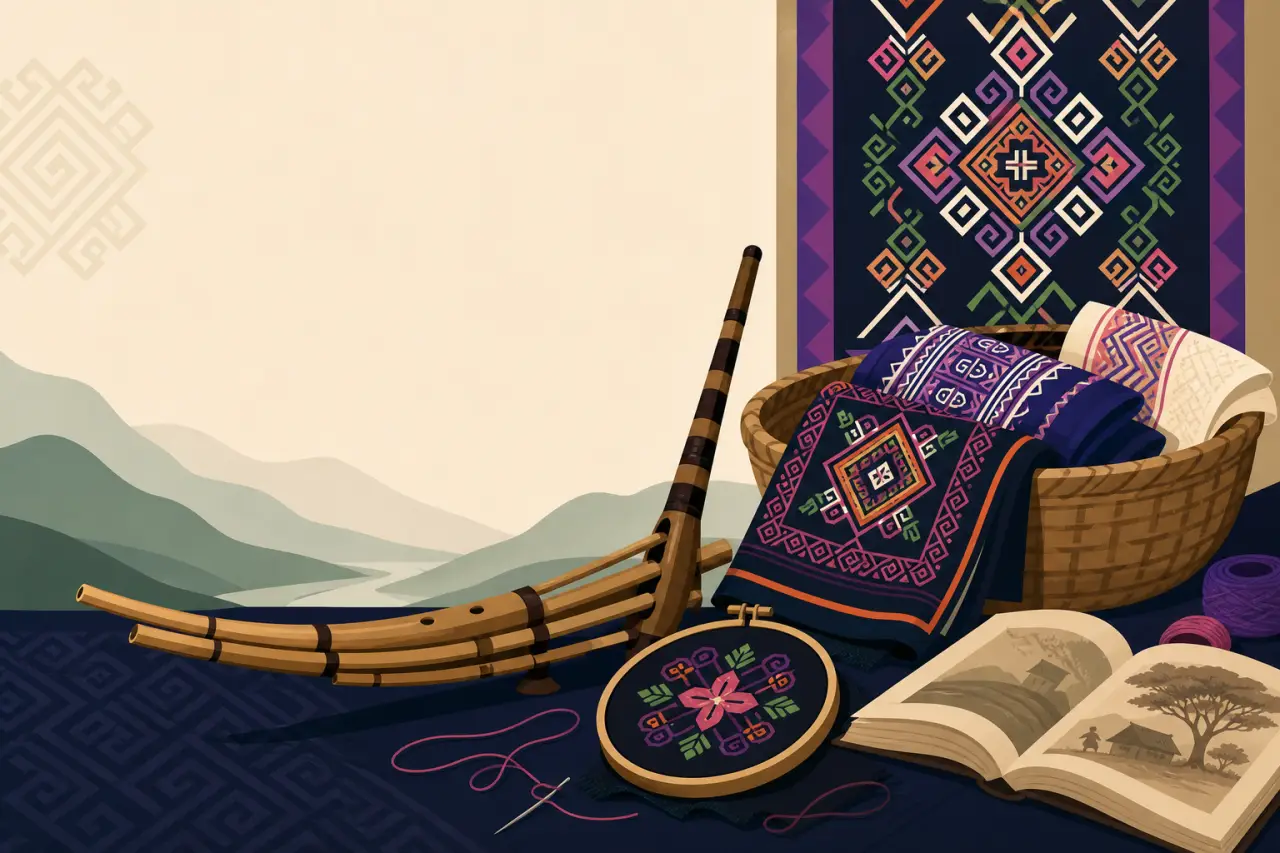
None of the cultural continuity that defines Hmong American communities today happened by accident. Paj ntaub, the intricate story-cloth embroidery traditionally made by Hmong women, was both an art form and, for many families in those first difficult years, a real source of income — sold at markets and through informal networks when there was little other work available to women who spoke limited English but had spent a lifetime perfecting a craft that didn't require it.
Music and oral storytelling carried the same weight. The qeej, a reed instrument central to ceremonial and funeral traditions, and the stories passed down through elders rather than written texts, both required someone to deliberately keep teaching them to kids who were growing up speaking mostly English and absorbing mostly American culture at school. A skill like that doesn't survive by itself across an ocean and two generations; someone has to sit down and teach it, over and over, to kids who'd rather be doing almost anything else that afternoon.
Hmong New Year celebrations are probably the clearest example of how that deliberate effort scaled up. What began as small family and clan gatherings grew, over decades, into multi-day community events drawing thousands of people — events that are now economic engines in their own right, filled with food vendors, clothing and textile sellers, and performances that double as cultural education for kids who might otherwise only encounter this history in a classroom, if at all. Language classes at community centers and colleges exist for the same reason: without deliberate effort, a language spoken fluently by grandparents can become one their grandchildren only half-understand, and a community that loses its language loses more than vocabulary — it loses the easiest way to pass everything else down.
What This History Means for Business Owners Today
The economy Hmong American entrepreneurs operate in now looks nothing like the one their parents or grandparents navigated. Formal credit is accessible in a way it wasn't in the 1970s and 80s. Digital marketing, online reviews, and searchable business directories have replaced word of mouth as the primary way new customers find a business — at least the first time. But trust still moves through the community roughly the way it always has: a recommendation from someone you know still counts for more than an ad, and a business's reputation is still built one satisfied customer, one referral, at a time — the same kind of trust that's what makes the Hmong community feel like family in the first place.
That's worth remembering for any Hmong-owned business deciding how to grow today. The families who built the first Hmong-owned storefronts didn't have a playbook — they built one, out of necessity, using clan networks and shared risk because no other option existed. Today's owners have more formal tools available:
- Business credit
- Online listings
- Marketing budgets
- Point-of-sale systems
All of that would have seemed like science fiction to a family running a card table at a weekend market. But the underlying instinct that made those early businesses work — leaning on community, extending trust to people who've earned it, and reinvesting in the next person's turn — is still the strongest asset most Hmong-owned businesses have over competitors with more capital and less community standing.
Documenting that history matters too, and not just as sentiment. Most of what the first generation built was never written down — no records, no interviews, often not even a photo of the original storefront. A business that takes the time to record its own founding story, in its own words, for its own customers, is preserving something that would otherwise disappear along with the generation that lived it. That's true whether the story gets written down for a website, told to a new employee on their first day, or simply repeated at the dinner table so a grandchild hears it before it's gone.
The Next Fifty Years Are Already Being Written
Today's Hmong American business owners are increasingly second- or third-generation, born in the United States, fluent in English, and comfortable with the digital tools — online ordering, social media marketing, e-commerce — that their grandparents never had access to. That generation includes a growing number of Hmong women entrepreneurs breaking barriers in industries their grandmothers rarely had the chance to lead. But the businesses that are thriving tend to be the ones that still carry forward what made the first generation's improvised economy work in the first place: real trust built inside the community, a willingness to help the next family get their footing, and a refusal to let the story of how they got here go untold.
That combination shows up in small, practical ways more often than dramatic ones:
- A restaurant owner mentoring a cousin who wants to open their own place
- A real estate agent explaining the process to a first-time buyer the way nobody explained it to their own parents
- An established business owner co-signing for someone starting out the way an uncle or aunt once did for them
None of it makes headlines. All of it is exactly how the last fifty years actually got built.
Fifty years after the first families arrived with almost nothing, that combination — modern tools paired with an old habit of looking out for each other — is what the next fifty years of Hmong American enterprise is being built on, one business, one referral, and one story passed down at a time.
Questions people ask
Why did Hmong families come to the United States as refugees instead of immigrants?
After the U.S. withdrew from Laos in the mid-1970s, Hmong communities faced retaliation for their involvement in the conflict. Entire villages fled on foot across the Mekong River into Thailand, spent months or years in refugee camps, and were resettled by agencies based on available sponsors — not by choice of timing, destination, or what to bring.
How did Hmong families get money to start their first businesses?
Since banks wouldn't lend without credit history or collateral, extended family and clan networks pooled money through informal rotating loans. These networks moved both cash and information, sharing which landlords wouldn't discriminate and which employers would hire without perfect English. This system funded the first storefronts and market stalls.
What role did children play in early Hmong American businesses?
Children old enough to speak English became translators for business licenses, health permits, and other paperwork. It was common for kids still in elementary school to fill out the forms for a business whose lease was in an adult's barely-literate name — doing business work they were too young to legally run.
How did Hmong farmers become successful in American farmers markets?
Farming was one of the few skills that transferred directly from Laos. Hmong farmers built reputations at local farmers markets stall by stall for quality produce and flowers grown on small leased plots, creating visibility and trust with non-Hmong customers who later became the base for other Hmong-owned businesses.
Written by
Hmong Network Team
Directory & Digital Services
We run the Hmong Network directory and do the web design and SEO/AEO work behind the results in our case studies. These guides come out of that same hands-on work with Hmong-owned businesses — not secondhand research.
