
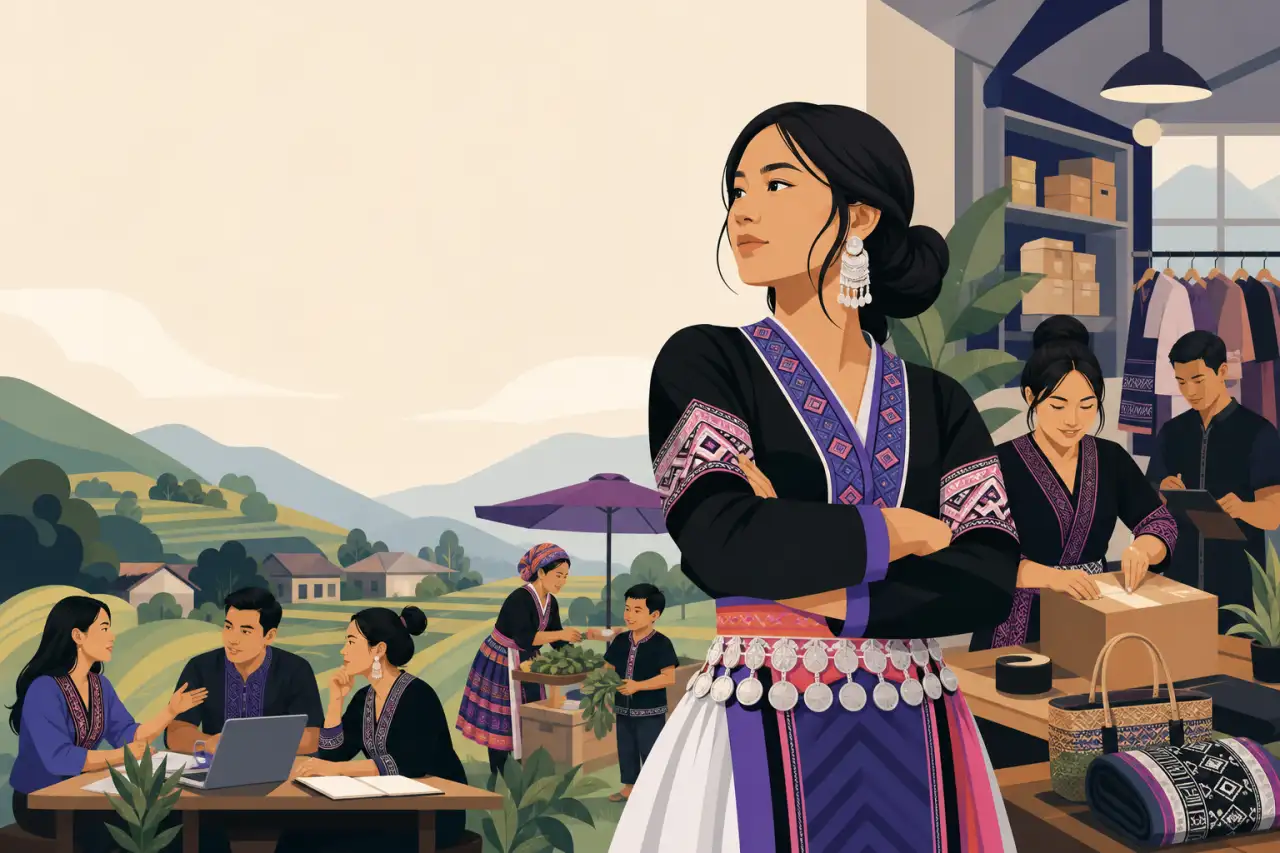
Hmong Women Entrepreneurs Are Redefining What's Possible
TL;DR
Hmong women are building businesses across restaurants, farms, beauty, healthcare, and professional services, often while navigating unequal access to credit, unpaid family labor, and being underestimated by lenders and clients. Here's what that path actually looks like, and what tends to help.
Building Businesses, and Building Room for Others
Starting a business is hard for anyone, but for many Hmong women it has also meant working against a quieter expectation: that leadership, risk, and public visibility were roles better suited to someone else, usually a husband, father, or older brother. That expectation was rarely stated outright. It showed up instead in who a landlord addressed first during a lease negotiation, who a wholesale supplier called back within the day, or whose name ended up on the business license even when the woman was doing most of the actual running of things. Every restaurant, salon, farm stand, or professional practice a Hmong woman opens and keeps open pushes back on that pattern a little further, simply by existing and succeeding on her own terms.
The effect tends to travel past the one business. A daughter who grows up watching her mother negotiate a lease, manage a payroll, or handle a difficult customer learns firsthand that those skills belong to her too, not as a hypothetical but as something she has actually watched happen at the kitchen table. Nieces, cousins, and younger sisters absorb the same lesson secondhand at family gatherings and community events, which is part of why one successful business owner in a family so often becomes two or three within a decade. Not because of a formal mentorship program, but because someone nearby proved it was possible — the same throughline behind what Hmong-owned businesses keep getting right more broadly.
The Expectations Hmong Women Entrepreneurs Are Actually Working Against
It helps to be specific about what breaking barriers actually looks like day to day, because the phrase can sound abstract until you see it play out in a lease negotiation or a bank meeting. A common one: being asked, directly or through body language, to bring a husband, father, or brother along to a meeting with a landlord, wholesaler, or loan officer. Not because anyone said a woman couldn't sign the paperwork, but because the default assumption in the room was that the real decision-maker would eventually show up. Many women describe having to establish credibility twice, once as a business owner, and again as the actual person in charge, separate from whichever male relative happened to be standing next to them.
A second, more internal barrier is the expectation that a woman's time and labor belong first to the household and extended family, and only after that to something she is building for herself. That does not disappear the day a business opens. It shows up as being expected to close early for a family obligation that a male-owned business down the street would not be expected to accommodate, or being the default person who handles both the books and the childcare because someone has to. None of this makes the business less real. It does mean the actual hours worked, and the actual planning that keeps things running, are often invisible to people outside the family.
Different Industries, One Common Thread
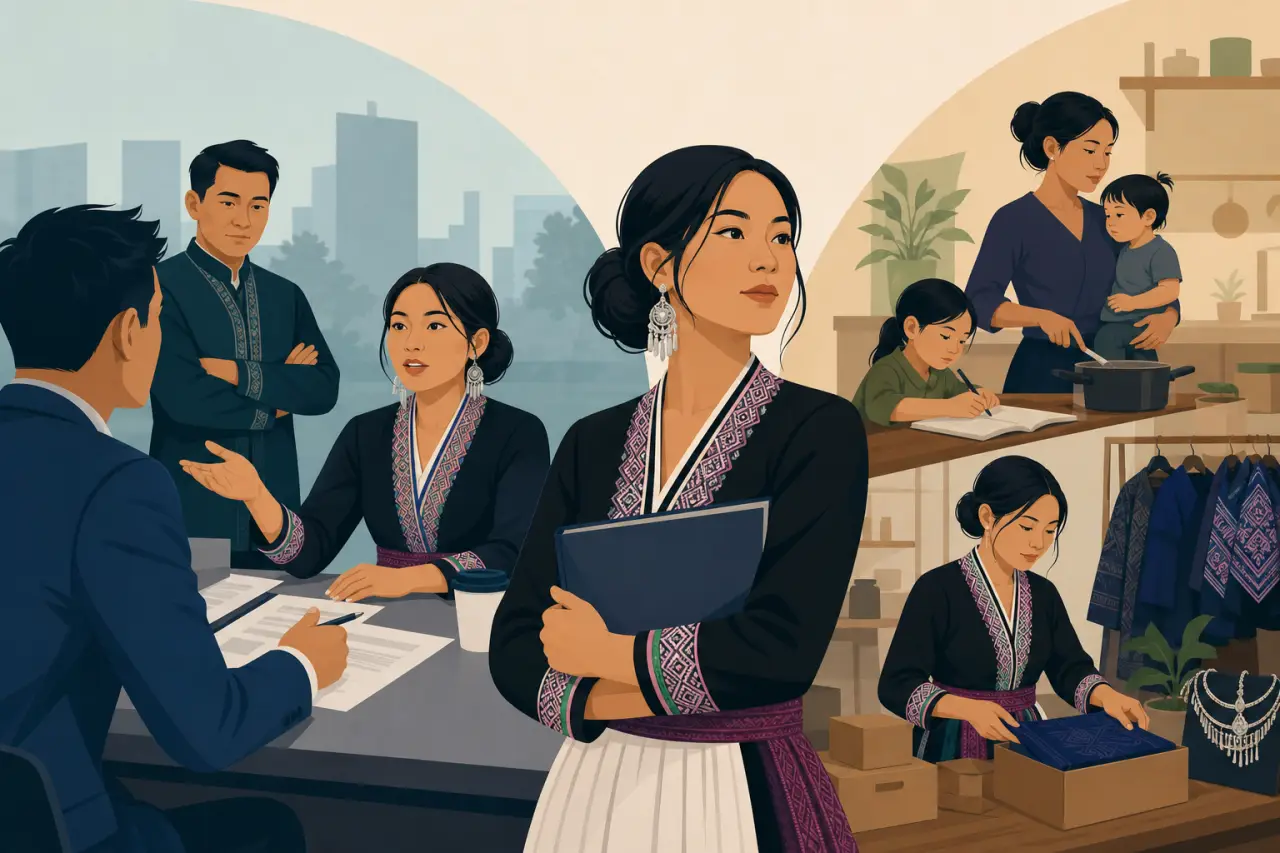
There is no single Hmong women's business story. The work spans:
- Restaurants and food trucks
- Farms and produce stands at Saturday markets
- Hair and nail salons
- In-home elder care and interpretation services
- Insurance and tax preparation
- Real estate (Shoua Thao's national SEO success story is one example of what that path can look like)
- Law
- Embroidery and paj ntaub sold both locally and shipped nationally
- Event and wedding planning built around cultural ceremonies that outside vendors often do not understand well enough to book correctly
Some of these businesses started as side income run out of a kitchen or garage long before there was ever a storefront or a business license.
What tends to connect them, regardless of industry, is a habit of reinvesting close to home:
- Hiring a cousin before posting a job publicly
- Buying produce, fabric, or ingredients from another Hmong-owned supplier even when a bigger distributor would be marginally cheaper
- Sponsoring a table at the New Year festival or a youth soccer team, not as a marketing tactic but because it is expected and it matters
That local reinvestment is exactly the kind of thing a directory built for this community can make more visible, connecting customers who specifically want to support these businesses with the women actually running them, rather than leaving that connection to word of mouth alone — see why — and how — to support Hmong-owned businesses for what that can look like in practice.
When Family Is Your Biggest Asset and Your Hardest Conversation
Family labor is often what makes a small Hmong-owned business possible in the first place:
- A sister doing books on weekends
- A teenage nephew covering the counter after school
- Parents watching the kids so the owner can work a double during a festival weekend
That support is real, and it is often the only reason the numbers work in year one. It is also, almost without exception, unpaid or underpaid, and undocumented in any formal sense.
The hard part comes later, when the business grows enough that helping out needs to become an actual job with actual hours, or an actual ownership stake with actual paperwork. Telling a relative they need to clock in on time, or that their unpaid weekend help does not entitle them to a say in business decisions, is a genuinely uncomfortable conversation, and skipping it tends to cause more damage than having it does. The owners who navigate this best tend to put things in writing early, even informally:
- Who is expected to work which shifts
- What happens if a family member wants to be bought out
- Whether helping at the restaurant is a favor or a job
Writing it down does not make the relationship less warm. It makes disagreements two years later much easier to resolve, because there is something to point back to besides memory.
The Money Problem: Credit, Capital, and Why So Many Start With Savings Alone
Access to money is where a lot of the real, structural difficulty lives, separate from any cultural expectation. Many Hmong women starting a business are the first person in their family to ever apply for a business loan, which means there is no established personal or family credit history a bank can point to, no collateral in the form of property already owned, and often no prior relationship with a loan officer who will take a first meeting seriously. The practical result is that a lot of these businesses start entirely on personal savings, help from family, or informally pooled money from relatives, not because that is the preferred path, but because it is the path that was actually available.
What tends to help, concretely:
- Opening a separate business bank account and a business credit card from day one, even before there is much revenue, so a credit history starts building in the business's own name rather than only the owner's personal accounts
- Community development financial institutions and SBA microloan programs are built specifically for borrowers who do not fit a traditional bank's risk profile, and they are worth applying to even for a modest amount, because a small approved loan, paid back on time, becomes the credit history that makes the next loan easier to get
- Keeping clean, simple records from the start, every sale and every expense in one place, matters less for taxes in year one than it does for being able to walk into a bank in year three with real numbers instead of an estimate

Finding Mentors Who Do Not Already Exist
One real gap: there often is not a formal mentor a young Hmong woman starting a business can just call. Chambers of commerce and small business development centers exist, but they are frequently built around, and staffed by, people who do not share the specific pressures of running a business inside a tight-knit immigrant community, things like extended-family labor questions, discount requests from relatives, or a language gap with a supplier's contract.
In practice, the mentorship that does exist tends to get built sideways rather than handed down:
- A group of women who all opened businesses around the same time comparing notes at a clan gathering
- A salon owner who mentors the younger woman renting the chair next to her
- A community group chat where a question about a difficult landlord gets several real answers within a day
That kind of peer support is worth being deliberate about rather than leaving to chance:
- Showing up to community business events
- Using a local women's business center's programming even when it was not built with this specific community in mind
- Being willing to be the person a newer owner calls, once you are a few years further along than she is
Getting Taken Seriously: Pricing, Contracts, and Learning to Say No
A specific, recurring problem is chronic underpricing, driven by pressure to give free or discounted work to relatives and community members who assume family rates apply by default. A hairstylist, photographer, or seamstress who does one favor for a cousin's wedding often finds herself doing the same favor for the cousin's entire circle of friends, at a rate that does not cover materials, let alone time. This is not a minor annoyance. It is a direct threat to whether the business survives, and the social pressure to say yes tends to fall harder on women than on male relatives running comparable businesses.
A written price list, even a simple one, changes this conversation more than almost anything else, because it moves the answer from I do not want to charge you to this is what it costs, which is a far easier line to hold. The same goes for a basic written contract or invoice, even for small home-based work. It protects the business, and it also signals, to clients who might otherwise assume they are dealing with a hobbyist, that this is a real operation with real terms. Age and accent still cause some clients to doubt expertise on first contact. A few concrete things do more to close that gap than almost any single credential:
- A professional-looking invoice
- A business card
- A listing with real photos and real hours
- Simply repeating prices without apologizing for them
What the Next Generation Is Actually Learning
The clearest long-term effect of all this is not the individual business. It is what the next generation absorbs from watching it happen. A daughter who has spent Saturdays helping restock a produce stand or answer phones at a family salon carries a completely different, unspoken sense of what is normal for a woman to run than one who has not. That is not a marketing point. It shows up later as more of that generation treating opening a business as an obvious option rather than a leap.
It also changes what a community expects from its own institutions: who gets asked to speak at a chamber event, whose name comes up when someone needs a referral, who a younger owner pictures when she imagines her own business five years from now. None of that happens because of a single success story. It happens because enough Hmong women kept their businesses open long enough, and loudly enough, for it to stop being remarkable and start being ordinary, which, for the next woman deciding whether to take the leap, is exactly the point — one thread in fifty years of Hmong American resilience that keeps proving itself out.
Questions people ask
What makes it harder for Hmong women to get a business loan compared to other entrepreneurs?
Many Hmong women applying for their first business loan lack an established personal or family credit history, property to use as collateral, and prior relationships with loan officers. This often leaves them starting entirely on personal savings or informally pooled family money instead. Community development financial institutions and SBA microloan programs are built for borrowers who don't fit traditional bank profiles and can help build credit history over time.
How do I stop giving away my work for free to family and friends?
A written price list, even a simple one, shifts the conversation from "I don't want to charge you" to "this is what it costs." A professional invoice or basic contract does the same thing and signals to clients that you run a real business with real terms. Repeat your prices without apologizing for them.
What's the biggest mistake Hmong women make when family members start helping with the business?
Skipping the hard conversation about when helping out becomes an actual paid job or ownership stake. Write things down early, even informally: who works which shifts, what happens if someone wants to be bought out, whether help is a favor or employment. Documentation prevents damage later without making the relationship less warm.
Why do so many Hmong women's businesses start as side work in a kitchen or garage?
Limited access to traditional business loans and capital forces many to start with personal savings or family help. Building a business gradually from home lets owners test the idea and reinvest early profits without taking on debt before the business is proven.
Written by
Hmong Network Team
Directory & Digital Services
We run the Hmong Network directory and do the web design and SEO/AEO work behind the results in our case studies. These guides come out of that same hands-on work with Hmong-owned businesses — not secondhand research.
