

How To Raise Healthy Chickens: Qaib Thai's SEO Launch
TL;DR
Qaib Thai is a Hmong-rooted poultry supplement and accessories brand that had no website or digital presence at all when it approached Hmong Network. The project built a complete Shopify store from the ground up, launching with a 92/100 SEO score and a 96/100 Best Practices score on both mobile and desktop.
Starting From a Business Concept: Who Qaib Thai Is and What "No Website" Actually Meant
Qaib Thai operates in the market for poultry supplements and accessories, serving a customer base that runs from backyard hobbyists raising a handful of hens to commercial farmers managing much larger flocks. The name itself carries the brand's identity: "Qaib" comes directly from the Hmong word for chicken, which means the business is named after the animal it exists to support, not after a founder or a generic industry term. That naming choice matters for a brand trying to serve communities with deep agricultural traditions — it signals, before a single product is described, that this company understands the world its customers actually live in.
Before this project, Qaib Thai existed only as a business concept. There was no website, no e-commerce platform, and no analytics of any kind. That's a meaningfully different starting point than most projects Hmong Network takes on, where the work is usually rebuilding or repositioning something that already exists. Here, there was no legacy content to preserve, no old URLs to redirect, and no existing customer data to build from — but also no established domain history, no prior search rankings, and no baseline traffic to compare against. Everything, from the first line of product copy to the first indexed page, had to be built at once — the same process of taking your business online step by step that any brand-new business faces when it has nothing existing to build from.
The Market Qaib Thai Was Stepping Into
Poultry supplements sit in an unusual spot in the broader pet and agricultural supply industry. On one end are commercial farm-supply retailers selling in bulk to operations that measure flock size in the hundreds or thousands. On the other end is a genuinely large and growing population of backyard chicken keepers — people raising a small flock in a suburban or rural backyard, often as much for the relationship with the animals as for the eggs. Those two customer types shop very differently, look for different signals of trust, and respond to very different kinds of marketing, which makes a poultry-focused brand harder to position than a typical single-audience retailer.
A new entrant with no existing reputation has to earn credibility with both groups simultaneously, and it has to do it around a category of product — supplements meant to affect an animal's health — where buyers are naturally more cautious than they'd be shopping for, say, a feeder or a coop accessory. That caution is exactly why the challenges identified going into this project centered as much on trust and differentiation as they did on the absence of a website in the first place. A brand entering that space with zero prior track record needed its very first impression to do a lot of persuading.

Why Shopify, and What That Choice Actually Solves
The store was built on Shopify — picking the right platform for your store is one of the first real decisions any new business has to make — chosen specifically for its inventory management, secure payment processing, and mobile optimization. Each of those reasons maps to something particular about this business rather than being a generic platform recommendation. Supplements are a consumable product — customers who see results tend to reorder on a recurring basis rather than making a single purchase — which makes reliable inventory tracking more than a back-office convenience, and makes pricing your products the right way matter just as much for a category where the same customer is buying again and again; running out of stock on a repeat customer's preferred product is a direct hit to the trust a new brand is still trying to build. Secure payment processing matters for the same underlying reason as the rest of the trust-building work on this project: a first-time visitor deciding whether to buy a health product for their animals from a brand they've never heard of is evaluating every signal available, and a checkout that feels handled by a serious platform is one of those signals.
Mobile optimization was arguably the most important of the three, given who Qaib Thai's customers actually are. A largely rural customer base doesn't always mean unreliable internet, but it does mean a meaningfully higher share of visits arriving on a phone rather than a desktop, often from someone standing in a coop or a feed store rather than sitting at a desk. Building mobile-first rather than treating mobile as an afterthought was a decision that shaped the rest of the design work that followed, part of turning a Shopify trial into a launch-ready store rather than launching with whatever the default theme happened to look like.
A Look Built to Say Modern and Professional in a Traditionally Conservative Industry
The visual design uses a dark color palette with high-contrast white typography and red accents. That's a deliberate departure from the visual language a lot of farm and pet-supply sites default to — busy layouts, bright primary colors, and a fairly utilitarian look that can read as dated or generic. A dark, high-contrast palette reads as more premium and more considered, which was the point: the case study describes the goal explicitly as reading as modern and professional in what it calls a traditionally conservative industry. For a brand with no existing reputation to lean on, the design itself has to do some of the trust-building work that an established competitor could otherwise rely on word of mouth or years of reviews to accomplish.
On the homepage, a "Customer Favorites" section uses tabbed filtering rather than a single flat product grid. Tabbed filtering does two things at once for a new store with a still-limited catalog: it lets a first-time visitor quickly narrow to what's relevant to their situation instead of scrolling through everything, and it makes the catalog feel more organized and substantial than a flat list of the same products would. For a brand trying to look established on day one, small structural choices like this carry more weight than they would for a retailer with years of accumulated content to lean on.
Placing the Pitch Where It Actually Lands: The "Qaib Thai Difference" Section
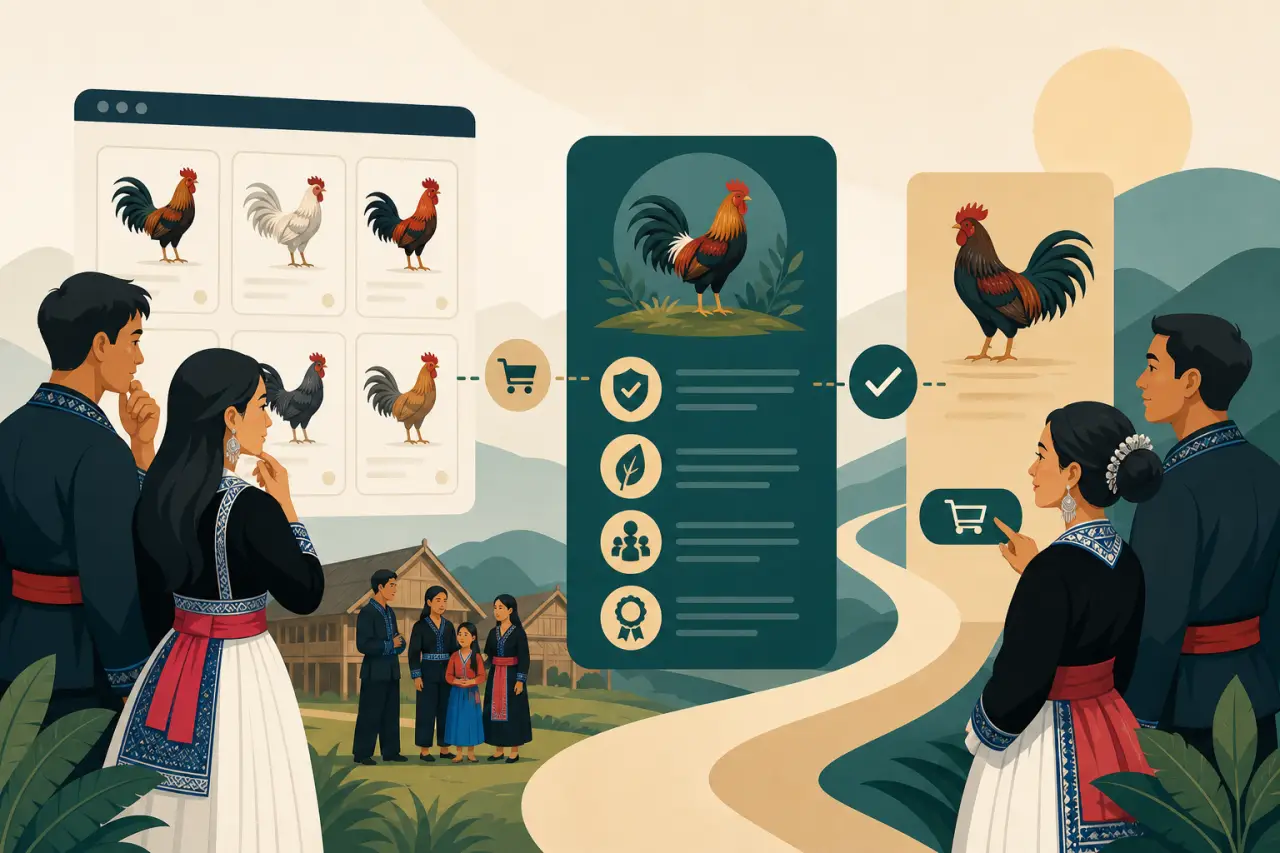
One of the more deliberate structural decisions on the site is where the "Qaib Thai Difference" section sits: strategically placed after product exploration but before the final purchase decision. That placement is doing real work. A visitor who has already browsed a few products has moved past the question of whether this store sells what they're looking for, and has shifted into a quieter, more consequential question — why buy this brand's version instead of a competitor's, or instead of whatever they already use. That's precisely the moment a differentiation message is most useful, and precisely the moment it's most often missing on e-commerce sites that either bury their story on a separate About page nobody visits, or lead with it before a visitor has any context for why it matters.
Putting it after browsing but before checkout means the message arrives exactly when the buying decision is actually being made, not before the visitor cares yet and not after they've already decided. For a supplement brand specifically, where the product's effectiveness can't be verified by looking at it, that's often the difference between a cart that gets abandoned for a more familiar competitor and one that converts.
Building the Technical SEO Foundation From Zero
Alongside the design work, the team built out the pages a legitimate e-commerce business needs before it can be trusted with a purchase:
- Contact Us
- Privacy Policy
- Terms of Service
- A Sitemap
- A custom 404 page
None of those pages sell anything directly, but their absence is one of the fastest ways a new store signals itself as unfinished or untrustworthy — both to a cautious first-time shopper and to search engines evaluating whether a site is a legitimate, complete business rather than a placeholder.
On search specifically, the business had zero organic presence for any relevant industry keywords going in, which is the expected state for any brand-new domain but still meant the technical groundwork had to be done comprehensively rather than incrementally. That included optimized URL structures, meta descriptions, title tags, and e-commerce-specific schema markup — the structured data that helps search engines understand that a given page is a product listing, what it costs, and whether it's in stock, which can influence how that page is represented directly in search results. Google Analytics was implemented from day one as well, so that behavior and conversion paths would be tracked from the very first visitor rather than backfilled later once there was already a gap in the data.
The Launch Numbers, and What They Actually Mean
Performance testing at launch scored the new site 55/100 for performance on mobile and 45/100 on desktop, with accessibility at 84/100 on mobile and 85/100 on desktop. Those numbers are worth stating plainly rather than glossing over: they're solid but not exceptional, and they're exactly the kind of scores that reflect a brand-new store prioritizing structure, content, and search visibility first, with speed optimization work still ahead of it — which lines up directly with the documented next steps described below.
What stands out is the SEO score, which came in at 92/100 on both mobile and desktop, and Best Practices, which scored 96/100 on both. Those are the two categories most directly tied to the technical SEO foundation described above — the schema markup, the meta descriptions and title tags, the URL structure, and the full set of legitimacy-signaling pages — and scoring that high at launch, before the site had any accumulated traffic, backlinks, or search history, means the foundation was built correctly the first time rather than patched together after the fact. The case study describes the launch as creating an immediate professional presence in the poultry supplement market, and the SEO and Best Practices numbers are the clearest evidence for that claim; the performance and accessibility scores are the honest reminder that a strong launch and a finished project aren't the same thing.
What Comes Next
The documented next steps for Qaib Thai are:
- A blog archive
- A customer testimonials page
- Image and code optimization to improve load times
Each addresses a different piece of what the launch numbers show still needs work. A blog archive gives the site an ongoing way to earn new keyword rankings over time rather than relying solely on the fixed set of product and category pages built at launch — genuinely useful for a niche category like poultry care, where informational searches (how to raise healthy chickens, what supplements a flock actually needs) are just as valuable to rank for as direct product searches. A testimonials page starts building the social proof that a brand-new store can't have on day one by definition, but that matters enormously for a health-adjacent product category where buyers are naturally cautious about a brand they've never heard of. And image and code optimization is the direct answer to the mobile and desktop performance scores, which is exactly where a site like this should focus once the structural and search foundation is already solid.
Taken together, the case study frames the project as proof that thoughtful web design and strategic SEO can establish a strong foundation for success in specialized e-commerce markets — one built to honor Qaib Thai's Hmong agricultural roots while still competing on the technical and search fundamentals that any modern e-commerce brand has to get right.

Questions people ask
Why does the name "Qaib Thai" matter for how the brand is positioned?
"Qaib" comes directly from the Hmong word for chicken, so the brand's name itself signals cultural authenticity before a customer reads a single line of product copy. For a company selling health-related products to communities with strong agricultural traditions, that kind of built-in credibility is a real advantage over a generic supplement brand entering the same category.
Why was Shopify chosen over other e-commerce platforms for this launch?
Shopify's inventory management, secure payment processing, and mobile optimization each matched something specific about the business: supplements are a recurring, consumable purchase where reliable stock tracking matters, secure checkout builds trust with first-time buyers evaluating an unfamiliar brand, and a largely rural customer base meant a meaningfully higher share of visits arriving on mobile devices.
How can a brand-new store with no traffic history score 92/100 for SEO right at launch?
The SEO and Best Practices scores reflect the technical foundation built before launch — optimized URL structures, meta descriptions, title tags, and e-commerce-specific schema markup — rather than accumulated traffic or backlinks, which a new domain doesn't have yet. Scoring that high before the site had any search history shows the foundation was built correctly the first time rather than patched together afterward.
The performance scores were only 55/100 on mobile and 45/100 on desktop at launch — is that a problem?
It reflects priorities more than a shortfall: the project focused first on structure, trust-building design, and the technical SEO foundation, with documented next steps specifically naming image and code optimization to improve load times. Performance and SEO aren't the same category, and a strong SEO launch doesn't automatically come with strong speed scores until that optimization work happens separately.
Written by
Hmong Network Team
Directory & Digital Services
We run the Hmong Network directory and do the web design and SEO/AEO work behind the results in our case studies. These guides come out of that same hands-on work with Hmong-owned businesses — not secondhand research.
