

Tax Information for Marketplace Sellers
TL;DR
Marketplace facilitator laws mean Hmong Network handles sales tax on most of your platform orders automatically, but income reporting, bookkeeping, off-platform sales, and international VAT are still on you — here's how each piece actually works.
What "Marketplace Facilitator" Actually Means for You
Most states now have marketplace facilitator laws on the books, which shift the job of calculating, collecting, and remitting sales tax from individual sellers to the platform the sale happened on. Practically, that means when a customer checks out and buys your embroidered paj ntaub pillow or your jar of chili paste through Hmong Network, the tax due on that specific transaction is calculated and added automatically, and Hmong Network is the one that sends it to the state — not you.
That's a real compliance burden lifted off your plate, and it's worth understanding exactly what it covers so you don't either over-worry or under-prepare.
- It applies to orders placed and paid for through the marketplace checkout.
- It does not retroactively cover sales you made before you started selling here.
- It doesn't extend to any sale that happens outside that checkout flow, which we'll get into below.
A handful of states still don't have facilitator laws, and a few product categories (certain services, some digital goods, some exempt food items) are taxed differently or not at all depending on the state — so the amount added at checkout will vary order to order, and that's expected, not a bug.
Why Your Legal Name and Tax ID on File Actually Matter
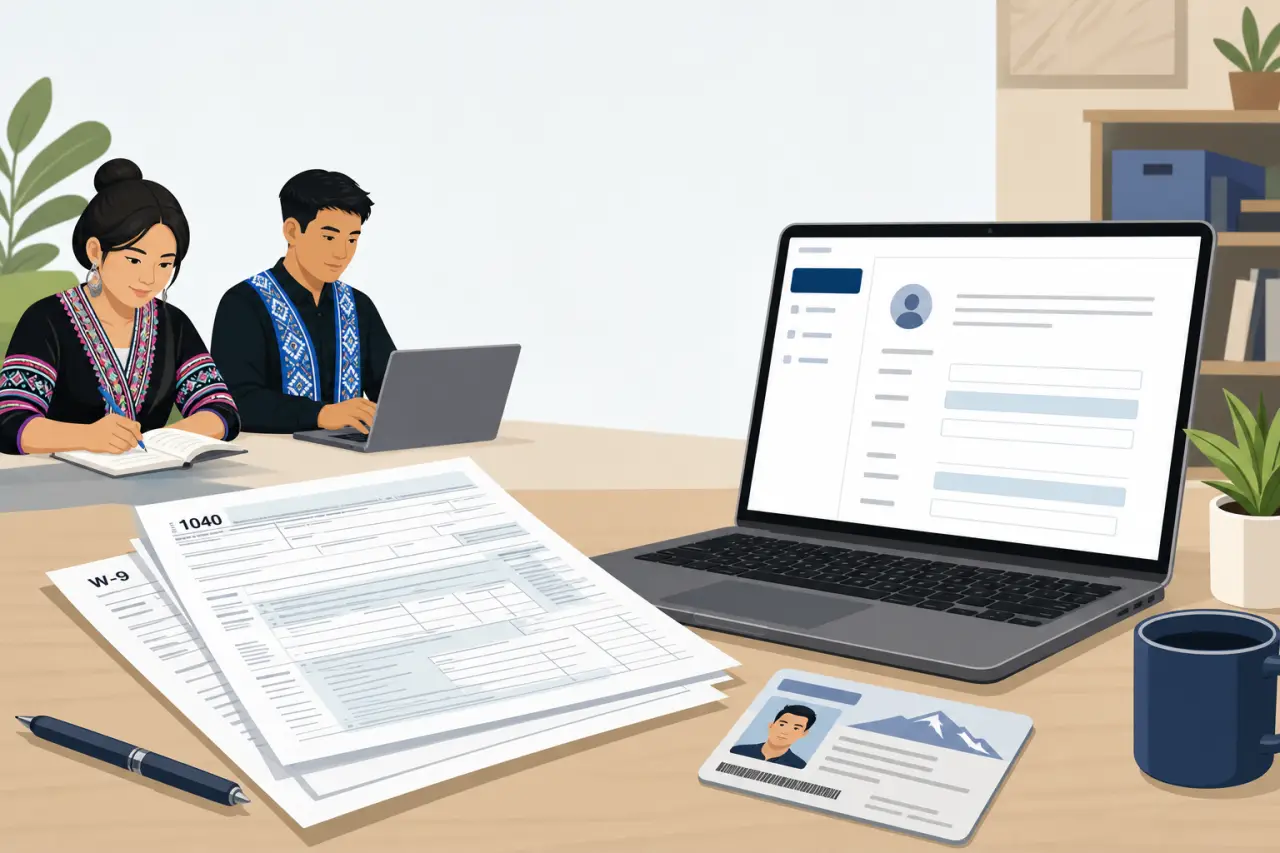
If your sales activity crosses the federal reporting threshold in a given year, Hmong Network is required to report your gross payment volume and send you the corresponding tax form. To do that, we need your correct legal name and taxpayer ID — your Social Security number if you're selling as an individual or sole proprietor, or your EIN if you're operating as an LLC or corporation — matched exactly to what the IRS has on file for you. Keeping this information accurate is also how Hmong Network meets the identity-verification side of the INFORM Consumers Act requirements, a separate federal law aimed at high-volume online sellers.
This is the single most common thing that causes a payout hold. If you got married and changed your name, or you formed an LLC partway through the year and switched your tax ID but never updated your seller profile, the name-to-ID mismatch flags automatically and slows your money down. It's a five-minute fix in your account settings, but only if you catch it before a payout is already stuck. Set a reminder to double-check this any time your business structure or legal name changes, not just once when you first sign up.
Worth saying plainly: the specific dollar threshold that triggers this reporting has changed more than once in recent years at the federal level, and it can vary further by state. Don't try to estimate whether you're close to it from memory — check your Payouts tab, which shows your actual year-to-date gross volume, or ask a tax preparer what the current threshold is before assuming either way.
Keep Business Money and Household Money Separate
A lot of Hmong-owned marketplace shops start as something a family already does — cooking for events, sewing on the side, importing goods for relatives — and the money for it naturally flows through the same bank account as groceries and rent. That's fine when you're testing an idea. It becomes a real headache the moment you're trying to figure out what you actually earned for tax purposes.
- Open a separate bank account, even a free one.
- Route your Hmong Network payouts into it directly.
- Pay your supplies, your shipping labels, and your marketplace fees out of that same account.
This isn't about looking official — it's that come tax time, you'll be able to hand a bank statement to whoever does your taxes instead of trying to reconstruct six months of Venmo and cash transactions from memory. The separation is the whole trick; everything else about bookkeeping gets easier once it exists.
If multiple family members touch the money — a parent handles pickup and delivery, a sibling manages the listings, a cousin helps at events — agree early on who logs what and where. The businesses that struggle most at tax time usually aren't the ones with the least income; they're the ones where three people each kept a partial, different memory of what happened, and nobody wrote any of it down consistently.
Track What It Actually Costs You to Make a Sale
Your tax bill isn't based on what customers paid you — it's based on your profit, which means every real business expense you can document reduces what you owe. These are all legitimate costs of doing business, and most of them are deductible:
- Materials and ingredients
- Packaging
- Shipping supplies
- The mileage to pick up fabric or restock at a wholesaler
- The platform's own commission
The commission piece is easy to miss because it feels like it's already "handled" — the money is deducted before it ever reaches you, so it's tempting to just look at your payout total and call that your income. Don't. Every order in your Payouts tab shows the commission that was taken out and what you actually netted — see how seller payouts are tracked for the full breakdown — and that itemized breakdown is exactly what you or your preparer should be working from, not the sticker price of what you sold. Keep a running log (a simple spreadsheet is enough for most sellers) of materials purchased and mileage driven, even if it feels small — it adds up faster than people expect, especially for anyone making handmade goods.

Sales That Happen Off the Marketplace Are Still Your Responsibility
Marketplace facilitator tax collection only applies to the transaction that actually runs through Hmong Network's checkout. If you also sell the same products at a Hmong New Year vendor booth, a church craft fair, or directly to a customer who paid you in cash or over Venmo after seeing your listing, none of that sales tax gets collected or remitted by us — because we were never part of that transaction.
Depending on your state and how much you sell this way, you may need your own sales tax permit to collect and remit tax on those direct sales yourself. This trips up a lot of sellers who reasonably assume that because "the platform handles tax," all their selling activity is covered. It isn't. If in-person or direct sales are a meaningful part of your business — not just an occasional favor for a neighbor — it's worth a quick call to your state's department of revenue to find out whether you've crossed the threshold that requires you to register.
This is also where it pays to keep your two sales channels visibly separate in your own records, not just mentally. A simple habit that works for a lot of sellers: log every booth or cash sale into the same spreadsheet you're already using to track expenses, the day it happens, rather than trying to remember it later or lump it in with your Hmong Network payout totals. Two clean, separate columns beat one column you have to guess at every time you file.
Selling to Buyers Outside the United States
If a buyer outside the U.S. orders from your storefront, their country may charge VAT or a similar consumption tax on the sale, and Hmong Network does not currently calculate, collect, or remit that on your behalf. That responsibility, along with any customs or import duties the buyer might owe on their end, sits outside what the platform handles today.
If international orders are rare for your shop, the practical move is simply to be upfront in your product listing that the buyer may be responsible for their own country's import fees, so it isn't a surprise on their end either. Say it plainly rather than burying it — a buyer who's warned up front that customs charges might apply is far less likely to leave a bad review over it than one who finds out when a package shows up with an unexpected bill attached.
If international sales become a real part of your volume rather than an occasional order, that's the point where it's worth asking a tax professional whether you need to register for VAT collection in any specific country — the rules differ enough by destination that a blanket answer isn't useful, and this is a place where getting it wrong can mean real back taxes later, not just a confused customer.
Sales Tax Isn't Income Tax — Don't Confuse the Two
This is the mix-up that catches new sellers off guard the most: the sales tax handled at checkout has nothing to do with what you owe on your own earnings. Your net profit from selling — after materials, commission, and other real expenses — is income, and if you're operating as a sole proprietor or through a single-member LLC, it's also generally subject to self-employment tax on top of regular income tax. How much of that liability lands on you personally also depends on your entity — worth revisiting choosing your business structure if you haven't already.
If this business is bringing in real money alongside a day job or other income, you may be expected to make quarterly estimated tax payments rather than settling everything at once in April. Missing that isn't just inconvenient — it can mean an underpayment penalty even if you pay the full amount owed by the filing deadline. Base your estimate on your actual net earnings (again, what's in your Payouts tab after commission, not gross sales), and set aside a percentage of each payout as it comes in rather than treating the whole deposit as spendable income. For more on budgeting for variable income like this, a simple habit — moving a fixed percentage into a separate savings account every time a payout lands — keeps this from becoming a scramble at tax time.
Building a Habit You Can Actually Keep Up
None of this needs to be complicated, but it does need to be consistent. Once a month:
- Download your payout history.
- Note any off-platform sales and their receipts.
- File away digital copies of anything you spent money on for the business.
Most tax preparers suggest holding onto that documentation for at least three years, longer if you're claiming a loss or running close to any audit-relevant thresholds. A shoebox of paper receipts works if that's genuinely your system and you stick to it — a folder in your email or a phone app works just as well. The only wrong system is the one you abandon by March.
If your situation has any real complexity — multiple states, international orders, a business structure change, or you're simply past the point where guessing feels safe — bring in a licensed tax professional rather than trying to piece it together from forum posts. If you'd rather work with someone who understands running a Hmong-owned business specifically, the Professional Services category in the directory is a good place to find bookkeepers and tax preparers in your own community. This page is meant to orient you to how the pieces fit together, not to replace that conversation.
Questions people ask
Does Hmong Network collect sales tax for me?
If you sell through Hmong Network's checkout, yes. The platform automatically calculates and remits sales tax to the state on those transactions. This only covers orders placed through the marketplace checkout, though. Any sales you make outside that flow — at a vendor booth, directly to a customer, or over Venmo — are your responsibility to handle.
What information do I need to keep accurate in my seller profile?
Your legal name and tax ID must match exactly what the IRS has on file. Use your Social Security number if you're a sole proprietor, or your EIN if you're an LLC or corporation. Mismatches between your name and ID are the most common reason payouts get held up. Update your profile whenever your legal name or business structure changes.
What business expenses can I deduct on my taxes?
Materials, ingredients, packaging, shipping supplies, mileage to pick up supplies, and the marketplace commission are all deductible. Track these with a simple spreadsheet as you spend the money, rather than trying to remember later. Commission is easy to miss because it's deducted before you're paid — but it counts as a real business expense that reduces what you owe.
Do I need to set aside money for taxes if I'm making good income?
Yes. Your profit from selling is income tax and likely self-employment tax too. If this is bringing in real money alongside other income, you may owe quarterly estimated tax payments instead of paying everything in April. Set aside a fixed percentage of each payout into a separate savings account rather than spending the whole deposit.
Written by
Hmong Network Team
Directory & Digital Services
We run the Hmong Network directory and do the web design and SEO/AEO work behind the results in our case studies. These guides come out of that same hands-on work with Hmong-owned businesses — not secondhand research.
