
The Living Sound of Hmong Music
TL;DR
Hmong music has always done two things at once: preserve the past and adapt to the present. Here's a closer look at the instruments, the people who still build and play them, and how to find and support that tradition in your own community.
The Qeej: A Bamboo Instrument That Speaks Instead of Just Plays
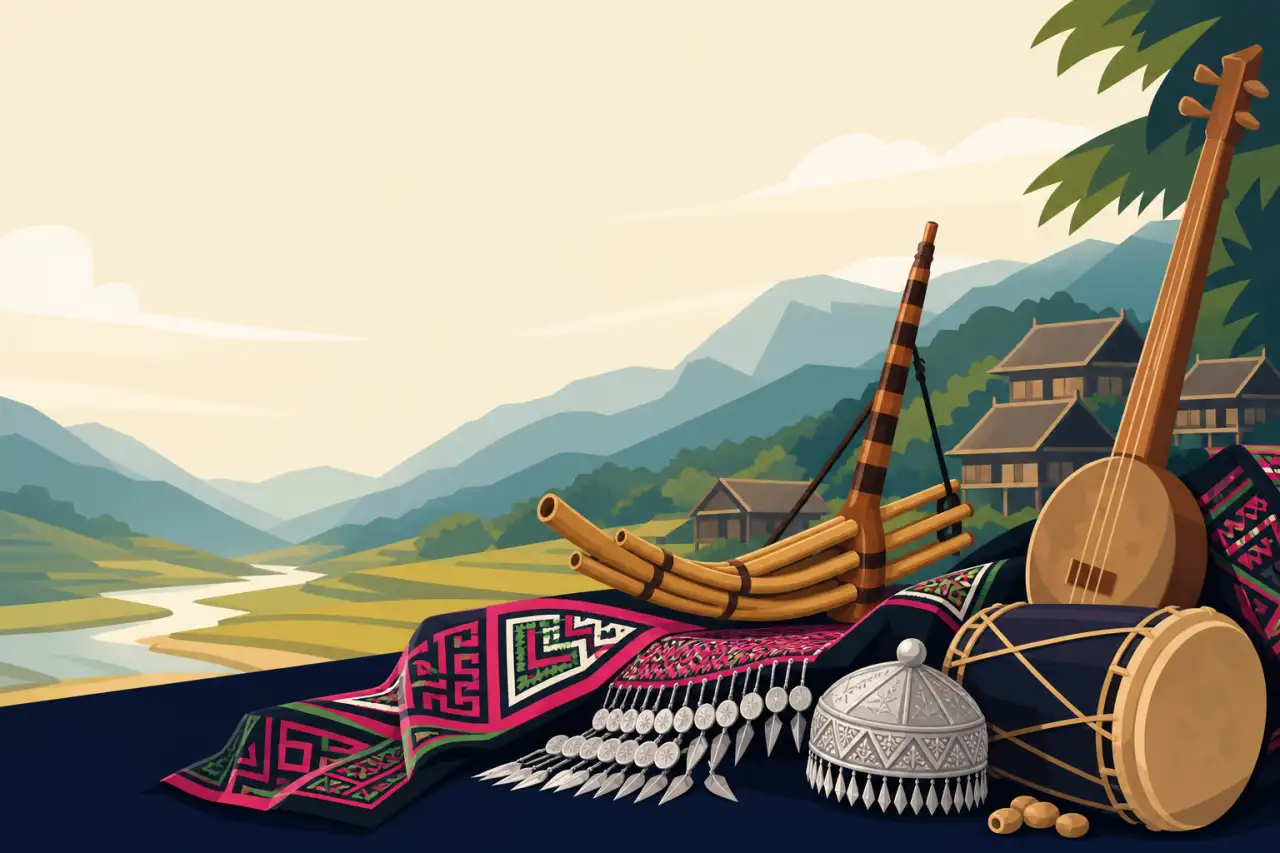
The qeej is built from six bamboo pipes of different lengths, each fitted with a brass reed, bound together and set into a carved wooden windchest. What makes it unusual among wind instruments is that it's played on both the inhale and the exhale, which means a skilled player can sustain a continuous tone for minutes at a stretch using circular breathing. That technical demand is only half the difficulty. The qeej isn't played from sheet music or memorized melody the way a guitar or piano might be. Its phrases are built to mirror the tones and rhythms of spoken Hmong, so a listener who understands the tradition can follow actual words and sentences in what's being played. A trained ear can recognize when the instrument is telling someone's life story, guiding a spirit, or announcing a stage of a ceremony.
That's why the qeej is inseparable from Hmong funeral rites. Over the course of a funeral, which can run several days, specific ordered phrases are played to walk the deceased's spirit back through their life and toward their ancestors. The player isn't performing in the way a musician performs at a concert; they're carrying out a ritual responsibility, and the sequence, timing, and correctness of what's played matters. Outside of funerals, the same instrument turns celebratory. At Hmong New Year gatherings, qeej playing is paired with dance and, in competitions, judged on technical skill, breath control, and the acrobatic footwork that goes with it. Learning the instrument well enough to do either version competently typically takes years, historically passed down within families, though community classes now fill that role for kids who don't have a qeej player in their household.
The Instruments You're Less Likely to Have Heard
The qeej gets most of the attention, but it's not the only instrument carrying weight in Hmong musical tradition.
The ncas
The ncas, a small mouth harp made of thin metal or bamboo, is held against the lips and plucked to produce a soft, buzzing tone that's shaped into different pitches by the shape of the mouth and tongue. Historically, it served as a kind of coded language between young people during courtship, when speaking directly wasn't always appropriate. A specific pattern of plucks could carry a sentence a suitor wasn't supposed to say out loud. It's quiet and intimate in a way the qeej isn't, meant to be heard by one person rather than a room.
The raj and nplooj
The raj, a bamboo flute, plays a similar emotional register: solo melodies for courtship, reflection, or simply passing an evening. Unlike the qeej, it isn't tied to a fixed ceremonial script, which gives players more room to improvise or adapt a known tune. Even simpler than that is nplooj, playing a folded leaf held against the lips like a reed, an instrument that costs nothing but a hand and a nearby tree and was historically one of the first ways young people learned to carry a melody before ever touching the qeej.
The nruas
Drums, generally referred to as nruas, show up alongside the qeej in funeral processions and larger ceremonies, providing the rhythmic backbone that helps coordinate movement during multi-day rites.
None of these instruments are relics sitting in a museum case. They're still built, tuned, and played by people in Hmong communities today, and the skill required to make or repair one properly is its own specialty that doesn't get talked about nearly as much as the performance side.
Where You'll Actually Encounter This Music Today
If you're not from the community, the easiest place to hear Hmong traditional music is at a Hmong New Year festival, where qeej competitions, dancing, and courtship games like pov pob (ball tossing) all happen with music running through them. These events are public, often held in large halls or fairgrounds in cities with sizable Hmong populations, and they're built for visitors as much as for the community itself. Weddings are another common setting, where the music woven through Hmong weddings accompanies specific stages of the ceremony rather than running as background entertainment the way a DJ set might at a non-Hmong wedding.
Funerals are different, and worth understanding as different. The qeej played there isn't for an audience in the entertainment sense — it's a ceremonial function, performed by someone trained specifically for that role, and it isn't something to request or applaud. If you're ever a guest at a Hmong funeral, the respectful move is to observe quietly rather than treat it as a performance. Beyond these formal settings, you'll also find this music at cultural center open houses, school heritage programs, and increasingly, recorded and streamed online — a shift that's changed who gets to encounter this tradition and how often.
The Diaspora Remix: New Sounds Built on Old Foundations
Hmong communities are spread across Minnesota, Wisconsin, California, and other pockets of the U.S., as well as Laos, Thailand, France, and Australia, which means a shared musical tradition has become one of the few threads connecting people who may never meet in person, the same kind of connective pull that turned Hmong visibility on a world stage into a shared moment of pride a few years back. Younger artists are leaning into that connective role by folding traditional melodic patterns, vocal styles, and even sampled qeej tones into hip-hop, R&B, and pop production. The result isn't a dilution of the tradition so much as an extension of it into formats that travel easily — a song can move through TikTok or Spotify in a way a live qeej performance never could, reaching Hmong teenagers in a different state or a different country the same week it's released.
Lyrically, a lot of this newer music sits at the intersection of two languages and two identities, sometimes switching between Hmong and English within the same verse, which mirrors how a lot of diaspora households actually talk. That in-between space used to be treated as a gap to explain or apologize for. In the music coming out now, it reads more like the actual subject matter — an honest description of what it's like to carry a tradition forward while building a life somewhere the tradition didn't originate. It's also given traditional instrumentation new relevance with an audience that might not otherwise seek out a funeral rite or a New Year competition, which matters for keeping the older forms from feeling sealed off from anyone under thirty — much like a modern take on Hmong tradition has done for textiles and everyday style.
The People Who Teach, Build, and Perform This Music for a Living
Behind almost every qeej you hear is someone whose actual trade is building and tuning them, usually working alone or with one or two family members. Making one involves a few steps:
- Sourcing specific bamboo for pipe length and density
- Hand-fitting brass reeds
- Tuning each pipe to match the tonal system a particular family or region expects
A custom instrument can take weeks between selecting materials and finishing the tuning, and pricing reflects that it's closer to instrument-making craftsmanship than manufacturing. Buyers often go directly to a known maker rather than a retail source, because reputation and word of mouth are what establish whether an instrument is actually tuned correctly.
Teaching runs on a similarly personal model. Most qeej and traditional music instruction happens one-on-one or in small groups, often out of a teacher's home, a rented room at a cultural center, or informally after a community event, rather than through a large studio with a fixed curriculum. Performers who play at funerals and ceremonies occupy a distinct role within this — it's a paid occupation for some, but one built on being specifically trusted to carry out a ritual correctly, not just play well. The more reliably someone performs the correct sequences, the more they're sought out, which means reputation in this line of work travels almost entirely through community relationships rather than advertising.
What to Know Before You Book a Traditional Musician for an Event
If you're planning a wedding, community event, or cultural program and want to include a qeej player or traditional musician, here's what to keep in mind:
- Book early — demand spikes hard around Hmong New Year celebrations, roughly November through February, when the same small pool of skilled performers is fielding requests from multiple families and organizations at once. Waiting until a few weeks out significantly narrows who's available.
- Ask directly what kind of occasions a performer specializes in. Funeral qeej playing and celebratory qeej playing are related but distinct skill sets, and not every player does both — someone excellent at ceremonial funeral phrasing may not be the person you want for a New Year showcase, and vice versa.
- Confirm space requirements too: qeej performance often involves footwork and movement, so a cramped stage or a room full of tables close to the performance area isn't going to work well.
- Most traditional performances are acoustic by design, but for a large hall, ask whether the performer wants amplification and plan for it rather than assuming a handheld mic will do.
- If the event has any ceremonial component, ask what's appropriate around timing, attire, and audience behavior rather than guessing — the people who do this professionally would rather answer that question upfront than have it go wrong in the moment.
Ways to Support the Musicians Keeping This Tradition Going
The most direct thing you can do is pay for the real thing:
- Buy a handmade qeej, ncas, or raj from a known local maker instead of a mass-produced import
- Hire a live performer for a wedding, cultural event, or celebration instead of defaulting to a recorded track
Both choices put money directly into the hands of people whose actual livelihood depends on this craft continuing to have demand.
Beyond direct purchases, showing up matters more than it might seem:
- Attending a New Year festival's qeej competition
- Sitting through a full performance instead of walking past it
- Bringing kids to a community class
These all signal that the tradition has an active audience, not just a historical one. If you know a younger artist blending traditional sounds into new genres, following, sharing, or simply listening all the way through does real work in building the audience that lets that kind of music keep getting made.
If you're trying to track any of this down and don't already have a personal connection into the community, a local Hmong business directory or community organization listing is usually a faster starting point than a general search — it gets you to an actual name and phone number instead of a generic result. None of this requires being part of the community to matter — it just requires treating the music as something worth actively supporting rather than a cultural detail to observe from a distance.
Questions people ask
What's the qeej and why is it so important to Hmong funerals?
The qeej is a bamboo wind instrument played with six pipes fitted with brass reeds. It's central to Hmong funerals because it's designed to mirror spoken Hmong—a trained player can tell the deceased's life story and guide their spirit using specific ordered phrases. Over days-long funeral rites, the qeej player walks the spirit back through life toward ancestors. It's not entertainment; it's a ritual responsibility that requires years of training.
Can you actually hire a traditional Hmong musician for a wedding or event?
Yes, but you need to plan ahead. Book early because demand spikes during Hmong New Year (November through February). Ask the performer directly which occasions they specialize in—funeral qeej and celebratory qeej are different skill sets. Confirm they have space for footwork and movement, ask about amplification needs, and if there's a ceremonial component, ask what's appropriate for timing and audience behavior beforehand.
How are younger Hmong artists keeping the tradition alive today?
Younger artists blend traditional melodic patterns and sampled qeej tones into hip-hop, R&B, and pop. They often code-switch between Hmong and English in lyrics, mirroring how diaspora households actually talk. This puts traditional sounds into formats that travel on TikTok and Spotify, reaching Hmong teenagers across states and countries while treating the in-between space of two identities as the real subject matter instead of something to apologize for.
Where can I actually hear Hmong traditional music if I'm not part of the community?
Hmong New Year festivals are the main public venue—they feature qeej competitions, dancing, and courtship games, and they're built for visitors. You'll also find it at weddings accompanying specific ceremony stages, cultural center open houses, school heritage programs, and increasingly online through streaming. Just remember: at funerals, the qeej is ceremonial, not entertainment, so the respectful approach is to observe quietly.
Written by
Hmong Network Team
Directory & Digital Services
We run the Hmong Network directory and do the web design and SEO/AEO work behind the results in our case studies. These guides come out of that same hands-on work with Hmong-owned businesses — not secondhand research.
