
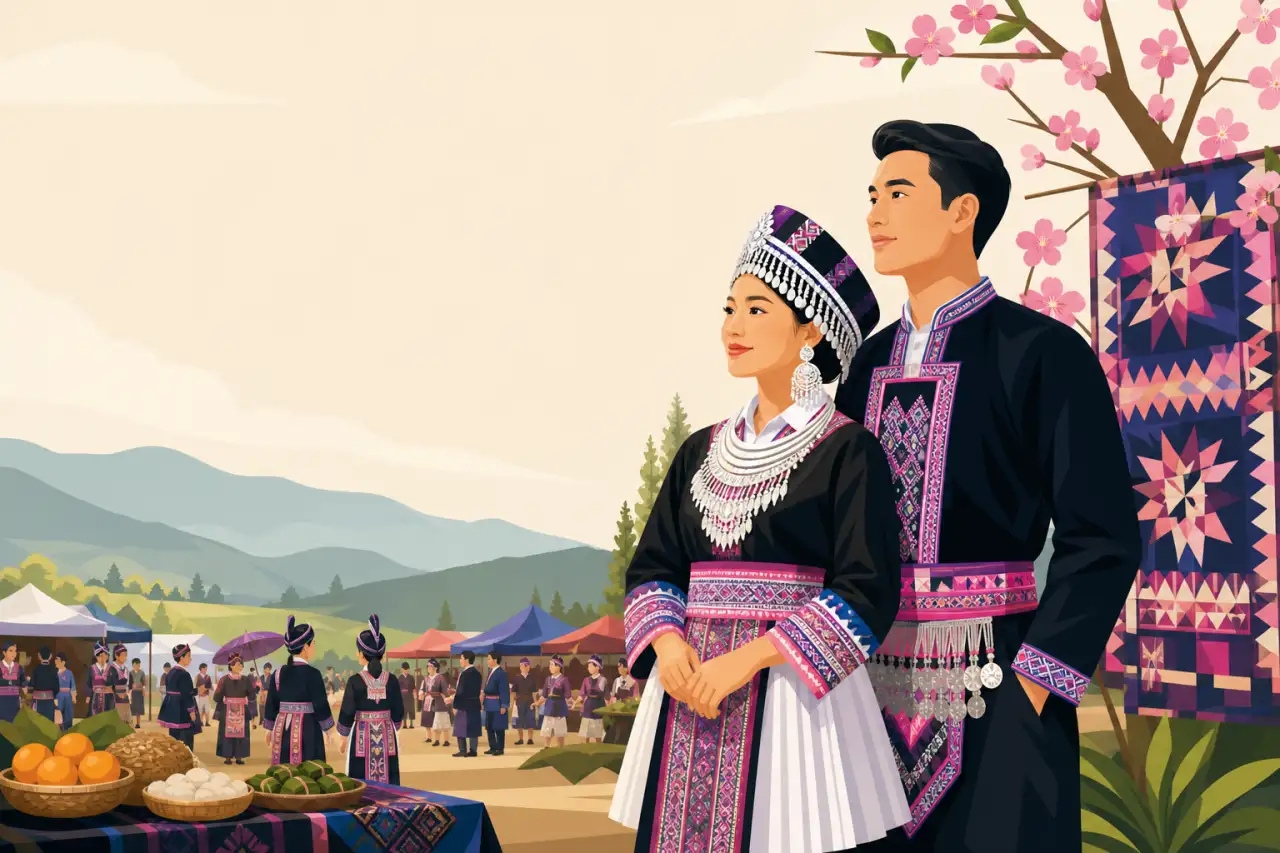
Noj Peb Caug: What Hmong New Year Is Really About
TL;DR
Noj Peb Caug is equal parts harvest ritual, family reunion, and public showcase of clothing, food, and games — with meaning that runs much deeper than the festival grounds most visitors see.
A Harvest Celebration Rooted in Renewal
Hmong New Year, or Noj Peb Caug, began as an agricultural marker — the point in the year when the harvest was in, the fields were done for the season, and families could finally stop and take stock before winter set in. The name itself reflects that: it roughly translates to eating the thirty, a reference to the closing days of the lunar year. Historically it followed the lunar calendar exactly, timed to the actual end of the harvest rather than a fixed date on a Western calendar.
Renewal sits at the center of it. Homes are cleaned thoroughly before the new year begins, not for appearance but to clear out whatever the old year left behind. Families perform hu plig, a soul-calling ceremony meant to call back any wandering or lost souls in the household and welcome them into the year ahead with health and good fortune. None of this requires a stage, a vendor booth, or a crowd — it happens quietly, inside individual homes, often before anyone leaves for the larger public celebration.
That private, spiritual layer is easy to miss if your only exposure to Hmong New Year is a weekend festival at a fairground or convention center. It's worth knowing it's there, because it's the part that hasn't changed even as everything built up around it has.
Family, Courtship, and a Celebration That Keeps Growing
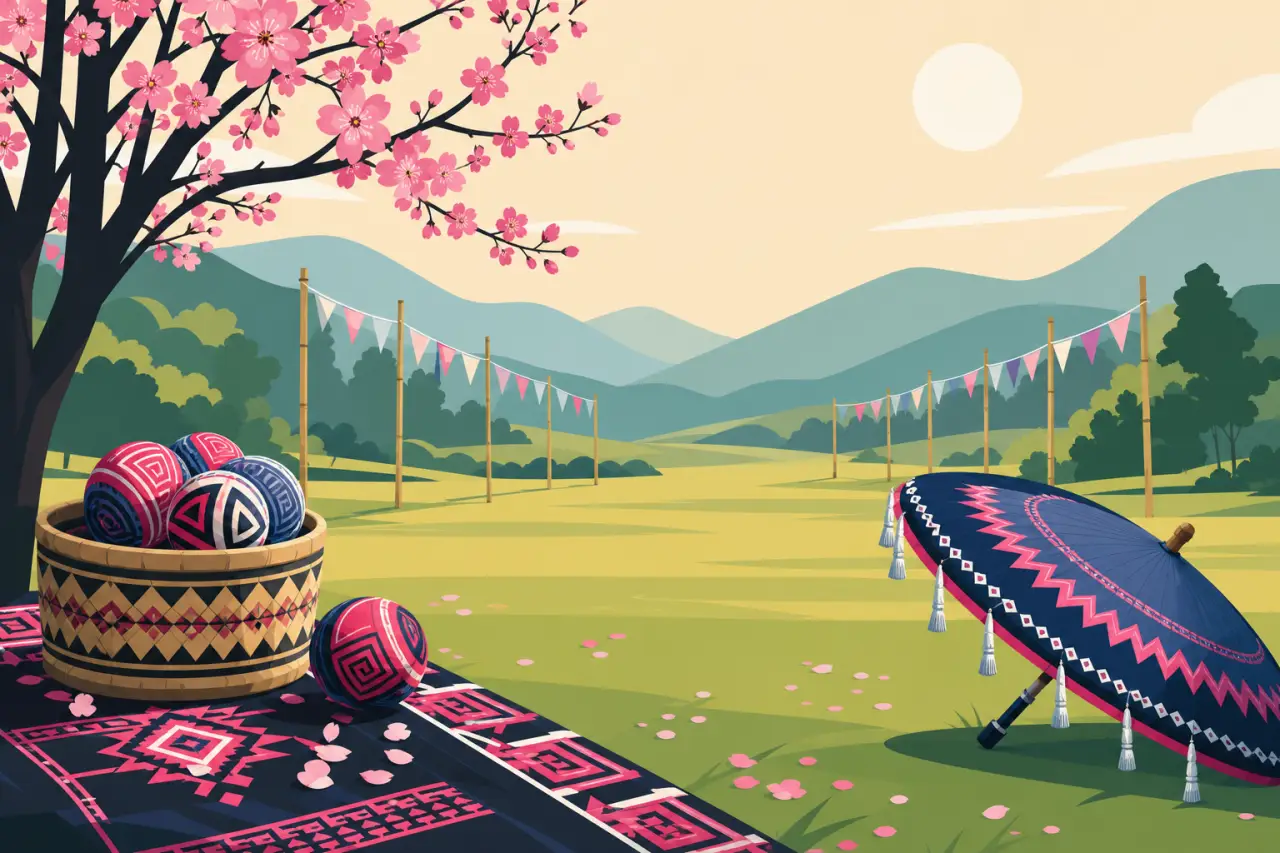
Traditionally, Noj Peb Caug was also the one time of year young people from different clans were reliably in the same place at the same time — which made it the community's de facto courtship season. Pov pob, a ball-tossing game played in rows between young men and women, was as much a way to talk to someone new as it was a game; a dropped ball was often an excuse to keep the exchange going a little longer. Singing, joking, and long conversations across the pov pob line were part of how relationships started, and some marriages trace back to a New Year celebration two families still bring up decades later. It's worth knowing something about Hmong wedding traditions if you want to understand just how much weight those early conversations could carry.
That same gathering impulse is what turned a village-scale tradition into the large public events many people now picture when they hear Hmong New Year:
- Soccer and volleyball tournaments that run all weekend
- Fashion shows that put both century-old textile techniques and modern reinterpretations of Hmong dress on the same runway
- Pageants that are less about beauty and more about young people representing their clan, their state, or their generation in front of the whole community
In cities with a large Hmong population, these events can draw tens of thousands of people over a single weekend.
For a lot of families, going isn't really optional. It's the one weekend a year when relatives who've scattered across different states — for college, for work, for marriage — are actually in the same city. People plan flights and time off work around it the way others plan around Thanksgiving, because for a lot of Hmong families, functionally, it is Thanksgiving weekend.
What the Clothing Is Actually Saying
If you go to a Hmong New Year celebration and see families in elaborate embroidered clothing and heavy silver jewelry, that's not costume — it's closer to a language. Hmong textile work, paj ntaub, literally flower cloth, uses reverse appliqué, cross-stitch, and batik techniques that differ by sub-group. White Hmong, Green Hmong, and other regional groups each carry distinct patterns, colors, and silhouettes, and someone who grew up around it can often tell which group a family belongs to just by looking at the outfit. That same craftsmanship gets its own dedicated spotlight at events like Hmong arts and crafts fairs, where paj ntaub and silverwork are the whole point rather than one part of a much bigger weekend.
A lot of that clothing is made by hand, sometimes over months, by mothers and grandmothers sewing for their own children and grandchildren rather than buying off a rack. Silver jewelry — neck rings, coin belts, headpieces — gets passed down and added to over generations, and the weight of it on a young woman at New Year isn't incidental; it's meant to be seen and felt as a marker of family wealth and care.
This is also, practically, one of the busiest seasons of the year for Hmong tailors, seamstresses, and jewelry sellers. Families often order or alter outfits months ahead, and it's common for a shop that does Hmong clothing or silver work to be booked solid in the weeks leading up to New Year season. If you know a family attending for the first time, this is the detail that tends to matter most to them — what they wear says something real, and getting it right, or at least getting close, matters.
The Rituals Most Visitors Never See
Before anyone gets to the fairgrounds, there's a version of Noj Peb Caug that happens entirely inside the home. Beyond hu plig, families may perform ceremonies honoring household spirits and ancestors, offering food as a way of thanking them for protection over the past year and asking for continued blessing into the next one. Doors and thresholds get attention too — some families place symbolic barriers or perform small rites at the entrance to keep bad luck from following anyone in.
None of this is performed for an audience, and it's not something you'd stumble into at a public event. It's also not uniform — practices vary by clan, by region of origin, and by how a given family has adapted their traditions after resettling. Two Hmong families at the same festival might have completely different private observances behind them, shaped by whether their ancestors came from Laos, Thailand, or Vietnam, and by which clan they belong to.
Understanding that this private layer exists, even if you never see it, changes how you read the public celebration. The fashion shows and tournaments are the visible tenth of something much larger; the actual new year happens at home, days before, in a ceremony that isn't for sale and isn't on the program.
The Food, the Games, and the Fairground Feel of It
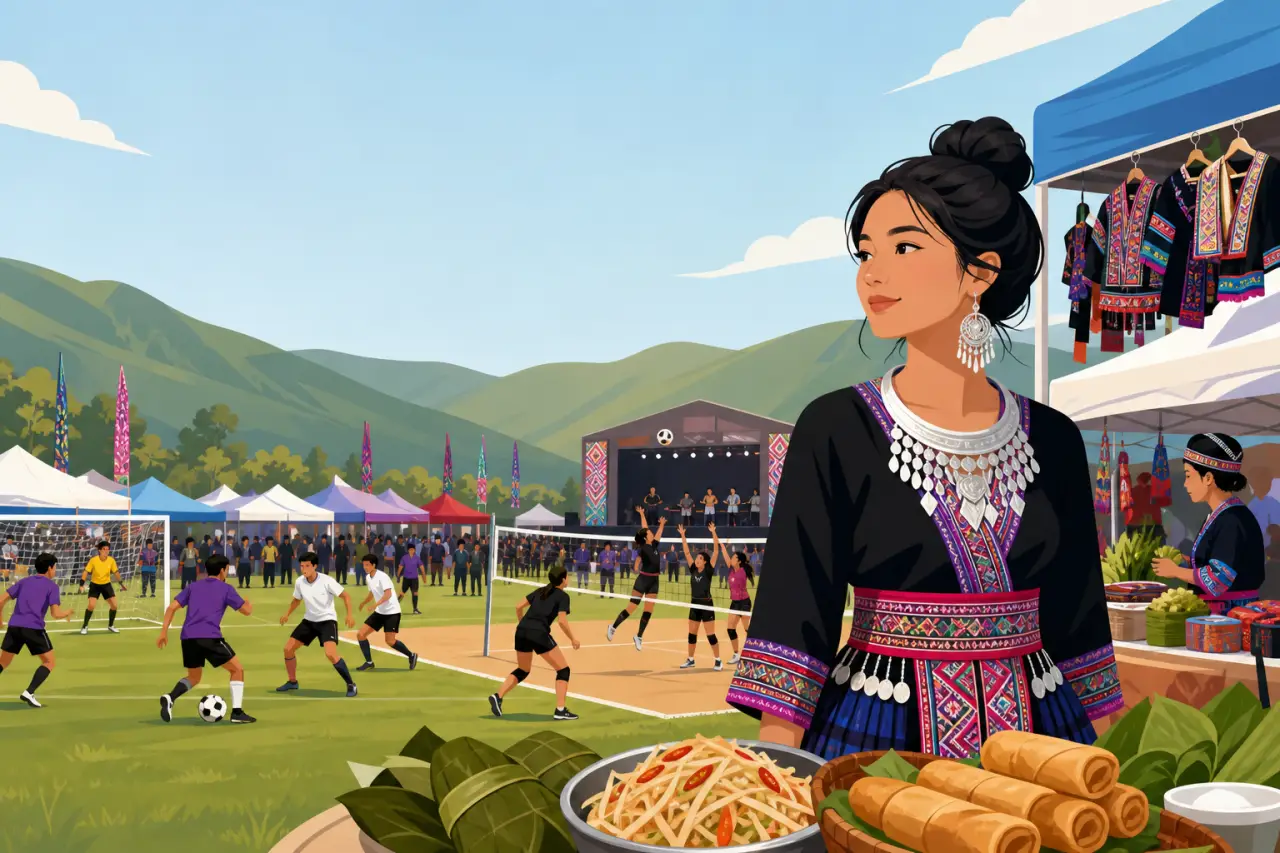
Walk into a large Hmong New Year celebration and it can feel closer to a state fair than a religious observance — and that's by design. Soccer and volleyball tournaments run in shifts across a weekend, with teams that have practiced together for months. Rows of vendor booths sell everything from egg rolls and papaya salad to specialty Hmong ingredients that are hard to find the rest of the year. Music, announcements, and the occasional live performance showcasing the living sound of Hmong music run over a PA system loud enough to hear across the whole grounds.
Food at these events tends to split two ways. There's the practical, festival-style food, the stuff sold from booths to feed a crowd all weekend, and there's the food each family actually eats at home around the New Year itself, which leans more traditional: pork, chicken, and dishes tied to specific ceremonies rather than concession-stand fare. If you're attending as a guest, the booth food is the easy entry point; the home-cooked version is usually reserved for people who've actually been invited into someone's house.
Pov pob still shows up at most large celebrations, usually in a section set aside specifically for it, alongside tuj lub, a spinning-top game that's just as old. Both draw a mix of teenagers half-seriously flirting and older adults who remember playing the exact same games decades ago at their own first New Year.
Why This Season Matters for Hmong-Owned Businesses
If you run a Hmong-owned business, especially one selling clothing, textiles, silver, catering, photography, or event services, New Year season isn't just a cultural event you attend. It's close to the busiest stretch of your year, and it's worth planning for like one. For specific tactics on planning your Hmong New Year marketing, the season deserves its own calendar entry, not a last-minute scramble.
Clothing and tailoring shops typically see order volume climb weeks before the season starts, as families order or alter outfits for kids who've grown since last year. If that's your business, the practical move is to set a real order cutoff date and communicate it clearly — a last-minute request you can't fill well is worse for your reputation than turning it down early. Photographers who shoot family portraits in traditional dress face the same crunch; booking out the calendar in advance, rather than trying to squeeze in same-week requests, protects both your quality and your sanity.
Food vendors and caterers face a different version of the same problem: demand spikes hard for a short window, which means the following all need to be locked down early rather than figured out the week of:
- Ingredient sourcing
- Staffing
- Booth logistics
If you're planning to sell at a public celebration, most events require vendor applications well ahead of time, and popular spots fill up.
This is also, honestly, a good moment to make sure your business is easy to find. A family looking for a tailor, a caterer, or a photographer for New Year season is searching now, not in January — a claimed, up-to-date listing on a directory like this one is a small thing that can be the difference between getting found and getting overlooked during the one stretch of the year when demand is highest.
If You've Never Been: What to Expect and How to Show Respect
If you're attending a Hmong New Year celebration for the first time, as a friend, a coworker, a neighbor, or just someone curious, a few things will make the day better for you and for the people around you.
- Expect crowds, noise, and a full day if you want to see most of it — tournaments, fashion shows, and pageants are often scheduled across a whole weekend, not compressed into an hour. Wear comfortable shoes; most of these events happen on fairgrounds, in parking lots, or in large convention spaces where you'll be walking and standing for long stretches.
- Ask before you touch. The clothing and jewelry on display represent real time, money, and family history, and it's not costume to be handled casually. If you want a closer look or a photo with someone in traditional dress, ask first — most people are happy to talk about what they're wearing if you're genuinely interested, and less happy to be treated like a photo backdrop.
- If you're invited into someone's home around New Year rather than just attending the public event, treat it as the bigger honor it is. Being asked to a family's private New Year gathering means you've been let into something most outsiders never see, and it's worth showing up with the same care you'd bring to any other family's most important holiday.
Keeping the Traditions Alive Across Generations
One thing that's changed, and kept changing, is timing itself. Hmong New Year traditionally followed the lunar calendar, but in the US, most large public celebrations have shifted to weekends around Thanksgiving, when families are more likely to have time off school and work at the same time. That's a practical adaptation, not a loss — the ceremonies inside the home still follow their own timing, and the public celebration exists to gather people when gathering is actually possible.
The same is true of almost everything else about the holiday. Fashion shows now put modern streetwear-influenced designs next to century-old embroidery patterns. Pageants ask contestants to speak Hmong and English both. Younger Hmong Americans who grew up going to New Year every year, sometimes without fully understanding every ceremony behind it, are now the ones organizing pov pob lines, running vendor booths, and teaching their own kids the games they learned from their parents.
That's really the point of the whole thing continuing to exist in its current, hybrid form: it's not a museum piece being preserved exactly as it was. It's a living celebration that each generation adjusts just enough to keep everyone showing up, which, after all, is what it was always for.
Questions people ask
What does Noj Peb Caug actually mean?
Noj Peb Caug roughly translates to eating the thirty, a reference to the closing days of the lunar year. Hmong New Year began as an agricultural marker — the point when the harvest was in, fields were done for the season, and families could stop and take stock before winter set in.
What's the difference between the public celebration and what happens at home?
Before anyone gets to the fairgrounds, families perform private ceremonies at home. They clean their houses, perform hu plig (soul-calling), and may honor household spirits and ancestors with food offerings. The public festival is visible, but the actual new year happens at home days before, in ceremonies not performed for an audience.
What's paj ntaub and why does it matter at New Year?
Paj ntaub, or flower cloth, is Hmong textile work using reverse appliqué, cross-stitch, and batik. Different regional groups like White Hmong and Green Hmong have distinct patterns and colors. Families often spend months handmaking outfits for New Year, and the clothing and silver jewelry represent family wealth, care, and cultural identity.
What's pov pob and why was it important historically?
Pov pob is a ball-tossing game played in rows between young men and women. Historically, Hmong New Year was the one time young people from different clans reliably gathered together, making it the community's courtship season. A dropped ball was an excuse to keep the conversation going; many marriages trace back to New Year conversations decades ago.
Written by
Hmong Network Team
Directory & Digital Services
We run the Hmong Network directory and do the web design and SEO/AEO work behind the results in our case studies. These guides come out of that same hands-on work with Hmong-owned businesses — not secondhand research.
