
Understanding the Heart of a Hmong Wedding
TL;DR
A Hmong wedding isn't one ceremony but a multi-day process built on family negotiation, symbolic exchange, and ritual — here's what actually happens at each stage and why the details still matter to families today.
A Wedding Between Two Families, Not Just Two People
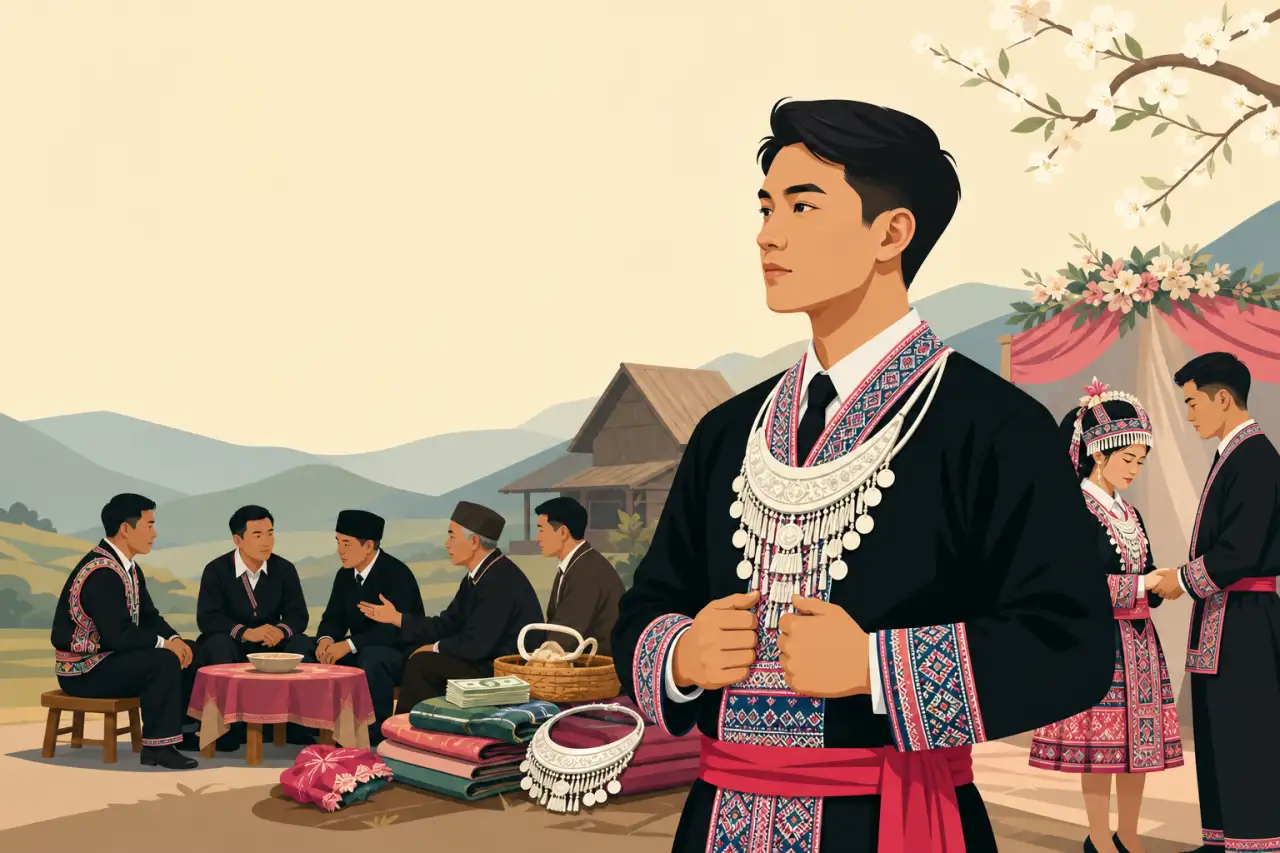
A Hmong marriage doesn't become official the moment a couple agrees to be together. It becomes official when two families sit down, through chosen representatives, and work through it together. That distinction shapes almost everything else about how the wedding unfolds. The couple's relationship is the starting point, not the finish line — the finish line is an agreement between families about how this marriage will be recognized, supported, and remembered.
This matters practically, not just symbolically. Once a marriage is recognized this way, both families take on real obligations to each other — showing up for:
- Future funerals
- Other weddings
- New Year gatherings
- Hard moments like illness or financial trouble
A wedding that skips the family process can leave a couple socially unanchored in ways that surface years later, at exactly the moments they'd want that extended support the most:
- No one from the other side notified when a grandparent passes
- No invitation extended to a cousin's wedding
- No clear standing when a family dispute needs elders to weigh in
That's a big part of why even couples who've been together for years, and who could legally marry with a trip to the courthouse, still go through the fuller process afterward — it's not paperwork, it's the thing that actually connects them to what makes the Hmong community feel like family.
For couples who've already married legally and want to complete this process later, there's no shame in that order. Families generally care more that the process eventually happens correctly than that it happened first.
Who Speaks for Whom: The Marriage Negotiators
Neither the bride nor groom does the talking during the formal negotiation. Each family selects trusted, respected men — often called mej koob — to represent them, and the two sides negotiate on behalf of the couple rather than the couple negotiating for themselves. This isn't a workaround for shyness. A skilled negotiator knows the traditional phrasing, the order topics are supposed to come up in, and how to raise a sensitive point — like a disagreement over timing or a family's expectations — without anyone losing face.
The negotiators aren't picked at random. Families look for someone articulate, patient, and genuinely familiar with how these conversations are supposed to go, since a negotiator who rushes or skips a step can make the whole process feel disrespectful, even if no one intends it that way. Some of the language used is formal and somewhat poetic, passed down through practice rather than written instructions, which is exactly why an experienced negotiator is worth more than a well-meaning relative reading off a checklist.
The conversation itself moves in rounds, often paced with rounds of drinks offered as a gesture of goodwill between the two sides:
- Questions about the couple
- Confirmation that both sides consent
- Discussion of what each family will contribute
- The details of timing and logistics
It's common for this to take hours, and not unusual for families to need a second sit-down before everything is settled. If a disagreement stalls things, the negotiators are also the ones who quietly work it out between sessions, so the two families themselves rarely have to sit across from each other mid-conflict.
What the Bride Price Actually Represents
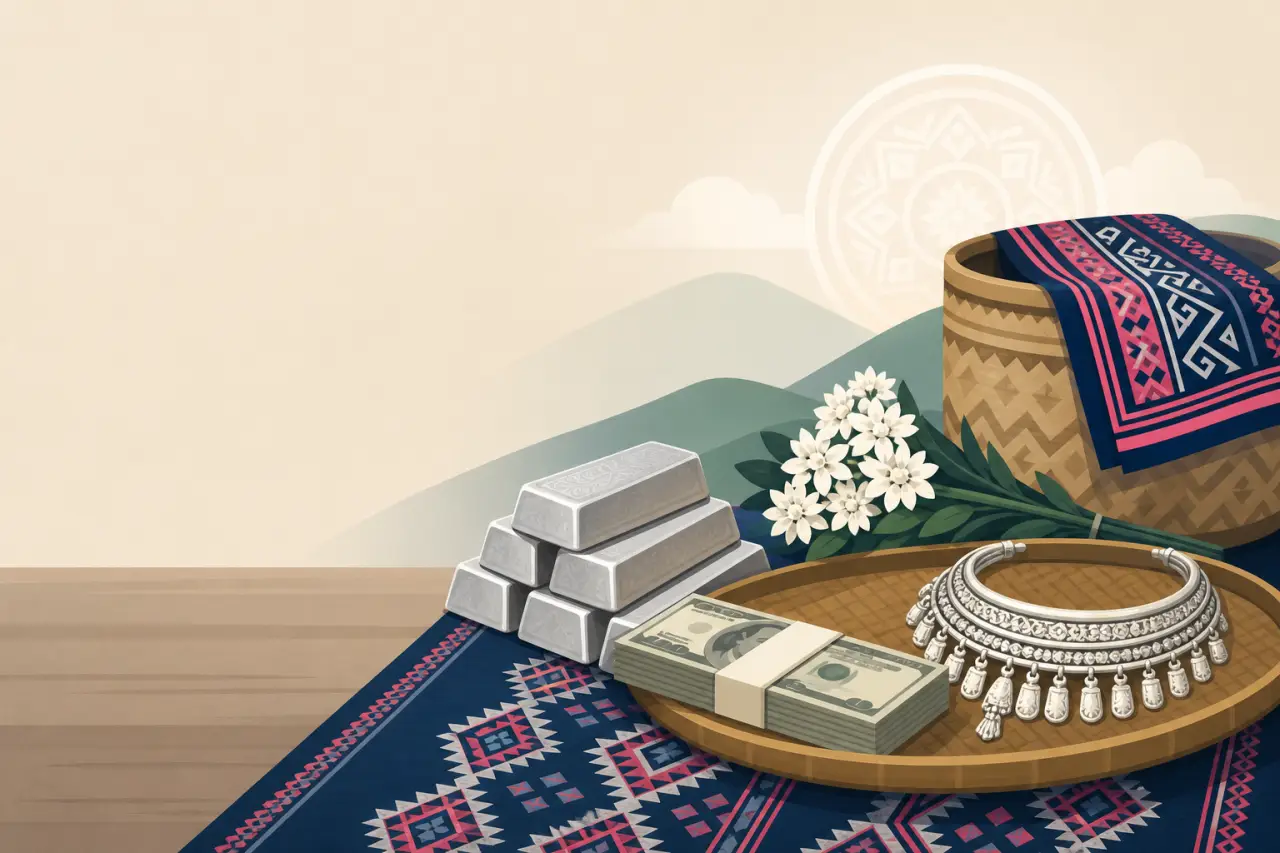
One of the most misunderstood parts of a Hmong wedding is nqi tshoob, often translated loosely as a bride price. Outsiders sometimes hear that term and assume it means a family is being paid to give up their daughter, which isn't what's actually happening. The exchange is better understood as the groom's family formally acknowledging the effort, time, and resources the bride's family put into raising her — and taking on responsibility for the marriage being handled properly and respectfully.
Historically, this was paid in silver bars; today it's typically negotiated in cash, and the amount isn't fixed by any single rule — it comes out of the same negotiation session described above, and varies by family, region, and what feels appropriate to both sides. Many families today keep the amount modest or largely symbolic, especially when both families already know and trust each other well.
A growing number of couples and families are also choosing to redirect some or all of this exchange back toward the couple's own wedding costs or their life together afterward, rather than treating it strictly as a gift to the bride's parents. That's a family-by-family decision, not a rule, but it reflects how a tradition built around formal responsibility can flex without losing its underlying purpose. What doesn't change is the core idea: this isn't a transaction that ends the bride's tie to her birth family. If anything, a properly negotiated nqi tshoob is what formalizes that both families now share responsibility for the marriage going forward.
Ritual, Color, and Meaning in the Celebration
Once the families reach an agreement, the celebration itself takes over, and clothing becomes one of the most visible parts of the tradition. Hmong wedding attire is rarely bought off a rack — much of it is traditional Hmong textiles like paj ntaub, hand-embroidered and layered with silver jewelry that signals more than just wealth. Specific stitch patterns and color combinations can point to a clan, a region, or a family lineage, which is why so much of the preparation for a wedding happens months in advance, long before a date is even locked in.
The groom's attire matters here too, and it's often overlooked next to the bride's — traditional outfits for the groom and his close attendants carry their own embroidery and styling, and coordinating both sides' clothing is part of what a family is quietly managing behind the scenes. Silver jewelry, worn heavily by the bride, isn't just ornamental either; historically it doubled as a portable form of family wealth, which is part of why older pieces are handed down rather than bought new every generation.
That lead time is worth appreciating rather than rushing. Skilled seamstresses who do this work are often booked well ahead of wedding season, and a rushed order rarely does justice to the level of detail these garments are meant to carry. Families who can't get a custom piece finished in time increasingly turn to rental options instead — a practical adaptation that still respects the tradition, since the goal is wearing something correct and well-made, not necessarily owning it outright. The clothing isn't costume for the day — it's a visible record of who someone is connected to, and it tends to stay in a family for years afterward, sometimes altered and passed to the next relative getting married.
How the Wedding Days Actually Unfold
A Hmong wedding rarely fits into a single afternoon. It's common for the process to stretch across two or three days, moving between households:
- Negotiation and formal agreement
- A ceremony bringing the bride to the groom's family home
- A larger celebration or reception that both extended families and the wider community attend
Along the way there are smaller but meaningful moments:
- A tea ceremony where the couple formally honors elders on both sides
- Blessings offered by parents and grandparents
- Time set aside for the two families to simply sit and eat together as newly connected relatives, not just guests at an event
Food carries its own weight in this process. Meals prepared during the multi-day event are usually a coordinated effort among aunts, uncles, and close family friends rather than something fully outsourced, even when a caterer is also involved for the larger reception — it's one more place where the wedding functions as a shared family project rather than a hired-out production. Toasts and rounds of drinks continue past the negotiation stage too, often marking each new stage of the celebration as it happens.
The exact order and length varies by family, region, and how far apart the two households live — a wedding involving families in two different states or countries often gets compressed into a tighter timeline out of necessity. What tends to stay constant is the shape of it: negotiation first, ceremony second, celebration last, with the couple moving through each stage alongside their families rather than standing apart from them.
Clan Lines and Why They Still Shape the Process
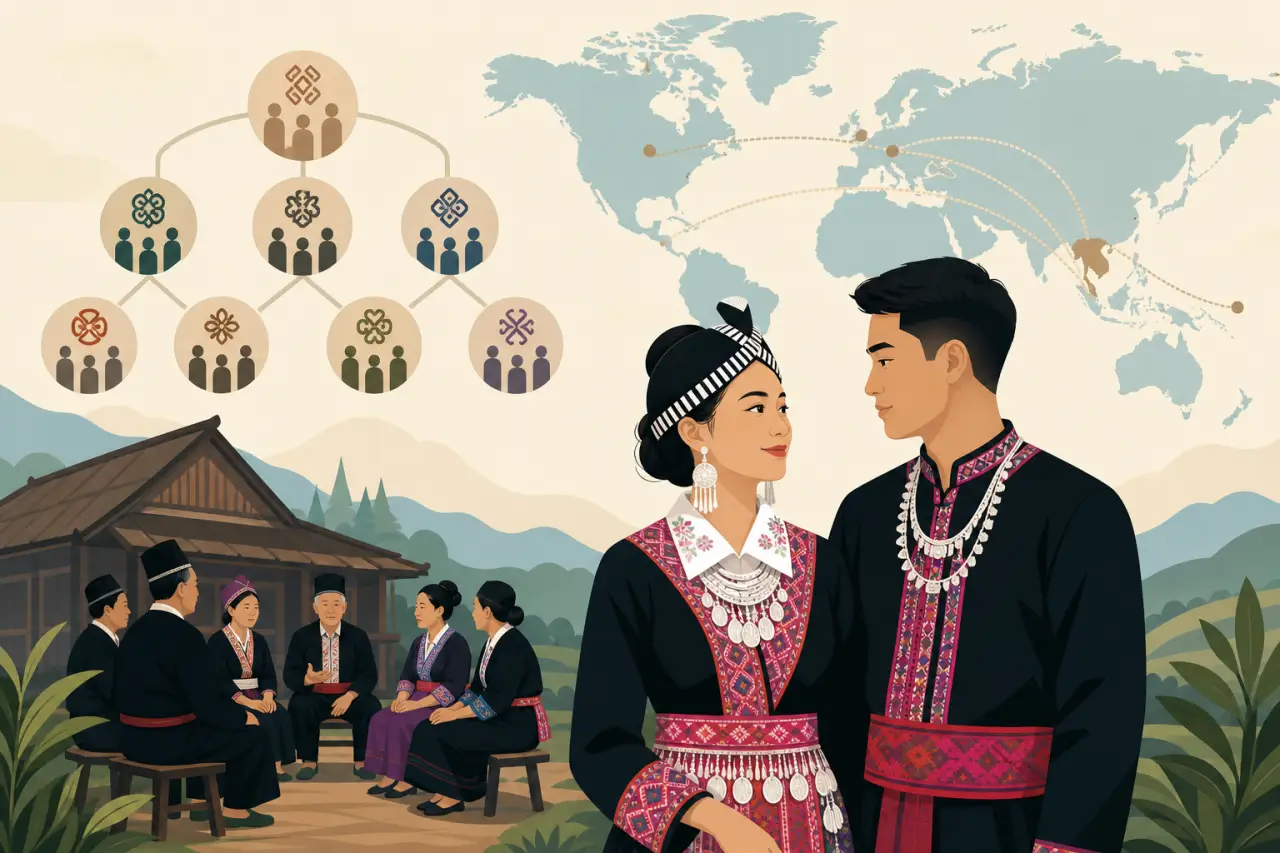
Hmong identity is organized in part around clan names — Vang, Lee, Yang, Thao, Moua, Xiong, and others — and in most communities, marrying within your own clan is avoided, since clan members are treated as family regardless of how distantly related they actually are by blood. This is one of the first things families quietly check before a relationship gets serious, and it's part of why the negotiation stage exists in the first place: it gives both families a structured moment to confirm there's no conflict before anything is finalized.
These clan lines don't stop at national borders either. Because the Hmong diaspora spans the United States, Laos, Thailand, France, and beyond, someone with the same clan name as a partner might come from a family with no direct connection for generations — but the clan relationship still applies the same way it would for two people who grew up in the same town. That's part of what makes clan such a durable organizing structure even across a scattered, mobile community: it travels with the family name, not the address.
Clan also shapes who gets chosen as a negotiator. It's common for a family to ask a respected member of their own clan, or someone with an existing relationship to the other family, to represent them — not a random outsider, and not someone from the same clan as the person they're negotiating with. Getting this detail wrong isn't just an etiquette slip; it can genuinely stall a negotiation until the right person is found, because the negotiator's standing is part of what makes the agreement feel legitimate to both sides.
Blending Old and New: How Couples Adapt the Tradition Today
Very few Hmong weddings today look exactly like they would have two generations ago, and that's not a loss of tradition so much as families making room for how people actually live now:
- Couples juggling jobs, out-of-state family, and limited vacation days often compress a three-day process into a single intensive weekend.
- Families that are part Christian and part shamanist frequently blend elements of both, sometimes with two officiants or two separate ceremonies back to back.
- A modern reception — a DJ, a seated dinner, a first dance — often follows the more traditional ceremony, where the music behind Hmong ceremonies still plays a role, rather than replacing it, and it's increasingly common to have both a Hmong-speaking and an English-speaking emcee so relatives on every side of the family can actually follow what's happening.
Venue choices have shifted too. Where earlier generations relied almost entirely on family homes for every stage, many couples now rent a banquet hall or community center for the reception portion specifically, while keeping the negotiation and ceremony stages at home where the more intimate, family-only moments make more sense.
None of this is treated as cutting corners, as long as the core steps are honored: the families still negotiate, the couple is still formally received by both sides, and elders still give their blessing. What's flexible is the format; what stays fixed is the underlying agreement between families that the wedding is meant to represent. Couples navigating this blend are usually better served by talking openly with both sets of parents early about what can be adapted and what can't, rather than guessing or assuming one side will simply go along with whatever's easiest.
Finding Vendors Who Actually Understand the Process
If you're planning a wedding that follows this structure, the vendors you work with matter more than they would for a single-day event:
- A photographer who doesn't know that the real ceremony often happens hours before the reception will miss it entirely.
- A caterer used to a four-hour event will underestimate how long a multi-family gathering actually runs, and may not plan for the informal, ongoing rounds of food and drink that happen alongside the scheduled meals.
- A seamstress who's never worked with paj ntaub won't know how to advise on timeline, let alone construction, and may quote a turnaround that simply isn't realistic for hand embroidery.
This is exactly where working with Hmong-owned businesses who've done this before pays off — they already know to ask about which days need catering, how many locations are involved, and what the tea ceremony and blessing moments require from a schedule standpoint. It's worth searching a directory like this one specifically for vendors experienced with Hmong weddings — the same artisans and caterers you might meet at Hmong arts and crafts fairs — rather than hiring a generalist and explaining the whole process from scratch.
Given how far in advance attire and some catering needs to be locked in, it's worth starting vendor conversations as soon as a date is even loosely possible, not after the negotiation stage is fully settled. The families doing the planning already have enough to coordinate without also having to train their vendors on what a Hmong wedding actually looks like.
Questions people ask
Why do Hmong families still go through a formal wedding process even if a couple is already legally married?
A legal marriage doesn't create the family-to-family connection that a Hmong wedding establishes. The formal process obligates both families to show up for each other at funerals, weddings, and during hardship. Without it, a couple can end up socially unanchored in ways that matter most when they need support years later. Families generally care more that the process happens correctly than that it happens first.
What does the bride price in a Hmong wedding actually mean?
The bride price, or nqi tshoob, isn't payment for giving up a daughter. It's the groom's family acknowledging the effort and resources the bride's family invested in raising her, and taking on responsibility for the marriage being handled properly. Today many families keep the amount modest or redirect it toward the couple's wedding costs or their future together, while still honoring the core idea that both families now share responsibility for the marriage.
Why can't the bride and groom just negotiate their own wedding arrangements?
Each family selects respected men, called mej koob, to negotiate on behalf of the couple. A skilled negotiator knows traditional phrasing, the correct order of topics, and how to raise sensitive points without anyone losing face. An experienced negotiator who understands the formal, somewhat poetic language passed down through practice can make the agreement feel legitimate to both sides in ways a couple speaking for themselves typically can't.
Can Hmong weddings be compressed into one day instead of spreading across multiple days?
Yes. Families juggling jobs, out-of-state relatives, and limited vacation time often compress the process into a single intensive weekend. Venue choices have shifted too — many couples rent a banquet hall for the reception while keeping negotiation and ceremony at home. As long as the core steps are honored — families negotiate, the couple is formally received, and elders give blessing — the format can be adapted to fit modern life.
Written by
Hmong Network Team
Directory & Digital Services
We run the Hmong Network directory and do the web design and SEO/AEO work behind the results in our case studies. These guides come out of that same hands-on work with Hmong-owned businesses — not secondhand research.
