
What Is Hmong Food? An Introduction to Flavor, Herbs, and Tradition
TL;DR
Hmong food is built on fresh herbs, sticky rice, and balanced flavors that survived migration from Laos to Thai refugee camps into American kitchens. Here's what actually defines it, and how to try it for real.
Fresh Herbs, Sticky Rice, and the Balance on Every Plate
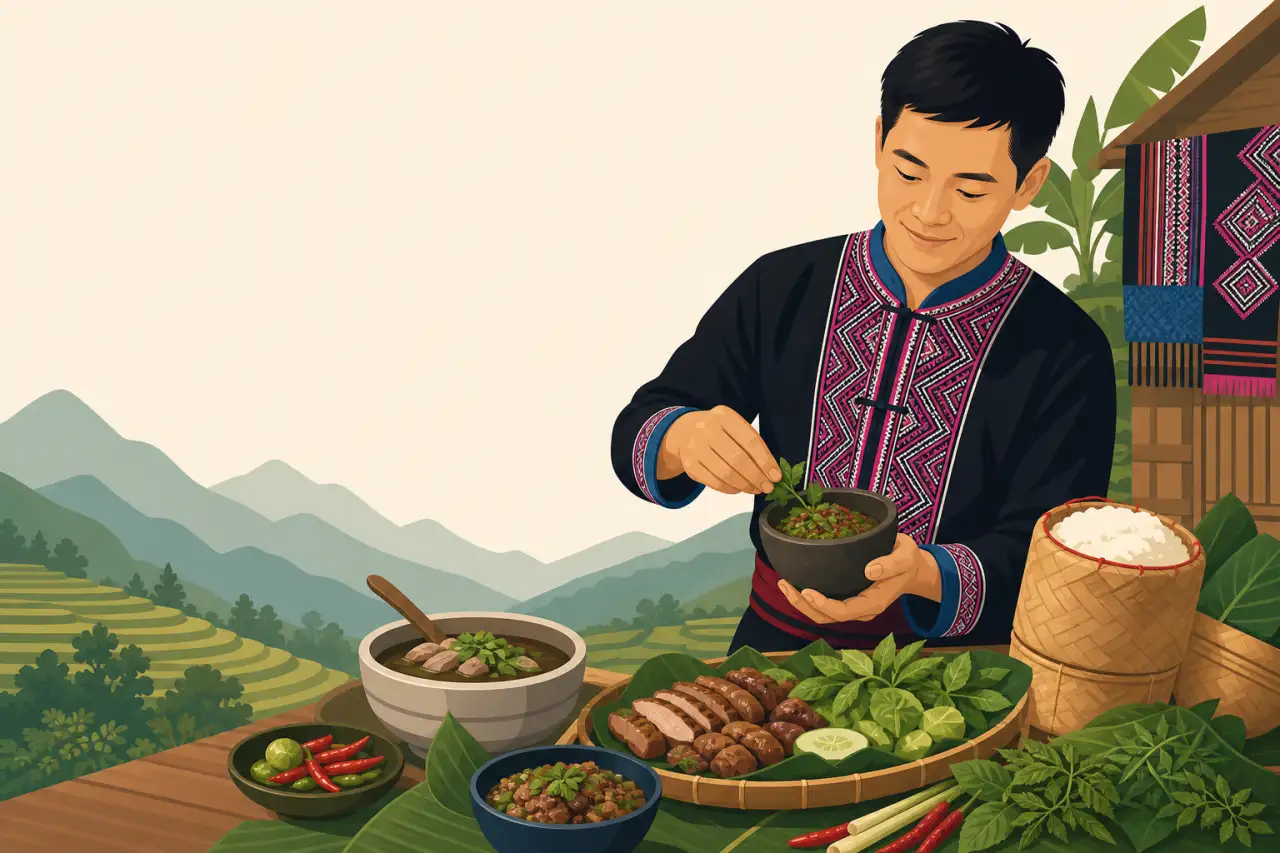
Ask someone who grew up eating it and the first word they reach for is almost always fresh. A meal doesn't finish in the kitchen and arrive at the table pre-seasoned — it arrives half-finished, with a plate of raw herbs sitting next to it that you're expected to tear apart with your hands and add yourself. Cilantro, mint, Thai basil, green onion, and lemongrass show up constantly, not as a garnish sitting on the rim of the plate but folded straight into the dish or piled on the side in a heap big enough to actually change how each bite tastes. Nothing gets cooked down into a smooth, background flavor. The herbs stay loud and identifiable, on purpose.
The other constant is sticky rice, and it isn't a side dish in the way rice is at a lot of other tables — it's closer to a utensil. It gets pressed into a small ball with your fingers and used to scoop up grilled meat, dip into sauce, or soak up broth, and a meal without it feels incomplete no matter what else is on the table. Around both of those anchors, a Hmong meal is built on balance rather than on any single showpiece dish:
- Something savory, from grilled or boiled meat
- Something sour and bright, from lime or tamarind
- Something sharp, from fresh chili
- Something crunchy and raw, from cucumber, cabbage, or green papaya
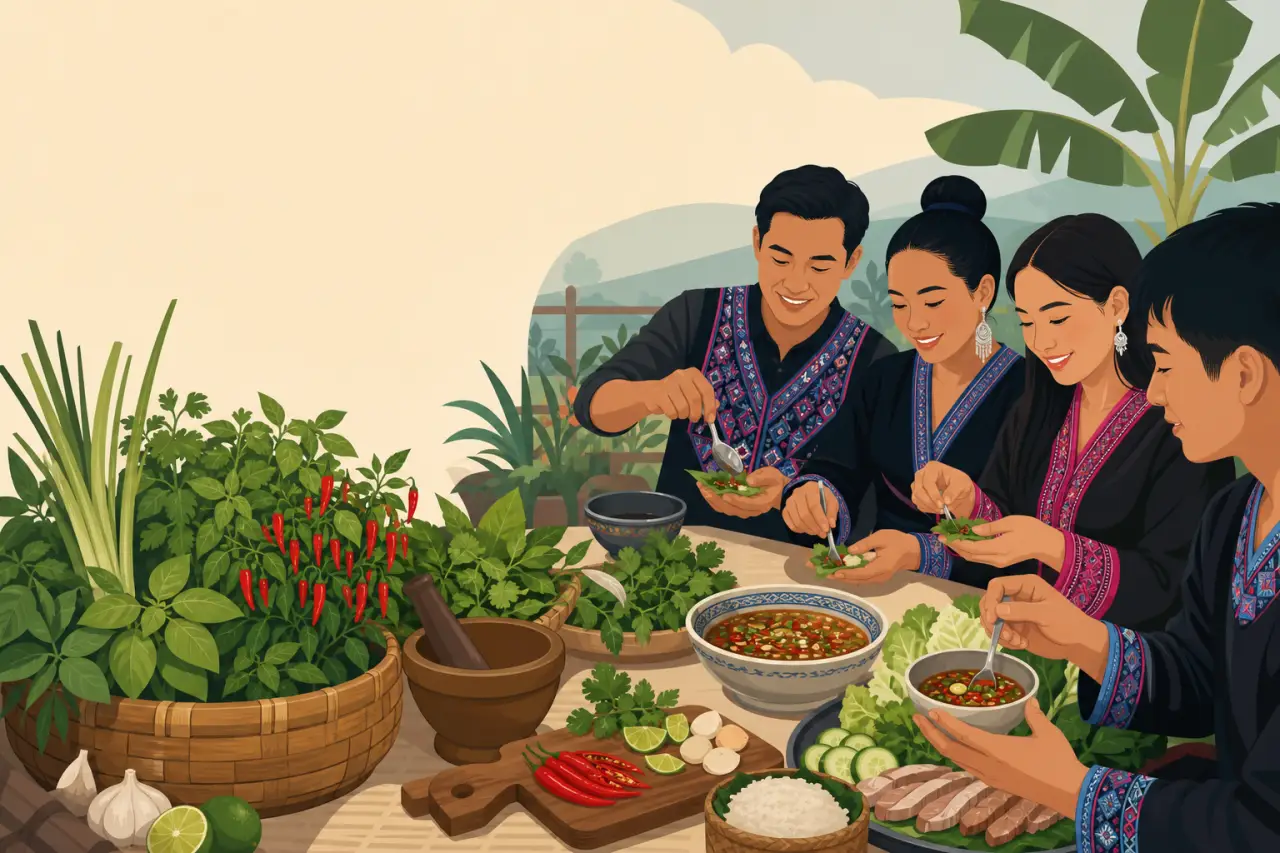
All of it is served at once rather than in courses. It's built to be eaten family style, with everyone reaching into the same dishes, which is exactly the setting it shows up in most — a New Year gathering, a wedding, a Sunday when three generations end up crowded into the same kitchen.
From Mountain Farms in Laos to Backyard Gardens in Minnesota
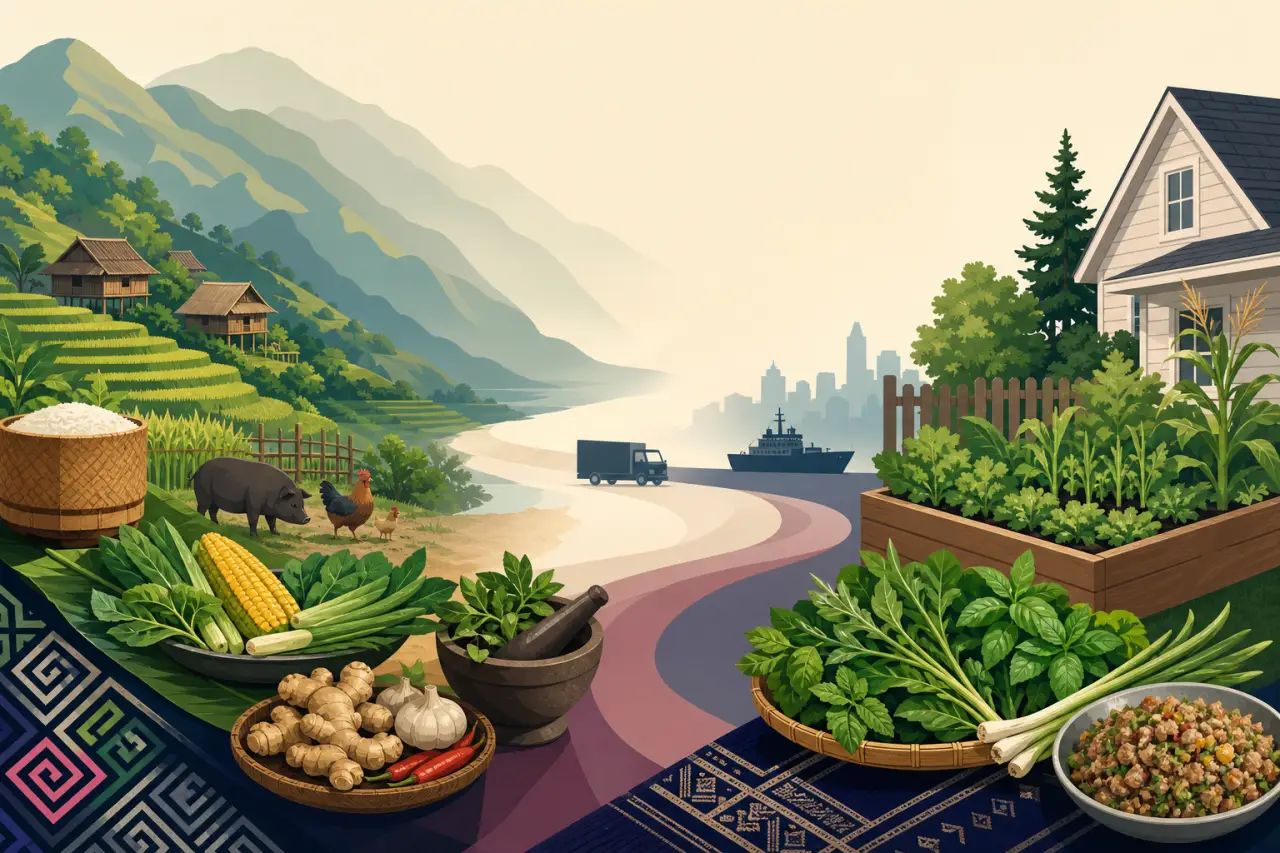
The shape of Hmong food traces directly back to where it was cooked for generations before resettlement ever entered the picture. Hmong communities farmed the highlands of Laos, and parts of Vietnam, Thailand, and southern China, growing rice, corn, and vegetables on hillside plots, raising pigs and chickens, and keeping a working herb patch close to the house because the herbs got used daily, not occasionally. Meat was treated as something you stretched across a family, not something that anchored every meal on its own, which is part of why so many dishes lean on a small amount of protein cut small and mixed through rice, herbs, and vegetables rather than served as a standalone cut.
The war in Laos in the 1960s and 70s scattered that way of cooking across the world. Families fled into refugee camps in Thailand and were later resettled — most visibly in the United States, but also in France, Australia, and French Guiana — and the food traveled with them even when the growing conditions and the grocery stores did not cooperate. What's remarkable is how much survived that move: families in Minnesota and Wisconsin, states with real winters and nothing like a tropical growing season, still plant lemongrass in pots they drag indoors before the first frost, still grow Thai chilies on a windowsill, still treat a backyard herb bed as a necessity rather than a hobby. That habit, more than any single recipe, is the throughline between a farm in Laos and a kitchen in St. Paul or Fresno today — including the Hmong Village marketplace in St. Paul, where that same herb-and-produce supply chain now fills an entire indoor marketplace.
The Dishes You'll Actually Meet at a Hmong Table
If you're new to Hmong food, a few dishes come up often enough that they're worth knowing by description even before you know them by name.
- Larb (sometimes spelled laab) is a minced meat salad — chicken, beef, or pork — tossed with toasted rice powder, lime juice, fish sauce, mint, and chili, and it's usually the dish that convinces skeptics this cuisine is doing something they haven't had before.
- A tart green papaya salad, pounded with a mortar and pestle so the dressing actually works into the shredded papaya instead of sitting on top of it, shows up at nearly every large gathering.
- Grilled or boiled whole chicken, often served simply with a salt-and-herb dipping mix rather than a heavy sauce, tends to appear at weddings and New Year celebrations specifically because it's easy to make in quantity for a crowd.
- You'll also run into a rice noodle soup built on a clear, herb-heavy broth, closer in spirit to a Vietnamese pho than anything Chinese-American menus call soup, and a fermented pork sausage — why Hmong sausage tastes like home is its own story — that takes days to make and shows up mostly around holidays because of the time it takes.
None of these dishes are meant to be eaten alone off a single plate — they're meant to sit next to each other, next to the sticky rice, so you're building your own bite out of two or three things at once rather than working through one dish at a time.
Sticky Rice Isn't a Side Dish, It's the Utensil
Real sticky rice starts the night before, not the hour before — the rice soaks for several hours or overnight so it steams evenly instead of turning gummy in the middle and dry on the outside. It's steamed, not boiled, usually in a two-part pot with a woven bamboo or metal basket that sits above simmering water so the rice cooks in steam rather than sitting in it, and it comes out chewy and slightly translucent rather than fluffy the way long-grain rice does.
Once it's done, it goes into a covered woven basket that keeps it warm and workable for hours, which is why you'll see one sitting in the middle of the table at a Hmong gathering long after the rest of the food has cooled. You eat it with your hands:
- Pinch off a piece.
- Work it into a small ball between your fingers.
- Use that ball to scoop meat, mop up sauce, or just eat on its own between bites of something spicier.
If you've only ever had sticky rice as a sweet dessert with mango, it's worth resetting that expectation — at a Hmong table it's savory, constant, and doing the job a fork would do anywhere else.
The Dipping Sauce Is Where the Real Flavor Happens
A lot of what makes Hmong food taste the way it does isn't cooked into the dish at all — it's mixed at the table. Kua txob, a chili-based dipping sauce built from fresh or roasted chilies, lime juice, fish sauce, garlic, and cilantro, sits next to almost everything, and it's common for each person to adjust their own portion rather than eat from one communal bowl of a fixed heat level. That's the real function of the backyard herb garden so many Hmong families keep: it's not decoration, it's the ongoing supply for sauces and dips that get remade fresh at nearly every meal, which is also why so many families would rather grow their own lemongrass and Thai chilies than rely on what's reliably in stock at a regular grocery store.
This is also where a lot of the customization happens that makes Hmong food feel personal rather than standardized. Two people eating the exact same plate of grilled meat and sticky rice can end up with two very different meals depending on how they build their own dipping sauce — more lime for one person, more chili for another, extra herbs stirred in by a third. If you're trying Hmong food for the first time and the base dish tastes milder than you expected, check the sauce on the side before you assume that's the whole story.
How to Try Hmong Food for the First Time, the Right Way
The easiest way in:
- Order like you're feeding a table, not just yourself, even if you're eating alone — ask for a couple of smaller dishes plus sticky rice rather than one entree, so you get the mix of savory, sour, spicy, and crunchy that the food is actually built around.
- Don't skip the plate of raw herbs that comes on the side; it's not a garnish you can leave untouched, it's an ingredient you're expected to add yourself, and the dish is genuinely incomplete without it.
- If a menu doesn't explain a dish clearly, it's completely normal to ask — most Hmong-owned kitchens are used to walking newcomers through what something is and how spicy it runs, and a quick question usually gets you a much better first plate than guessing.
Beyond restaurants — Hmong restaurants in Minnesota are as good a place to start as any — look for:
- Hmong New Year celebrations, which run through the fall and winter depending on the region and typically draw food vendors selling exactly the dishes you'd get at a family gathering
- Farmers markets in cities with large Hmong communities — the Twin Cities, Fresno, Sacramento, and Wausau among them — where Hmong growers sell the same herbs and produce that show up on the plate
A local business directory is often the fastest way to start finding real Hmong food near you, surfacing Hmong-owned restaurants, food trucks, and market stalls near you specifically, rather than hoping a general search does the work.
What Hmong-Owned Food Businesses Can Do to Welcome New Customers
For Hmong-owned restaurants, food trucks, and catering businesses, a lot of the work of reaching new customers comes down to translation, not recipe changes. A menu line that just names a dish assumes the reader already knows what it is; a line that adds one plain-language sentence — what's in it, how it's served, roughly how spicy it runs — turns a confusing menu into an inviting one without changing a single ingredient. Offering a small combo or sampler plate gives a first-time customer a low-risk way to try two or three dishes instead of gambling their whole order on one unfamiliar name, and it tends to turn into a bigger order the second time they come back.
Catering is worth treating as its own line of business rather than an afterthought, since so much of this food is already built for feeding a crowd — weddings, funerals, and New Year gatherings are exactly the events where a big tray of larb, a whole grilled chicken, and a warming basket of sticky rice do the most work. And because freshness is the whole identity of the cuisine, it's worth saying so out loud on a menu or a storefront:
- Where the herbs come from
- That the papaya salad is made to order
- That the sticky rice was steamed that morning
That's not marketing filler here — it's the actual difference between a good plate and a forgettable one, and it's worth telling customers you're doing it.
Questions people ask
What is sticky rice and why is it so important in Hmong meals?
Sticky rice is a staple of Hmong food, steamed rather than boiled so it comes out chewy and slightly translucent. It's not a side dish — it's eaten with your hands, pinched into small balls and used as a utensil to scoop meat, dip into sauce, or soak up broth. A Hmong meal feels incomplete without it.
What herbs and flavors show up at every Hmong table?
Fresh herbs are foundational to Hmong cooking. Cilantro, mint, Thai basil, green onion, and lemongrass appear in nearly every dish and on a pile on the side of the plate, so you can tear them up and add them yourself. Hmong meals are built on balance: something savory, something sour and bright from lime, something sharp from chili, and something crunchy and raw.
What's the right way to order Hmong food as a first-timer?
Order like you're feeding a table, not just yourself — ask for a couple of smaller dishes plus sticky rice instead of one entrée, so you experience the mix of flavors the cuisine is built around. Don't skip the raw herbs on the side; they're an ingredient you add yourself, not a garnish. And if a menu isn't clear, ask questions — most Hmong kitchens are happy to explain.
What is kua txob and where does it show up?
Kua txob is a chili-based dipping sauce built from fresh or roasted chilies, lime juice, fish sauce, garlic, and cilantro. It sits next to almost everything at a Hmong table, and each person usually adjusts their own portion to their preferred heat level. This is where a lot of the customization happens that makes the food feel personal.
Written by
Hmong Network Team
Directory & Digital Services
We run the Hmong Network directory and do the web design and SEO/AEO work behind the results in our case studies. These guides come out of that same hands-on work with Hmong-owned businesses — not secondhand research.
