
Hmong Restaurants in Minneapolis and St. Paul
TL;DR
Where to eat Hmong food in the Twin Cities: named restaurants in Minneapolis and St. Paul, the two big food courts, and how to order once you are there.
Where to Eat in the Twin Cities
Minnesota is home to one of the largest Hmong communities in the country, and the Twin Cities are where most of its restaurants are. These places have pages in the Hmong Network directory. Hours, menus and prices change, so check with a restaurant before you go.
Minneapolis
- Vinai, 1300 NE 2nd St. Chef-owner Yia Vang's restaurant in Northeast Minneapolis. The New York Times reviewed it alongside Diane's Place in August 2025.
- Diane's Place, 117 14th Ave NE. Its website describes a Hmong American full-service restaurant serving breakfast, lunch and dinner in Northeast Minneapolis.
St. Paul and North St. Paul
- Kongs Kitchen, 1098 Arcade St, St. Paul.
- Hmong House Restaurant and Banquet, 2112 11th Ave E, North St. Paul.
Food courts
- Hmong Village, 1001 Johnson Pkwy, St. Paul. Dozens of stalls and a food court under one roof.
- Hmongtown Marketplace, 217 Como Ave, St. Paul. Restaurants and food stalls alongside produce and goods.
Eater Twin Cities' list of the best Hmong restaurants in Minneapolis and St. Paul (December 2025) names Good Deal Oriental Foods, Diane's Place, Vinai, Little Asia Cafe and Hmong Village. The New York Times piece "Two Restaurants Are Making Minneapolis the American Capital of Hmong Food" (August 2025) covers Vinai and Diane's Place.
Not every restaurant stays open. Union Hmong Kitchen says on its website that it closed its Uptown and North Loop locations and appears at the Minnesota State Fair in summer.
To see every Hmong-owned restaurant in the state, browse Hmong restaurants in Minnesota.
Start With the Dishes That Define the Cuisine
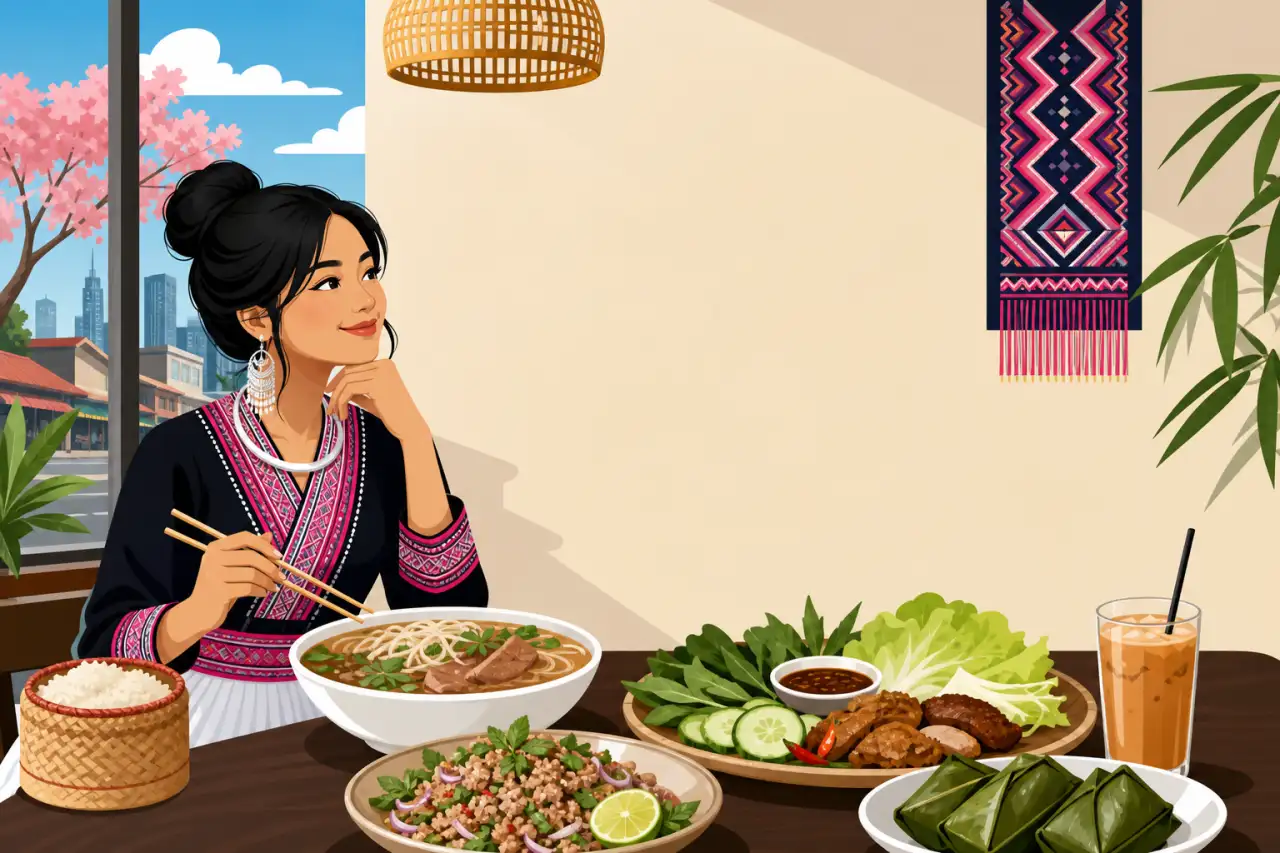
If you want an introduction to Hmong cuisine before diving in, start with the basics: Hmong cooking leans on bold, fresh flavor rather than heavy sauces — think lemongrass, mint, cilantro, chili, and lime working together instead of any one ingredient dominating. If it's your first time, look for staples like sticky rice, grilled or fresh-herb sausage, and a papaya salad pounded to order in a mortar and pestle, which is often a good sign of a kitchen doing things the traditional way. Herb-forward soups and grilled meats are also common, and many menus reflect the broader Southeast Asian influences that traveled with Hmong communities through Laos and Thailand before reaching the U.S.
A few dishes are worth learning by name before you go, because they won't always get much explanation on the menu.
- Laab (sometimes spelled larb) is a minced meat salad tossed with toasted rice powder, herbs, and lime — it can be raw, seared, or fully cooked, so it's worth asking which version a kitchen serves if that matters to you.
- Khaub poob is a noodle soup built on a pork or chicken broth, usually topped with bean sprouts, herbs, and a hard-boiled egg.
- Nqaij ci refers to grilled meat, often marinated overnight, and it's frequently the anchor of a plate rather than a side dish.
Don't be afraid to ask what's a house specialty. Family-run kitchens are often happy to point newcomers toward the dish they're proudest of, and that conversation is often the best menu guidance you'll get — better than any star rating.
Know Where to Look First
The Twin Cities metro is the center of Hmong commercial life in Minnesota, and St. Paul in particular has neighborhoods where that's easy to see and taste. The city's East Side and Frogtown areas have long histories of Hmong-owned businesses, and University Avenue is home to the Little Mekong cultural and business district, where Southeast Asian restaurants, grocers, and shops sit close enough together to walk between several in one visit. Indoor markets like the Hmong Village marketplace in St. Paul and Hmongtown Marketplace are worth knowing about specifically — both are large, multi-vendor spaces where individual stalls sell everything from fresh produce and butchered meat to ready-to-eat food, and they're some of the best places to sample a wide range of dishes from different cooks in one trip.
Outside St. Paul, look toward the northern and eastern suburbs — Maplewood, Brooklyn Park, Brooklyn Center, and parts of Blaine and Coon Rapids have growing numbers of Hmong-owned restaurants and grocery stores as the community has spread beyond its original settlement areas. These suburban spots are sometimes smaller and less visible online than the ones clustered in St. Paul, which is exactly why a directory that tracks Hmong-owned businesses specifically — rather than relying on general review platforms — tends to surface places a generic search misses entirely.
Signs You've Found an Authentic, Family-Run Spot
Minnesota's Hmong restaurant scene ranges from small, unassuming family kitchens to more contemporary spots reinterpreting traditional recipes for a wider audience — both are worth exploring, and neither is more "real" than the other. What tends to signal a place rooted in tradition is less about decor and more about detail:
- Herbs that taste freshly cut rather than wilted
- A menu that changes with what's in season
- Dishes described with real specificity rather than generic labels like "Asian noodle soup"
Another tell is how a kitchen handles its papaya salad. It's one of the hardest dishes to fake convincingly — the papaya needs to be shredded fresh, not pre-cut and held in a container for hours, and it should be pounded in a mortar and pestle right before serving so the dressing actually clings to the strands instead of pooling at the bottom of the bowl. If a place makes a visible show of pounding it to order, or asks how spicy you want it rather than serving one fixed heat level, that's usually a good sign the kitchen is used to serving people who already know the dish.
These restaurants are also frequently community gathering spaces — hosting family celebrations, catering cultural events, and serving as informal meeting points, not just places to grab a meal. Going in with curiosity, and a willingness to ask questions about what you're eating, tends to make for the best experience of all — and often leads to discovering a dish or a kitchen you'd never have found by scrolling through reviews alone.
How to Order Like a Regular, Not a Tourist
A few habits go a long way toward a better meal and a better impression.
- Ask about spice level before you order anything with a chili paste or fresh chilies involved — Hmong food can run hot, and a kitchen used to serving a mixed crowd will usually scale it down if you ask, but they won't assume you want it mild unless you say so.
- Ordering family style, with a few shared dishes and rice in the middle of the table, is closer to how the food is actually meant to be eaten than picking one entrée per person.
It's also worth knowing that some family-run kitchens operate on a shorter everyday menu but will take special orders for larger batches of things like sausage or egg rolls if you call or ask ahead — this comes up often around holidays, family gatherings, or Hmong New Year celebrations, when demand for those items spikes well beyond what's on the regular counter. If you're planning to feed a group or want to bring food to an event, a quick phone call in advance is almost always appreciated over showing up and hoping for enough on hand.
Don't assume every Hmong restaurant is a full-service, sit-down experience. Many of the best ones — especially inside markets like Hmong Village — operate on a counter-order model where you order at a stall, get a number, and either eat at shared seating nearby or take food home. That's not a lesser version of the restaurant experience; it's simply a different, and very common, format worth being ready for.
Timing Your Visit Around Markets and the Calendar
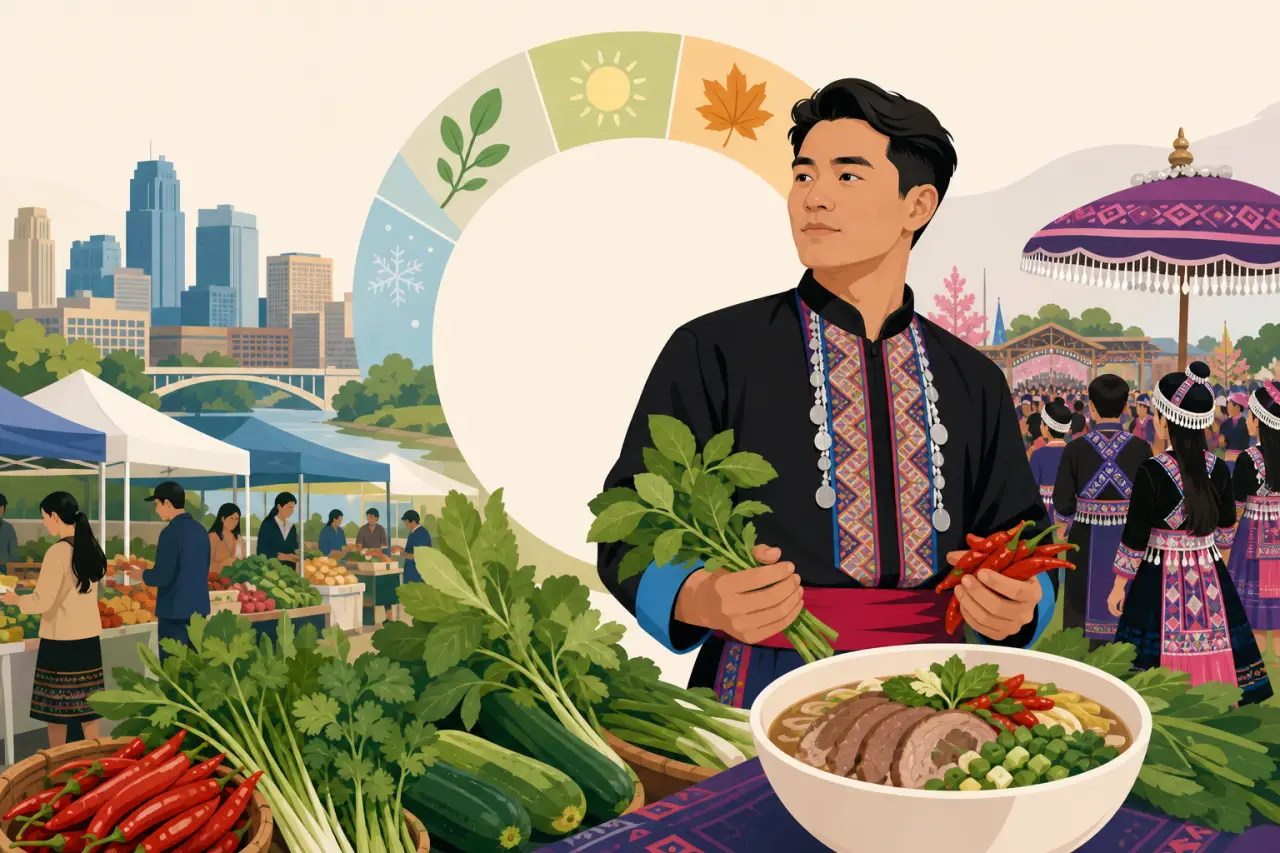
Hmong restaurants and food stalls don't exist in isolation from the broader food economy around them, and timing your visit can genuinely change what you get to try. Farmers markets across the Twin Cities — including markets where Hmong farmers sell produce they've grown themselves — run heaviest from late spring through early fall, and the fresh herbs, chilies, and vegetables that show up in restaurant dishes during that stretch are often noticeably better than what's available in the colder months, when kitchens lean more on preserved or frozen ingredients. If you can, visit a farmers market first and a restaurant second in the same week — seeing the produce a kitchen is likely drawing from gives you a better sense of what's actually in season and worth ordering.
Hmong New Year, typically celebrated in late fall or early winter depending on the community's calendar that year, is also worth planning around. It's a major cultural event with public celebrations, and many restaurants either see a surge in catering orders around that time or adjust their own hours to accommodate family and community obligations. If you're planning to visit a specific small kitchen during that window, calling ahead to confirm they're open is a smart move rather than an assumption.
Weekday lunch hours, by contrast, tend to be the most reliable time to find a family kitchen at its normal pace — less rushed than a weekend dinner service, and often when a wider range of daily specials is still available before the kitchen sells out of anything made in limited batches, like a particular soup or a hand-stuffed sausage.
Supporting the Business Beyond the Meal
If you find a place you like, there's more you can do than just come back for another plate.
- Leaving a review that actually names the dish you ordered — not just "great food, friendly service" — helps the next person who's unfamiliar with the menu make a confident choice, and it helps the kitchen understand what's landing with new customers.
- Asking directly about catering, even if it's not advertised, often opens a conversation these owners are glad to have; a lot of Hmong-owned restaurants do significant catering business that never shows up on their storefront or online listing at all.
Many family kitchens also sell frozen or vacuum-packed items — sausage (worth reading why Hmong sausage tastes like home for the whole story), egg rolls, spring rolls — meant to be taken home and cooked later. Buying a batch to freeze is a way to support the business between visits and introduce the food to people who haven't tried it yet. And because a lot of these restaurants are still building out their online presence, something as simple as tagging them on social media or telling a friend where you ate can matter more for a small, independent kitchen than it would for a chain with a marketing budget behind it.
Mistakes First-Time Visitors Tend to Make
Three mistakes come up again and again:
- The most common one is treating Hmong food as interchangeable with other Southeast Asian cuisines on the menu next door. There's real overlap in ingredients and technique with Thai, Lao, and Vietnamese cooking, given the shared geography and history, but Hmong dishes have their own identity — distinct preparations, seasoning choices, and dishes that don't have a direct equivalent elsewhere. Ordering the same three dishes you'd get anywhere else in the food court means missing what actually makes a specific kitchen worth visiting.
- Another mistake is sticking only to what sounds familiar. It's an easy trap — egg rolls and grilled meat are safe, recognizable choices — but skipping the papaya salad or a noodle soup because the name is unfamiliar means missing the dishes that a kitchen is often most proud of and most skilled at. Ask what the cooks themselves eat, or what's popular with regulars, rather than defaulting to the most familiar-sounding item on the menu.
- Finally, don't assume every listing you find online is current or complete. Small, family-run restaurants sometimes change hours, move locations, or go cash-only without updating every platform that lists them, and a lot of genuinely excellent spots have little to no online footprint at all. Checking directly with the business, or finding real Hmong food near you through a directory built specifically around Hmong-owned listings rather than a generic search, will get you a much more accurate picture than trusting the first result that comes up.
Questions people ask
What are the best Hmong restaurants in Minneapolis?
Vinai and Diane's Place, both in Northeast Minneapolis, are the two restaurants The New York Times reviewed together in August 2025. Both have pages in the Hmong Network directory. Hours and menus change, so check with the restaurant before you go.
Where can I eat Hmong food in St. Paul?
St. Paul has two large food courts, at Hmong Village on Johnson Pkwy and Hmongtown Marketplace on Como Ave, plus restaurants such as Kongs Kitchen on Arcade St. Each food court stall is run independently.
What should I try if it's my first time eating at a Hmong restaurant?
Start with staples like sticky rice, grilled or fresh-herb sausage, and papaya salad pounded to order in a mortar and pestle. Laab (minced meat salad with toasted rice powder, herbs, and lime), khaub poob (noodle soup with pork or chicken broth), and grilled meats are also good entry points. Ask the kitchen what their house specialty is. Family-run kitchens are usually happy to guide newcomers toward their best dishes.
Where can I find Hmong restaurants in Minnesota?
St. Paul's East Side, Frogtown, and the Little Mekong district on University Avenue have the largest concentration. Indoor markets like Hmong Village and Hmongtown Marketplace have multiple food stalls in one space. The northern and eastern suburbs, including Maplewood, Brooklyn Park, Brooklyn Center, and parts of Blaine and Coon Rapids, also have growing numbers of Hmong-owned restaurants and grocery stores.
How do I know if a Hmong restaurant is authentic and family-run?
Look for freshly cut herbs, menus that change seasonally, and dishes described with specificity rather than generic labels. A key sign is how they handle papaya salad. If they pound it to order in a mortar and pestle and ask your preferred spice level, that's usually a good indicator the kitchen knows the traditional way. These places often serve as community gathering spaces hosting family celebrations and cultural events.
What's the best way to order and eat at a Hmong restaurant?
Ask about spice level before ordering anything with chili paste or fresh chilies. Order family-style with several shared dishes and rice in the middle instead of one entrée per person. That's closer to how the food is meant to be eaten. Be prepared for counter-order formats in markets. If you want large batches for an event, call ahead rather than hoping they have enough on hand.
Written by
Hmong Network Team
Directory & Digital Services
We run the Hmong Network directory and do the web design and SEO/AEO work behind the results in our case studies. These guides come out of that same hands-on work with Hmong-owned businesses — not secondhand research.
