

Item Description Policy: What to Include
TL;DR
Your item description has to name exactly what a buyer is getting, disclose flaws upfront, and be written in your own words — here's what belongs in it, what to leave out, and how to keep it accurate as your inventory changes.
What Every Description Must Include
A strong item description is one of the four essentials of a strong listing, so start with the identifying facts a buyer needs to make a decision without having to message you first:
- What the item actually is
- The brand or maker
- Size or dimensions
- Material
- Color
- Quantity, if you're selling more than one
If you sew embroidered story cloth or beaded vests, that means listing the actual fabric, whether the stitching is hand-done or machine-assisted, and finished measurements — not just "handmade Hmong textile." A buyer states away can't hold the piece before buying it, so the description is doing the job your hands and your table normally do at a market or community event, which is also why pairing descriptions with strong photos matters just as much as the words themselves.
Condition and flaws come next, and they're not optional extras you add if you have room. If a vintage necklace has a clasp that sticks, say so. If a jar of chili paste has a shorter shelf life than your usual batch because you used fresh peppers instead of dried, say so. Leaving out something you already know is wrong with an item isn't a shortcut to a faster sale — it's the single most common way a listing ends up with a return, a dispute, or a flagged account, because the buyer finds out anyway, just later and more frustrated than they would have been up front.
If an item comes in more than one version, size run, or batch, be specific about which one the price and photos actually apply to — this is exactly what filling in the right product details in your item specifics fields is for, not just the paragraph text. "One size fits most" on a hand-sewn skirt means something different from seller to seller; give the actual waist and length measurements instead of a phrase that could mean five different things to five different buyers.
 Claim your free business listingFree forever — no credit card required.
Write It Yourself, Every Time
Copying text from a manufacturer's spec sheet, a competitor's listing, or even your own previous listing with just the color swapped out is against policy, even when nothing in the copied text is technically false. Original writing isn't a suggestion — it's a requirement, and it exists for a practical reason: descriptions that are duplicated word for word across several listings, yours or anyone else's, tend to get suppressed in search rather than shown, which defeats the entire point of writing one — see how listing text works as SEO for more on why originality matters beyond just policy compliance.
The fastest way to write something original is to talk it out before you type it. Describe the item the way you'd describe it to someone standing at your table at a Hmong New Year vendor fair — what it is, why you made it this way, what makes this batch or this piece different from the last one you sold. Type that up, trim it down to the useful parts, and you'll end up with something specific and in your own voice, which reads better to a buyer than a stiff, template-sounding paragraph anyway.
This applies even to products you sell every month. If you make the same sausage or the same style of apron on a regular schedule, resist the habit of reposting last month's text wholesale. Update it with the current batch date, current stock, and anything that's actually changed, so the listing stays both accurate and original instead of just recycled.

Format for Skimming, Not Reading Start to Finish
Most buyers scan a listing in the first few seconds to decide whether it's worth reading closely, so one long unbroken block of text works against you even when every sentence in it is useful. Break the description into short paragraphs, each covering one thing:
- What the item is
- Its condition
- How it ships
- How to care for it
A buyer should be able to skim the first line of each paragraph and get the gist before deciding to slow down and read the rest.
Lead with the most important fact, not the origin story. If you're selling a food item, buyers want to know what's in it and how fresh it is before they want to hear about your grandmother's recipe — save that story for a line further down, or for your seller profile, rather than opening with it.
Spelling and grammar matter more than they might seem to at first glance. A description full of typos reads as rushed, and buyers tend to extend that same "rushed" impression to the item itself, fairly or not. Read the description once out loud before you publish it — that catches more mistakes than reading it silently in your head ever does.

Say What's True, Not What Sounds Good
Description content gets judged on accuracy, not enthusiasm. Phrases like "best in the Twin Cities" or "guaranteed to sell out" are exactly the kind of claim that gets flagged, because they can't be verified and they don't actually tell the buyer anything real about the item. Replace them with something specific and true instead:
- How many batches you make a month
- How long you've been selling this particular item
- What makes the recipe or the stitching different from a mass-produced version of the same thing
This matters most, and carries the most real risk, on food and wellness items. If you write "no MSG," "gluten-free," or "nut-free," that has to be checked and true of that specific batch every single time, not just true in general or true of the recipe you usually follow. A buyer with an allergy is relying on that exact word choice, and getting it wrong isn't only a policy problem — it's a safety one. The same goes for "handmade": if part of the process is machine-assisted, say so plainly instead of letting the word carry more weight than it should.
Comparisons to other sellers, even friendly ones, are also worth leaving out. "Better than what you'll find at the grocery store" invites exactly the kind of dispute that a clear, factual description is supposed to prevent in the first place.
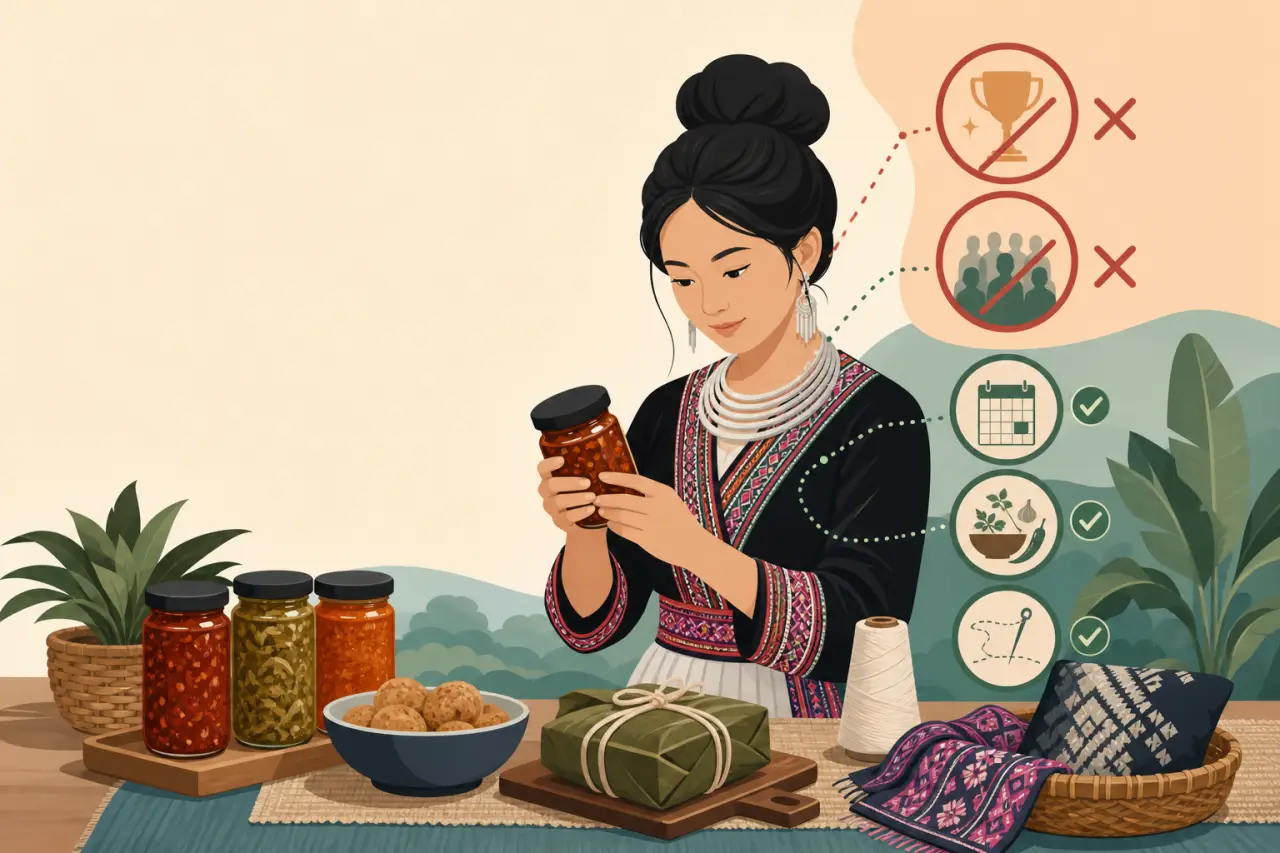
Answer the Questions You'd Otherwise Get in Messages
Every seller has a handful of questions that show up in their inbox before nearly every sale:
- How long shipping takes
- Whether returns are accepted
- Whether a custom order can be rushed
Put those answers directly in the description instead of waiting for someone to ask. It saves you the repeat typing, and it removes the single biggest reason a buyer abandons a purchase entirely: uncertainty about something they'd have to wait hours, or days, to get an answer to.
If you take custom orders — a specific embroidery pattern, an altered hem length, a personalized spice blend — state your turnaround time in the listing itself, not just after someone asks. A range like two to three weeks during a normal month, longer around Hmong New Year, sets the expectation before the buyer pays instead of after.
Care instructions belong in the description too, whenever they're not obvious. Hand-wash only, store in the refrigerator after opening, keep out of direct sunlight — a single sentence like that prevents the return that happens three weeks later when an item that was never mishandled just looks like it was.

Keep the Listing Current, Not Just the Product
A description is only accurate on the day you publish it, unless you go back and keep it that way. If a batch sells out, mark the listing unavailable rather than leaving it live and hoping nobody orders it — a canceled order after payment is a worse experience for a buyer than a listing that's temporarily out of stock. If your ingredient list changes, even for a single batch, update the description before that batch goes out for sale, not after a buyer points out the mismatch themselves.
Seasonal items need the same attention. A holiday-only recipe or a limited fabric run should say so plainly, including roughly when it'll be available again, rather than leaving a buyer to guess or be disappointed by something the listing could have told them upfront.
This is one of the more common, and more avoidable, ways sellers end up with disputes — not dishonesty, just a listing that quietly went stale while everything else about the business moved on. Get in the habit of glancing back over your active listings every couple of weeks, especially any tied to a batch, a season, or limited stock.

What Happens When a Description Falls Short
An inaccurate description — whether it left out a known flaw, exaggerated a claim, or just went stale — usually shows up first as a return request or a low review, and both cost more time and reputation than the extra few minutes it would have taken to get the listing right in the first place. A pattern of these across your listings is also what triggers a closer look at a seller account; a single honest mistake, corrected quickly once you notice it, is not treated the same way as a repeated pattern.
The standard exists to protect something bigger than any one listing: buyer trust in Hmong-owned businesses across the whole marketplace. Every accurate, well-written description makes the next buyer a little more comfortable ordering from someone they've never met and can't see in person, which is the entire premise the marketplace runs on — and every stale or inflated one chips away at that same trust for every other seller, not just the one who wrote it.

A Fast Check Before You Publish
Before you publish, read the description once as if you were the buyer, not the seller.
- Does it name exactly what you're getting, including size, material, and quantity.
- Does it disclose every flaw or limitation you already know about.
- Is every claim in it something you could prove if a buyer asked you to.
- Is it written in your own words rather than copied from somewhere else, including your own past listings.
- Does it answer shipping, returns, and care questions without making the buyer message you first.
If you can honestly say yes to all of that, the listing is ready to go up. If not, that's exactly the paragraph worth fixing before anyone else sees it — it's a lot easier to rewrite a sentence now than to handle the return, the message, or the review that comes from skipping it.

Questions people ask
What should I include in my item description?
Start with the facts a buyer needs: what the item is, the brand or maker, size, material, color, and quantity. Then disclose any flaws or condition issues you already know about. For handmade items, include specific details like whether stitching is hand-done or machine-assisted and finished measurements. Skip phrases like "handmade" or "best quality" if they don't tell the buyer something specific and true.
Can I copy a description from my old listing or from a competitor?
No. Copying text is against policy even if nothing in it is false. Descriptions that are duplicated word-for-word get suppressed in search results. The fastest way to write something original is to describe the item the way you'd describe it to someone at your table at a Hmong New Year vendor fair, then trim that down to the useful parts.
What's the best way to format a description so people actually read it?
Break it into short paragraphs, each covering one thing: what the item is, its condition, how it ships, and care instructions. Lead with the most important fact, not the origin story. A buyer should be able to skim the first line of each paragraph and get the gist before deciding to read more.
What happens if I write "gluten-free" or "no MSG" in my description?
That claim has to be checked and true of that specific batch every single time, not just true in general or true of the recipe you usually follow. A buyer with an allergy is relying on that exact word choice. Getting it wrong is a safety issue, not just a policy problem.
Written by
Hmong Network Team
Directory & Digital Services
We run the Hmong Network directory and do the web design and SEO/AEO work behind the results in our case studies. These guides come out of that same hands-on work with Hmong-owned businesses — not secondhand research.
