

Choosing the Right Shipping Setup for Your Listings
TL;DR
Your shipping setup often decides whether a buyer checks out or bails at the last screen. This guide walks through every shipping method in your seller dashboard, how to price and configure each one, and when mailing a box is the wrong call entirely.
The Three Shipping Methods Your Dashboard Actually Supports
Your seller dashboard gives you three real ways to get a product from your hands into a buyer's, and most sellers end up using more than one depending on the listing.
- Flat-rate shipping charges a single, predictable amount no matter what's in the box, which makes it the easiest to set up and the easiest for a buyer to understand before they ever reach checkout — there's no guesswork about what they'll owe once they get there.
- Free shipping doesn't mean shipping costs you nothing — it means you've absorbed that cost into the item price or you're offering it above a minimum order total, and buyers overwhelmingly prefer it over any other option when the price otherwise looks the same.
- Local pickup and delivery skip carriers altogether, which matters if you're a home baker in St. Paul, a plant seller in Fresno, or anyone else whose product is heavy, perishable, or just not worth boxing up for a three-day truck ride.
None of these is universally "better," and picking one shouldn't be about which is easiest to set up first.
- A seller of small, lightweight jewelry or accessories can offer free shipping profitably almost every time, since the actual postage cost barely moves the needle on margin.
- A seller of ceramic serving bowls, framed paj ntaub textile art, or anything bulky is going to lose money on every free-shipping order unless the item price already accounts for real packaging and postage.
- A seller of fresh food or anything time-sensitive should be thinking about pickup or delivery before shipping enters the conversation at all.
Look at what you actually sell before picking a default, and don't be afraid to run more than one method side by side. The method should follow the product, not the other way around.
 Claim your free business listingFree forever — no credit card required.
Why Free Shipping Converts Even When It Costs You Something
Buyers consistently choose the listing that says free shipping over an identical listing with a shipping line item, even when the free-shipping listing's total price is the same or slightly higher. It's not that buyers can't do the math — it's that a shipping charge that shows up after they've already committed to buying feels like a bait-and-switch, and a lot of people back out of checkout right there rather than finish the math themselves. The same logic applies to choosing the right payment options at checkout — friction anywhere near the final click costs you sales you already had, whether it shows up as a shipping surprise or a payment method a buyer doesn't trust. If your margins can absorb it, building your average shipping cost into the item price and marking shipping as free is usually the highest-converting setup you can run, especially for smaller or lower-priced items where a few extra dollars of shipping looks disproportionate next to the item itself.
The way to do this without guessing is to actually calculate your average box-and-postage cost across your last several orders, then bake that number into your price rather than picking a round figure that feels safe.
- Pull your last ten or twenty shipping receipts if you have them.
- Average the cost.
- Add that to your item price before marking it as free.
It's a fifteen-minute exercise that beats guessing every time. If you're not there yet — margins are thin, or your product is heavy enough that shipping swings a lot order to order — a free-shipping threshold works as a middle ground: free above a set order total, flat-rate below it. That gives price-conscious buyers a reason to add one more item to their cart instead of checking out with just one, and it protects you from eating shipping on a single small order. It also gives you a natural upsell moment — a small note like "add $8 more for free shipping" on the cart page does real work without feeling pushy.
Setting a Storewide Default, Then Overriding It Where It Doesn't Fit
Set a default shipping method once, storewide, so you're not configuring shipping from scratch on every new listing you add. For most sellers that default should match whatever the bulk of the catalog actually is — if eight of your ten products are small and light, set flat-rate or free shipping as the default and move on. The dashboard lets you override that default on individual listings, which is where the real judgment call happens, and it's worth doing that review before you publish a new listing rather than after the first order comes in and you realize the shipping charge doesn't cover the box.
Override it for anything oversized, fragile, or meaningfully heavier than the rest of your catalog — shipping is one of the four essentials of a listing a buyer weighs before they ever click add to cart, so it's worth getting each override right rather than leaving it to a generic default. A large embroidered story cloth, a batch of glass jars of pickled vegetables, or a piece of furniture all cost real money to ship safely, and pricing them at your storewide flat rate either loses you money or looks suspiciously cheap next to what a buyer knows shipping something that size should cost. Give those listings their own shipping price, calculated from an actual carrier quote for a box that size and weight — not a guess rounded down to look competitive. It's also worth flagging any listing where you genuinely can't ship at all — a piece too fragile to trust to a carrier, or something you only intend to sell locally — and restricting it to pickup only rather than letting a buyer order something you'll have to cancel and refund.
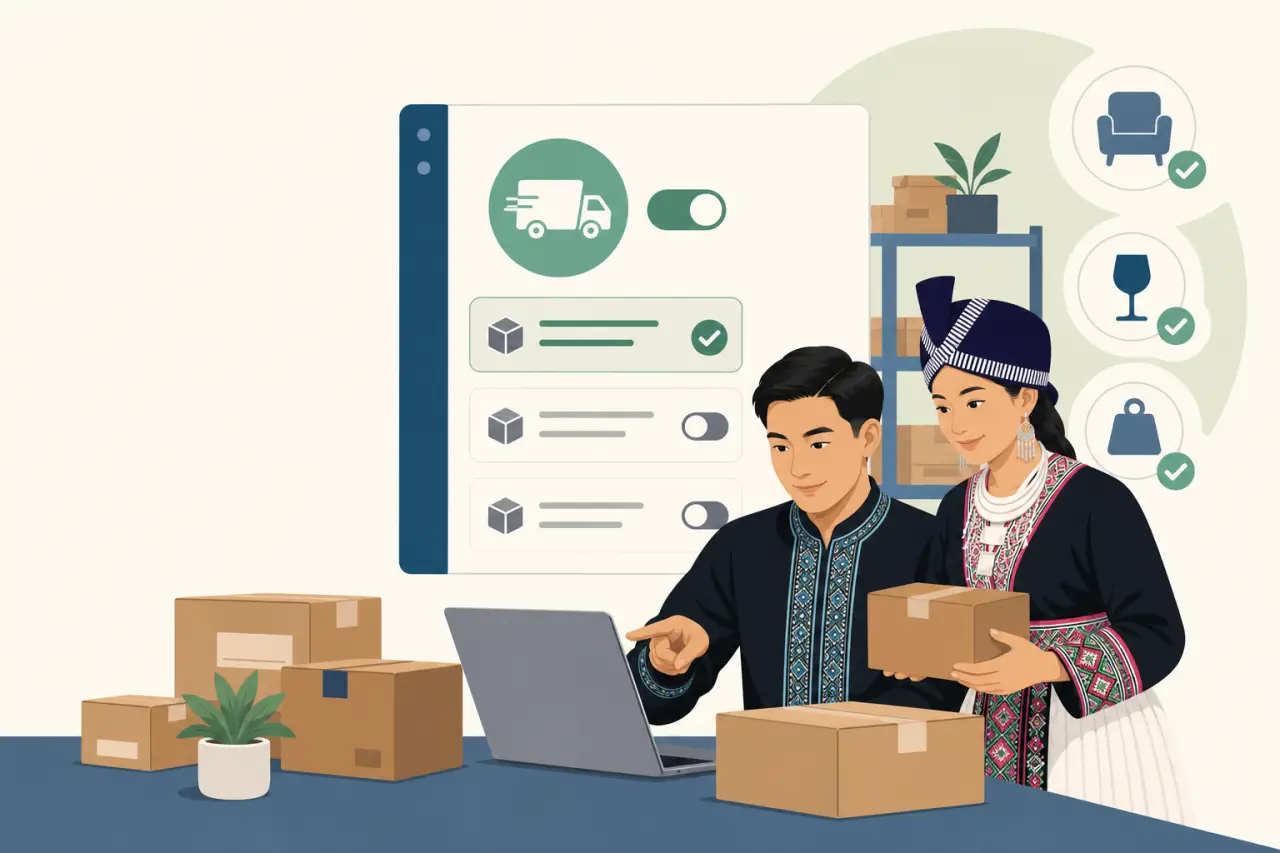
When Local Pickup or Delivery Beats Mailing It Entirely
If your business is rooted in a place with a concentrated Hmong community — the Twin Cities, Fresno, Merced, Sacramento, Wausau — local pickup and delivery aren't a fallback option, they're often the better one. The following all survive a ten-minute drive across town far better than a multi-day carrier trip, and skipping shipping entirely removes both the cost and the risk of damage in transit:
- Perishable food.
- Anything that needs to stay cold or intact (egg rolls, sausage, fresh produce, cake orders).
- Large or awkward items like furniture or plants.
Local delivery also does something shipping can't: it keeps the transaction inside the community you're actually serving. A buyer picking up a custom order from your home kitchen or driving to your storefront is a different relationship than one who never sees you at all, and for event-driven products — catering trays for a Hmong New Year celebration, a wedding order, a bulk request for a community gathering — pickup is often what the buyer is expecting anyway. If you offer it, say exactly what area you cover and roughly how far out you're willing to drive, so a buyer outside your radius knows to pick a different option instead of placing an order you'll have to cancel.
Handling Time Is the Part Buyers Actually Complain About
Shipping speed and handling time get confused constantly, but they're not the same thing, and handling time is the one you fully control. Handling time is how long it takes you to pack and hand off the order after it's placed — not how long the carrier takes once it's in their hands. Set that number honestly. If you make items to order, or you only pack and ship on specific days of the week, say so up front rather than defaulting to a generic "1-2 business days" that you then miss.
Missed handling windows, not slow carriers, are the complaint that shows up most often in buyer messages and reviews, because a buyer can't tell the difference between "the carrier is slow" and "the seller hasn't shipped it yet" — all they see is a tracking number that hasn't updated. Build in slack around predictable crunch points:
- Hmong New Year season
- Back-to-school
- Any stretch where you know order volume jumps
And if you're still handling every order by hand, simplifying shipping as orders grow is worth reading before a busy season is what forces the decision instead of you. If a specific order is going to run past your stated window, a quick message to the buyer before they ask costs you thirty seconds and almost always prevents a bad review.

Packaging That Protects Both the Product and Your Rating
What you ship in matters as much as what method you pick, and it's worth budgeting for real packaging rather than whatever's cheapest at the dollar store.
- Textiles and embroidered items should go out wrapped or bagged against moisture, not loose in a box where a shipping label sticker can end up stuck to the fabric.
- Ceramics, glass, and anything with a lid need rigid packaging and real cushioning — a flimsy poly mailer is the fastest way to turn a five-star sale into a damage claim and a refund.
- If you're printing more than a couple of labels a week, it's also worth figuring out whether you need a thermal label printer — hand-writing or laser-printing labels one at a time becomes its own hidden time cost once volume picks up.
- Food items need packaging appropriate to what's inside, not just what's on hand, and if something needs to stay cold, say so on the listing so the buyer knows to be home when it arrives.
The cost of doing this right belongs in your shipping price calculation, not treated as a separate expense you eat quietly. A few extra dollars of bubble wrap and a sturdier box is cheaper, every time, than a refund plus a damage-related dispute plus a public review mentioning it arrived broken.
Pricing Shipping So It Reads as Fair, Not Padded
Whatever you charge for shipping, it should roughly track what shipping that item actually costs you. Buyers have a rough intuition for what a small box should cost to send, and a shipping charge that looks inflated — even by a few dollars — reads as a hidden markup and erodes trust fast, even when your item price itself is fair or a great deal. Use your carrier's own rate calculator with the real weight and dimensions of your typical package before setting a flat-rate number, rather than picking a round figure that feels convenient.
If your products vary a lot in size or weight, a single flat rate across your whole catalog either overcharges your smallest items or undercharges your largest ones. In that case it's worth setting a couple of shipping tiers — light and heavy, or small and oversized — rather than forcing every listing through one number. It's more setup work up front, but it keeps your pricing defensible on every single order instead of quietly wrong on half of them.

Keeping Your Shipping Logic Consistent Across Similar Listings
Buyers browsing a storefront compare listings against each other, not just against your competitors, and inconsistent shipping logic between similar products reads as random or careless even when there's a real reason behind it. If two of your listings are close in size and weight, they should generally use the same shipping method and roughly the same price — a buyer who notices one costs three dollars to ship and an almost-identical one is free is going to wonder what they're missing, and that hesitation is enough to lose the sale.
When you do change your shipping approach — switching from flat-rate to a free-shipping threshold, for instance — update it across your whole catalog in one pass rather than letting it drift listing by listing over time. Revisit your shipping settings every few months the same way you'd revisit pricing: carrier rates change, your packaging costs change, and a shipping setup that made sense when you had five listings can quietly stop making sense once you have fifty.
Questions people ask
What's the difference between handling time and shipping speed?
Handling time is how long it takes you to pack and ship an order after it's placed — not how long the carrier takes afterward. You fully control handling time. Buyers can't tell the difference between a slow carrier and a slow seller, so setting your handling time honestly and building in slack around busy seasons prevents complaints and bad reviews.
Should I use free shipping or flat-rate shipping?
Free shipping converts better than flat-rate, even at the same total price, because buyers hate surprises at checkout. If your margins allow it, calculate your average box-and-postage cost and build it into the item price. For heavy items, use flat-rate or a free-shipping threshold above a minimum order total to protect yourself.
When should I offer local pickup instead of shipping?
Choose local pickup for anything perishable, fragile, or heavy that survives a car ride better than a multi-day carrier trip. In communities like the Twin Cities or Fresno, pickup keeps the transaction local and works better for event orders like catering or wedding requests. Be specific about what area you cover.
How do I price shipping so it doesn't look inflated?
Use your carrier's rate calculator with real weight and dimensions of your typical package before setting a price. Buyers sense when shipping charges look padded, even by a few dollars, and it erodes trust. If your products vary widely in size, set shipping tiers instead of one flat rate across everything.
Written by
Hmong Network Team
Directory & Digital Services
We run the Hmong Network directory and do the web design and SEO/AEO work behind the results in our case studies. These guides come out of that same hands-on work with Hmong-owned businesses — not secondhand research.
